This Little Babe

When I was in college we had a large chapel choir. It was large enough, in fact, that I could be a member without noticeably impairing the sound quality. I gained much of my appreciation of historical Christian music from my experience there and from the Hymnology class I took with the director of the choir (If your eyes are especially sharp you can even find my picture from those days in the video here at the site for his obituary).

One year for our Christmas concert we did Benjamin Britten’s A Ceremony of Carols. The words to one of the songs in that chorale have stayed with me ever since:

This little babe, so few days old,

Is come to rifle Satan’s fold;

All hell doth at his presence quake.

Though he himself for cold do shake,

For in this weak unarmèd wise

The gates of hell he will surprise.

With tears he fights and wins the field;

His naked breast stands for a shield;

His battering shot are babish cries,

His arrows looks of weeping eyes,

His martial ensigns cold and need,

And feeble flesh his warrior’s steed.

His camp is pitchèd in a stall,

His bulwark but a broken wall,

The crib his trench, hay stalks his stakes,

Of shepherds he his muster makes;

And thus, as sure his foe to wound,

The angels’ trumps alarum sound.

My soul, with Christ join thou in fight;

Stick to the tents that he hath pight;

Within his crib is surest ward,

This little babe will be thy guard.

If thou wilt foil thy foes with joy,

Then flit not from this heavenly boy.

If you’ve ever heard Britten’s piece, you know it’s not easy. The words move very quickly and in the second and third stanzas the voice parts echo each other.

Britten didn’t write these words – he took them from a poem by Robert Southwell. Southwell was a Roman Catholic priest who died 1594 while still in his early 30s. He didn’t die peacefully, but by being hanged, drawn, and quartered by the regime of Queen Elizabeth. You might think that being a Protestant I’d be on the Queen’s side, but treating anyone (let alone a fellow Christian!) in such a manner is antithetical to the way of Jesus.

What Southwell has done with these words is cast the birth of Jesus in the frame of spiritual warfare. When we think about spiritual warfare images of mighty angels, swords, and clashing armies might come to mind. Southwell, however, is aligned with scripture seeing God’s entry into our broken and sinful world as a defenseless baby as the true reality. Our way of taking up that warfare, similarly, is not employing violence and coercion “in the name of Jesus,” as Christians have been tempted to do through the ages. Instead, we walk in the ways of Jesus (“Stick to the tents that he hath pight”) and live as joy-filled redeemed people in the face of any and all opposition.

Posted in Christianity, Christmas, Jesus | Tagged , , , , , , , , | Leave a comment

Heaven, Hell, & Borders

I’ve seen a meme floating around social media for a few years now:

Although the words are ostensibly theological, telling us something about heaven and hell, they’re really using heaven and hell to appeal to Christians to adopt a “biblical” perspective on current immigration debates in the USA.

The assumption is that as Christians we want to be heavenly rather then hellish. Since we want to be heavenly, we need to adopt heavenly policies in our national politics. The suggestion is that God rules heaven like a modern nation state. As a wise deity, God puts strict rules in place as to who should be allowed in and under what conditions. This model misses the biblical teaching nearly entirely.

The Bible says things like, “The Spirit and the bride say, ‘Come!’ And let the one who hears say, ‘Come!’ Let the one who is thirsty come; and let the one who wished take the free gift of the water of life.” (Revelation 22:17)

If we’re making an analogy between the the phenomenon of immigration and the phenomenon of entering eternity to live with Jesus, I read that Jesus invites all – and the only only condition is faith in him.

In cartoons we see the devil as the ruler of hell (Milton portrayed him as saying, “Better to rule in hell than to serve in heaven.”), but that’s not what I see in the Bible. Sure, if we were pagan Greeks who equated hell with hades and Hades with the devil, we might be happy with the image of the devil ruling over hell. Such a devil would be happy to have anyone come join him in eternal torment, no questions asked. Again, such a picture of hell and the devil is not what we see in the Bible.

Jesus actively tried to keep people out of hell – and calls his people to do likewise. Paul says that God desires all people to be saved and to come to a knowledge of the truth.” So does heaven/eternity with God have “strict immigration policies?” Sure, if by “strict” we mean something like “clear and definite.” If by “strict” we mean “difficult” or “only for a few who are acceptable to current occupants,” then that misses the Bible entirely.

So what do heaven and hell have to do with the immigration practices of a modern nation state? Nothing. Well, if the nation state happened to think of itself as a Christian nation state – and as blessed by God – there’s a likelihood that such a nation state would see the numbers of people who want to come enjoy those blessings as an opportunity to share. If a nation state has no interest in being a Christian nation state (if there can be such a thing), or if its citizens do not profess the Christian faith and do not want that faith to shape their nation’s immigration policies, then it would be unsurprising that they would want to keep as many out as possible, lest their wealth be diluted by having to share with others.

Posted in Bible, Christianity, Immigration, Politics | Tagged , | Leave a comment

Freedom in Galatians 5:13-14 and Beyond

We didn’t make much progress in our study of Galatians last night – just two verses. Here’s a link to the mp3. We spent much of the time talking about freedom – in the Bible and in American culture. Beyond Galatians, we strayed to John 8. In American culture I mentioned the work of David Hackett Fisher – Liberty and Freedom – in response to a question about the difference between the two. (If you listen to the recording you hear that I misremembered his first name.) I also mentioned Isaiah Berlin and his concepts of Negative and Positive liberty.

Today I see this post from Ben Crosby that looks at similar territory.

Posted in Bible, Discipleship, Love | Tagged , , , , | Leave a comment

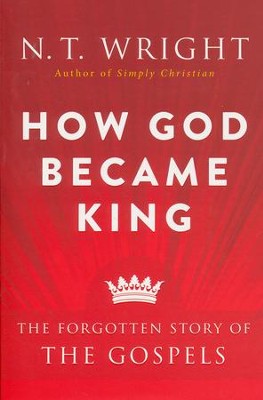
How God Became King

We’ve been doing a study of NT Wright’s book, How God Became King. It’s been a very slow study, sometimes make less than a page of progress in our hour of discussion. There’s been lots of repetition. I’ve spent time going into the background – biblical, historical, theological, linguistic, and philosophical – to what we read in Wright’s book. There’s been lots of repetition from session to session. My primary goal is to produce understanding. If you’d like to dip into the study, here are the recordings of the sessions thus far:

Session 1

Session 2

Session 3

Session 4

Session 5

Session 6

Session 7

Session 8

Session 9

Session 10

Session 11

Session 12

Session 13

Session 14

Session 15

Session 16

Session 17

Session 18

Session 19

Session 20

Session 21

Session 22

Session 23

Session 24

Session 25

Session 26

Session 27

Session 28

Session 29

Session 30

Session 31

Session 32

Session 33

Session 34

Session 35

Session 36

Session 37

Session 38

Session 39

Session 40

Session 41

Session 42

Session 43

Session 44

Session 45

Session 46

In this last session we listened to Graham Kendrick’s creedal song, We Believe, focusing on this missional passage:

We believe He sends His Spirit

On His church with gifts of power

God, His word of truth affirming,

Sends us to the nations now.

Posted in Bible, Books, N.T. Wright, Theology | Tagged , , , , | Leave a comment

How’s the Economy?

I understand the claim that “the economy is doing great.” Inflation (the rate at which prices are increasing) is down. Unemployment is low. The stock market is booming.

“The economy is doing great” isn’t the whole story; it’s not the story many people feel. Sure, inflation is down, but the price level is much higher. For many (most?) increasing wages have not kept up with that price level. Housing, as shown in the link, may lead concern in this area. Here’s a bit from that article on housing costs:

“When mortgage interest rates were hiked in 2022, homeownership shot out of reach for the median household income. By June 2024, the required income had climbed to about $120,000. And with the median household income trailing at around $84,000, a small affordability gap suddenly became a staggering $36,000 deficit. That means the minimum required income for a median-priced home is now more than 40% above actual median incomes.”

I’m not smart enough to see an easy fix to the problem (though our leading candidates make confident pronouncements about what they’ll do). We could do something that makes wages go up – that’s wage inflation. We could do something that housing costs go down (increasing supply is the natural way to do that, but building isn’t keeping up), but if we see housing DEflation, the longer that deflation comes after the inflation, the greater the number of homeowners will be “underwater” (their homes are worth less than what they owe). There is also a large established base of homeowners who LIKE the idea that the value of their property is increased so much and they take it to be in their own interest to keep the price high.

Posted in Uncategorized | Tagged , , , , , | Leave a comment

Who Owns You?

Do you think many Americans today agree with this claim of John Locke?

“every Man has a Property in his own Person. This no Body has any Right to but himself. The Labour of his Body, and the Work of his Hands, we may say, are properly his.”

This belief in “self-ownership” is hard for us to shake. And yet we who claim to follow Jesus are confronted by biblical teaching that we who are baptized belong to God and to each other, since we are baptized into the Body of Christ together. Do you feel the tension between our modern Lockean assumptions and our claimed biblical convictions?

Posted in Discipleship | Tagged , , | Leave a comment

Conformed to the World?

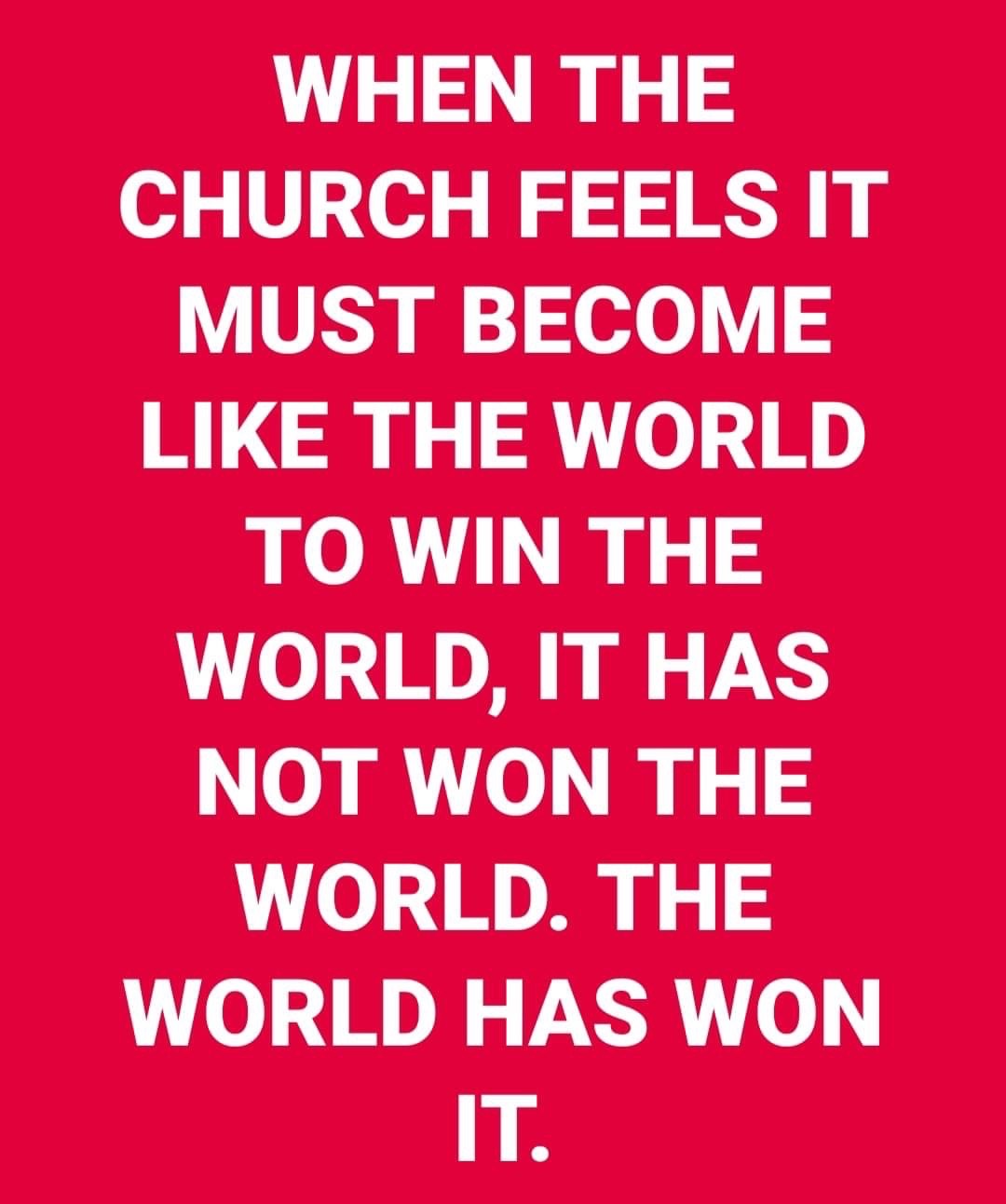
This meme has been circulating on social media lately:

The truth to this requires nuance. There is almost always more than one way to “become like the world.”

The world tends to give us at least two options. It doesn’t care which we choose, as long as we remain blind to the fact that each of those options fails to align with Jesus, his character, and his kingdom.

The world loves to offer us that false dichotomy (probably more common than a false trichotomy), making us think that since we are against ONE wrong option we must therefore be doing the right thing, though it’s quite possible both are wrong.

Reading Christopher Watkin’s Biblical Critical Theory I see, “Now, if I live in a society that every day finds a hundred subtle ways to send me the message ‘Conform!’ and I do conform, then how do I know whether my conforming is something I want to do or just something I have been conditioned to value? I can hardly claim to be following my own initiative. In just the same way, if I live in a society which every day finds a hundred subtle ways to send me the message ‘Go your own way!’ and I determine to go my own way, then am I not in the same position as the conformist in a society of conformity?”

The world tells us that the “They” (a useful Heideggerian idea) wants to manipulate us, to push us to conform. As our pretend friend, that element of the world sidles up to us, points at the “They” and invites us to boldly stand on our own – with them – against the “They.” That pretend ally says, “Be your own person – exactly as I tell you to.”

Posted in Culture, Discipleship | Tagged , , , , | Leave a comment

Multicausality vs. Monocausality

Think of an event – let’s call it X. X is almost never the result of a single cause. Multiple other events happened to bring about (cause) X. This is a rejection of a norm of monocausality.

What if X is in the future, some desired state that has not yet happened? If monocausality is usually not true, then the idea that the event or outcome we desire will happen as a result of a single factor is also unlikely. Said otherwise, the outcome we desire will likely have multiple inputs to bring it about.

Posted in Uncategorized | Leave a comment

Thinking About Cause and Effect

The process we call “cause and effect” is complicated. Our world is full of it, but it doesn’t always operate as we think it should.

Our model too often is the light switch. You flip the switch, the light comes on (or goes off). It’s instantaneous. Some cause-effect relationships are like that.

The more complicated the system, the more we see both a network of causes and effects (not a one to one phenomenon). With that complexity comes delay. An action (or network of causes) produces varying effects over time. The actions we do today, have an effect on today; but they also can affect tomorrow, next week, next year, even years from now. Effects that we initially take to be positive (or negative) can, over time, transition to what we take to be negative (or positive).

Every action we perform has effects, some intended, some unintended. Each of those actions can be interpreted by us or others as a result of other actions (our own actions and the actions of others). Since we operate within a social network of acting people, people whose actions produce effects that impinge on our own actions, the degree of credit we can claim (or deny) for any effect is rarely an all or nothing affair.

Posted in Uncategorized | Tagged , , | Leave a comment

Paying for Education

I continue to see posts on social media defending the proposition that those who are either childless or who have reached a certain age should no longer pay taxes to support education. I confess that I’d rather pay no taxes for anything. I also know that we often get what we pay for.

As long as we don’t need any doctors, nurses, engineers, pastors, lawyers, entrepreneurs, leaders, scientists, younger than we are, I guess we’ll be ok not educating the coming generations. We’ll save lots of money!

Or I guess we could be satisfied with only children of those who can afford to educate their children getting an education. Perhaps those who do not have parents wealthy enough to pay for their education should just do manual labor jobs, say in the farm sector. Since we’ll have fewer educated people, we’ll have to revert to older methods of farming that are manpower intensive, so that’ll help employ masses of less-educated people. For some, this will have the added benefit of putting a damper on immigration. Instead of having people coming across the border to do the grunt work on our farms we’ll be able to fill those jobs with our own children, leaving no room for immigrants.

Sarcasm aside, I’d rather have an educated populace. I think we’d all be better off if children – our own and those in other families – received more education. I even think we’d be better off if we invested in educating the children of those who may have entered out country illegally.

Posted in Education, Politics | Tagged , , , , | Leave a comment