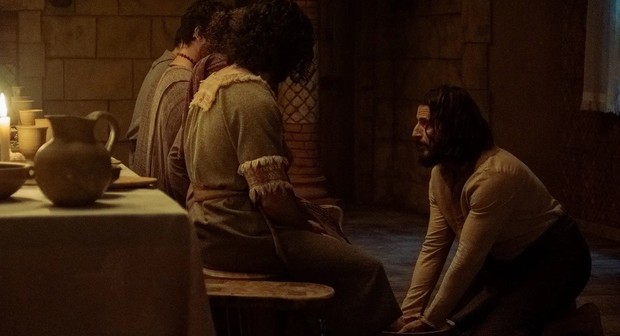
The highlight of this episode – maybe the highlight of the season for me – was the depiction of Jesus calling Thaddeus. As things go, reading the Bible alone, we know next to nothing about Thaddeus. He’s been much more fleshed out in The Chosen.
Watch this capture of Jesus’ call of Thaddeus. Let me know what you think.
Though each episode this season has begun with a bit of conversation from the Last Supper/Upper Room Discourse, in this and the next episode we’re finally getting into the set up and beginning of that last night itself.
For all the weight he’s bearing, Jesus starts off cheerful. He’s happy that he’s able to have this meal with his disciples, with his friends. We know there is deep pathos underlying that cheerfulness when he describes it as “Our last meal together.”
We see Jesus washing the disciples’ feet. They’re all confused by his action, though Peter is the only one putting up strong resistance. In the face of his not giving in easily, Jesus comments, “Sometimes Peter is still Simon.”
The episode also features flashbacks to times in the disciples’ lives before they met Jesus.
Do you know Charles Wesley’s And Can It Be, a hymn written on the anniversary of his conversion? Some find the tune difficult the first few times, but consider the words. As with so many Wesley hymns, they are stuffed with good theology.
And can it be that I should gain
an interest in the Savior’s blood!
Died he for me? who caused his pain!
For me? who him to death pursued?
Amazing love! How can it be
that thou, my God, shouldst die for me?
Amazing love! How can it be
that thou, my God, shouldst die for me?
Wesley expressed amazement that the savior would die for him. Notice the high Christology here: “How can it be that [you], my God, should die for me?” Jesus is the savior who died for us. He wasn’t just some awesome guy that happened along. He was God in the flesh, come to live among us as one of us. He took upon himself all our sin and brokenness.
‘Tis mystery all: th’ Immortal dies!
Who can explore his strange design?
In vain the firstborn seraph tries
to sound the depths of love divine.
‘Tis mercy all! Let earth adore;
let angel minds inquire no more.
‘Tis mercy all! Let earth adore;
let angel minds inquire no more.
Do you see the mystery here? Sure, the previous stanza gave us a mystery, that God would love us so much. But consider the language here. What does the word “Immortal” mean? It means “not liable to death.” Here is this Being, this Person, to whom death is a foreign experience. Yet this Immortal One takes on mortality and dies. This idea – the Immortal dying – is so strange that angels look into and can’t figure it out. The “firstborn seraph (a kind of angel)” makes an attempt. Here Wesley uses a metaphor drawn from navigation. Ships in those days would take soundings to see how deep the water was. They would make a sound at the surface and then wait and see how long it took for that sound to echo back from the bottom. A short time till the echo meant relatively shallow water; a long time till the echo means relatively deep water. In this case all soundings are in vain. The sound at the surface goes down and down and down. But there is no bottom to the ocean vastness of God’s love; thus the echo never comes. Sounding fails.
He left his Father’s throne above
(so free, so infinite his grace!),
emptied himself of all but love,
and bled for Adam’s helpless race.
‘Tis mercy all, immense and free,
for O my God, it found out me!
‘Tis mercy all, immense and free,
for O my God, it found out me!
Now we see Jesus, the Son of God, in action. Wesley draws this description from Philippians 2:5-11. There we see Jesus, who “being in very nature God, did not count that equality with God as something to be exploited (for his own gains), emptied himself and became one of us, fully human.” This Jesus, Paul tells us, became obedient, even to the point of submitting to death on the cross.
Romans 5 informs the next bit, where we sing of Jesus doing this for “Adam’s helpless race,” or in other words, us humans. Wesley could have left this at a high level of abstraction – that Jesus died for “humans” or for “us sinners.” Instead, he gets personal. That deep, mysterious, life-giving love of Jesus “found out ME!”
In the fourth stanza Wesley gets even more personal, talking about his own experience.
Long my imprisoned spirit lay,
fast bound in sin and nature’s night;
thine eye diffused a quickening ray;
I woke, the dungeon flamed with light;
my chains fell off, my heart was free,
I rose, went forth, and followed thee.
My chains fell off, my heart was free,
I rose, went forth, and followed thee.
Here Wesley tells his testimony, his story of how the grace of God tracked him down and set him free. For me, this is where the hymn grabs me and won’t let go. This metaphor of being rescued from a deep dark prison fits my own experience. I wasn’t some basically good person who just needed some divine advice or information. I was “fast bound” – utterly stuck – in “sin and nature’s night.” There was NOTHING I could do for myself. At just the right time God shown the light of Jesus on me, awakening me to my state (I didn’t even know my desperate condition!), and saving me from it. I wasn’t just set forth to go do whatever I wanted; I was set free to follow the Jesus who saved me.
Wesley’s language here follows the story of Peter in the Book of Acts. Peter had been arrested and was in jail. The Christians were back at the house praying fervently for him. Peter was awakened when an angel came to him, freeing him from his chains and leading him out of the jail. Wesley likens his own experience to what happened to Peter. The “quickening” – life-giving – ray of light from God touched Peter; it touched me.
So here we are – saved and delivered by this God who gave himself totally for us. The fifth and final stanza brings this to a climax. (If I haven’t told you yet, this is considered our Asbury Seminary “fight song.” Whenever we sang it in chapel it was loud the whole time – but them twice as loud on the final stanza. Consider the words and you’ll see why.
No condemnation now I dread;
Jesus, and all in him, is mine;
alive in him, my living Head,
and clothed in righteousness divine,
bold I approach th’ eternal throne,
and claim the crown, through Christ my own.
Bold I approach th’ eternal throne,
and claim the crown, through Christ my own.
Here’s Wesley working from Romans 8. “There is, therefore, NO condemnation for those who are in Christ Jesus.” That, for Wesley, is not just a detail or fact to be cataloged and believed. It is to be experienced. “No condemnation now I DREAD.” Yes, I know the depth of my sin. I know I don’t deserve anything Jesus has done for me. Yet I receive it with all my heart and let it become the determining reality of my life. No fear, no dread, Jesus died for me! More than that, I am now “alive in him.” I am “in Christ.” I am clothed – characterized – not by my own righteousness, but by God’s own righteousness. Now I boldly come to the throne of God – look at Ephesians if you want to see the scriptural origin of the idea – and claim the crown God offers me. Again, my boldness and the offered crown aren’t by-products of who I am or what I’ve done. All is of Jesus. He’s qualified me, and I live in him.
So far Season 5 has begun each episode with vignettes from Jesus’ time with the disciples in the Upper Room. We see them seated at tables. We hear Jesus teaching, some from the synoptic gospels, quite a bit from John’s “Upper Room Discourse.” Each week much time is spent on Jesus’ prediction that one of the disciples will betray him. All vehemently deny it even while when apart, they seek to discover the guilty party to be.
As is characteristic of The Chosen, Jesus goes into more detail explaining his words and actions than what we see in the gospels. When instituting the eucharist he prays (and I paraphrase here and elsewhere since I cannot write notes as quickly as I’d like), “Tonight we celebrate your redemption from sin because of me.” He explains, “Normally wine allows us to remember the blood of the lamb spread on the doorposts, but now this is my blood shed for you.”
Through all this Jesus is clearly emotional, nearly breaking down at times. He knows what’s coming. He’s like to avoid it. He keeps treading the way to the cross anyway.
We run into Nicodemus again. He’s confused about why Jesus is “turning allies into enemies.” He takes his calling to lead and protect Israel from false prophets very seriously. He’d like to be able to reject Jesus as one of those false prophets. But between what he’s seen for himself and what his spy has reported, he’s seen and heard too much to do that.
Judas finally meets up with Caiaphas to bargain his price for betrayal. Judas thinks he’s in control of the situation, that he knows what he’s doing, but he’s out of his depth. When asked why he, a disciple, is betraying Jesus, he says, “I do believe Jesus is most likely the Messiah.” His idea is that Jesus just needs the right kind of push, the kind he’ll provide, to openly reveal himself Messiah and lead Israel against its enemies.
In the background Atticus is playing multiple sides in his game to get rid of Jesus. What he really thinks isn’t clear to me. Could he be the Roman who says, “Truly this man is the son of god” at the crucifixion? If he is, what would this man who invokes “Bacchus” and other pagan gods mean by the title?
Two interesting choices I noticed. First, the writers have Nicodemus refer to Jewish leaders as “Israelis,” a clear anachronism. Second, Nicodemus uses the idiom, “The die is cast,” a line attributed to Julius Caesar.
I’ve spent quite a bit of teaching time on the scriptural picture of God wanting a people who are his very, a “chosen people” who will be his primary agents to extend his blessings to everyone else. This was the theme of the Sunday sermon on baptism: I tried to make the case that too often in our thinking about baptism we think merely as individuals: Baptism is about my being washed from my sins, my being made new, or, if one is a credobaptist, my making my profession of faith. I worked my way from Genesis 12, through Exodus 19, Jeremiah 31, Ezekiel 36 in the Old Testament to Matthew 3 and 1 Corinthians 12 in the New Testament.
Then on Wednesday in our class that’s discussing Stanley Hauerwas’s essay, “Discipleship as a Craft, Church as a Disciplined Community,” I spent most of the time going back over those scriptures, taking more time to reason through each one to the next. HERE’S THE AUDIO if you’d like to check it out. This tied into Hauerwas’s case at the point of the last claim in this paragraph:
First it reminds us that Christianity is not beliefs about God plus behavior. We are Christians not because of what we believe, but because we have been called to be disciples of Jesus. To become a disciple is not a matter of a new or changed self-understanding, but rather to become part of a different community with a different set of practices.
Becoming a Christian, on this account, is not merely adding to our stock of beliefs, getting baptized, or changing our moral practices. Becoming a Christian includes “becoming part of a different community,” a community we call “church” (even as we understand that “church” doesn’t merely mean the voluntary association of like minded believers who share a geographical location at certain days and times of the week.
Just a few brief comments on this episode we watched last week:
The characters around Jesus continue to be absolutely sure they know what they’re doing – and that they are correct.
Caiaphas, the high priest, is sure that he’s motivated by love for God. He thinks the answer to the “Jesus problem” is prayer. He leads the assembly in prayer that they can thwart Jesus. Similarly his brother in law Ananus is confident he and his group are agents of God.
Judas is sure that the Messiah is a conquering king like David. He thinks all Jesus needs is the right kind of prodding for him to step up and fulfill that role. Judas is going to work in the background and ensure that that happens.
A while back I mentioned the Methodist General Rules. Briefly summarized they say:
First, Do no harm.
Second, Do Good.
Third, Attend to all the ordinances of God.
Let’s consider the first rule in more detail. In context the full language is: “By doing no harm, by avoiding evil of every kind, especially that which is most generally practiced, such as…”
You immediately noticed there’s no verb in that sentence. By “doing no harm” and by “avoiding evil” what are we accomplishing? Wesley’s claim is that becoming a Methodist is ridiculously easy (my language, not his). All that’s required is a “desire to flee the wrath to come,” or, put another way, a “desire to be right with God,” “to be saved.” Becoming a Methodist was easy. Remaining a Methodist was more complicated. For Wesley a Methodist would “continue to evidence their desire for salvation.” This is where the “by” comes in: they evidence their desire for salvation by doing the three things laid out in the General Rules.
Do you notice the importance of desire in this way of thinking? The Methodist desires “to flee the wrath to come;” the Methodist desires for “salvation.” Wesley and the Methodists understood salvation as more than a simple binary state. If salvation were just a binary state we’d speak as some do as if people were either “saved” or not, or more crudely, headed to heaven or to hell. For Wesley and the Methodists there was a binary aspect to salvation, but the full biblical picture of salvation included much more than that. In the Bible we see Jesus calling people to follow him, to become his disciples (that is, his apprentices), to take up his way of life, to give their allegiance to God’s Kingdom.
Let’s try the marriage analogy. A person is either married or not. That’s binary. A wedding is the normal way to enter the state of “being married.” The point, however, is not to have a wedding. The point is to live in the state of marriage, to live in a new and life-long relationship with the person you’ve married.
Maybe you’ve known someone who entered the state of marriage with a person but later came to a point where they no longer “evidenced a desire to be married.” That’s the kind of thing Methodists are thinking about. Our living in a certain way (a way described by the General Rules) shows that we continue to desire salvation, to live in relationship with God.
What is your life showing about your desire for salvation?
In this episode we see Judas in the grip of “not God.” That’s Jesus’s response to Judas’s question. Jesus has said to him, “He has you now.” “Who?” said Judas. “Not God.”
Judas is happy Jesus called him to be a disciple. He wholeheartedly believes Jesus is the Messiah. He’s a true believer. But he doesn’t understand what Jesus means by “Messiah.” He also doesn’t trust Jesus to know what he’s doing. The other disciples are confused. They don’t understand what Jesus is doing. But they still trust Jesus.
In a long conversation with Jesus, Judas expresses his frustration to Jesus. “Why’d you call me, Master, if you won’t listen to my advice.” Judas thinks his calling is to be the wise one to advise the Messiah.
Judas’s deep confusion leads him to hand Jesus over to the authorities. We’ll see in a future episode how the producers of The Chosen have him rationalize his betrayal. Given his status as a “true believer,” it’s likely they’ll have him believing that handing Jesus over will force his hand, compel him to finally “Reclaim his birthright,” and be the Messiah Judas knows he’s supposed to be.
I notice Christians still have a tendency to offer Jesus advice. We still think Jesus doesn’t rightly understand what it means to be Messiah (Or Savior, or Lord, etc.). Jesus chose us, intelligent, wise, and dedicated as we are, to give him advice, to make up for his deficiencies. No more of that “turn the other cheek” or “take up your cross” nonsense. “Jesus, what you need to do is show them who’s boss! Put them in their place!” Maybe we don’t even admit the other side of that, our urging Jesus to put us in our place, a place of ruling and authority, a place of setting things right. We don’t want to say that out loud, unwilling to admit that we don’t think Jesus knows what he’s doing.
Whose speech act is this? Though the words are from the Bible, they are an edited version of what’s found in Exodus 20 with some of the words cut out. Does that make this a speech act of the Texas government (though an appropriation of God’s words)?
The translation provided is from the King James Version (the Authorized Version). This presentation of the text of the commandments (which is taken directly from the legislation) keeps the capitalization of “LORD” at the beginning but drops it elsewhere. Should we take this to mean that they are adhering to the convention of translating “יְהוָה” as “LORD” in the first place, but not in the others? When we see LORD in the Old Testament it is the conventional way of signifying the personal name of the God of Israel, יְהוָה (or YHWH/Yahweh). Should we make something of their use of this convention – should we assume they are aware of and intentionally following this convention? If so, should we then take them to be specifying that this “LORD God” who is represented as giving these commandments is not just a generic god, a mere supreme being, but the God of Israel, the particular God honored and worshipped by Jews and Christians?
Or maybe we should assume the legislature doesn’t understand the convention regarding “LORD,” explaining why they changed it to “Lord” when it appears later in the text.
The text given in the Texas legislation drops the second half of verse 2: “who brought you out of Egypt, out of the land of slavery.” The advantage of this mutilation of the biblical text is that it allows readers to fudge on both the identity of the god who is purported to give these commands and the “you” to whom they are addressed. In Exodus 20 the God who is speaking is “the LORD your God who brought you out of Egypt, out of the land of slavery.” This God is not just a generic supreme being or giver of a universal moral scheme. This is a God who acted in history with a particular people. Having already delivered them from slavery in Egypt, this God is now making covenant with them. When we read the whole of verse two – and indeed read the commandments in their biblical context – we see that these commandments are addressed to those people, to Israel. They are not addressed to the Egyptians, the Edomites, the Greeks, the Chinese – you get the idea. By editing this line out of the text (and by taking the Ten Commandments to be separable from the rest of the biblical context), Texas seems to be reframing the Commandments as admonitions pertaining to a general morality applicable to everyone everywhere – even non Jews and non Christians in Texas.
Since the legislature has taken upon itself to edit the text in such significant ways, perhaps we see here an appropriation of what in the original context God’s words so that now these words are now the legislature’s words. This is certainly not how they are framed – they still claim an association with God. In the original context of Exodus 20, verse 1, another verse expunged by the legislature, says, “And God spoke all these words.” By cutting off verse 1 should we think that we should read instead, “And the Texas Legislature said all these words?”
To whom are the words on this Ten Commandments poster addressed? Since the legislature has mutilated verse 2, it’s no longer natural to read them as addressed to God’s covenant people, Israel (although I suppose some modern day adherents of British Israelism might want to claim that America is now God’s covenant people). Will students in classrooms take these words to be addressed to them? If they do, what reason might they take themselves to pay heed? Will the teacher, the principal, or the Commissioner of Education come down on them for disobedience? Israel took themselves to have reason to obey God’s commands and keep his covenant because they knew God and had experienced his saving work. God communicated love and built trust before giving the commands. Israel knew this. Has the legislature communicated love and built trust with students (and teachers?) before giving these commands? If so, do students take themselves to be aware of these actions?
Should non Jews & non Christians take these commands as coercive action against them? Must atheists, Buddhists, Hindus, Muslims, etc., give up their own belief systems, practices, and allegiances and acquiesce to these commands? Or are the commands not intended to function as commands but as pointers to something like a “history of morality?” Is the legislature merely saying, “Many of the people who formed our country valued these commands. The idea of valuing commands like this is still important to us. You don’t have to believe, obey, or practice these commands, but you should know they are there.”
If the government of the State of Texas values these commands enough to require their posting in all public schools, should we assume that they themselves seek to adhere to them? What does it mean to “value” commandments while not adhering to them? If the state wants students to value them and adhere to them, to what degree should those who enacted this law (who promulgated this edition of the Ten Commandments) be held accountable to them?
As Christians who not only value the Bible but seek to live by it, should we cheer that an edited version of part of it is required to be posted in all classrooms? Should we read the action as a religious performance, perhaps of the type addressed by Jesus in Matthew 23? If we believe our society (and world!) would be improved by universal adherence to God’s commandments, what strategies do we see in scripture that might move us in that direction? Are we ourselves leading the way, not merely by putting pieces of scripture in public view, not merely by talking about how we need “God back in schools,” but by living in the way of Jesus ourselves and demonstrating through the way we live that obeying God is not only good for us but a way to true joy and peace?