Study Questions for First John – Chapter 1

One of the classes I teach is doing an occasional study of I John. It’s occasional in the sense that these are the notes I leave for them when I have to be somewhere other than teaching the class.

I John 1:1-4 questions

NIV 1 John 1:1 That which was from the beginning, which we have heard, which we have seen with our eyes, which we have looked at and our hands have touched– this we proclaim concerning the Word of life. 2 The life appeared; we have seen it and testify to it, and we proclaim to you the eternal life, which was with the Father and has appeared to us. 3 We proclaim to you what we have seen and heard, so that you also may have fellowship with us. And our fellowship is with the Father and with his Son, Jesus Christ. 4 We write this to make our joy complete.

NRS 1 John 1:1 We declare to you what was from the beginning, what we have heard, what we have seen with our eyes, what we have looked at and touched with our hands, concerning the word of life– 2 this life was revealed, and we have seen it and testify to it, and declare to you the eternal life that was with the Father and was revealed to us– 3 we declare to you what we have seen and heard so that you also may have fellowship with us; and truly our fellowship is with the Father and with his Son Jesus Christ. 4 We are writing these things so that our joy may be complete.

Start at the end of this paragraph, v. 4. What reason does John give for writing? Note: There is a textual variant here. Some Greek manuscripts have your joy while others have our joy. (It’s the difference between humon and hamon.) Most of the newer translations consider our joy to be the better reading. As you read this book, ask the question, “How might what is written here increase the joy of the writer” (or the recipient)?

Back to the beginning: What is John talking about? He seems to be talking about “the eternal life which was with the Father.” What is this “life?” It seems natural to take it to be a reference to Jesus. Why might one talk about Jesus as eternal life? What is the difference between speaking of Jesus as eternal life and speaking of him as giving eternal life?

What is John’s relationship with this “Eternal Life?” He’s heard it, seen it, looked at it, touched it. That sounds like a close relationship – the relationship of an first-hand witness, not merely someone who has heard second or third hand. If he’s talking about a person, he’s talking about someone he knew intimately, face to face.

Now John is proclaiming this “life.” Why might he do that? Do we do that? Why or why not?

How does v. 2 indicate that John came to know this life? Observe that the life is revealed or manifested; it’s not just something John or the other disciples dreamed up for themselves. Some have suggested that the Christian teaching of eternal life is merely wish fulfillment: We dislike the idea of death, so we dream up some way to avoid it. Here the repetition is a way of emphasizing that John and his companions did not make this stuff up. It was revealed to them. Maybe it isn’t the right word – after all, Jesus – a person – seems to be who is in view here. It’s not just some vague life out there, it is a person who has come and is life.

Where was the life before it came to be with John and his companions? What does it mean to say this eternal life was “with the Father?” Who is “the Father?” Why would the “Life” leave the Father? Some parallel texts to consider are John 1:1-18 (on being with the Father) and John 5:19-30.


NIV 1 John 1:5 This is the message we have heard from him and declare to you: God is light; in him there is no darkness at all. 6 If we claim to have fellowship with him yet walk in the darkness, we lie and do not live by the truth. 7 But if we walk in the light, as he is in the light, we have fellowship with one another, and the blood of Jesus, his Son, purifies us from all sin. 8 If we claim to be without sin, we deceive ourselves and the truth is not in us. 9 If we confess our sins, he is faithful and just and will forgive us our sins and purify us from all unrighteousness. 10 If we claim we have not sinned, we make him out to be a liar and his word has no place in our lives.

NRS 1 John 1:5 This is the message we have heard from him and proclaim to you, that God is light and in him there is no darkness at all. 6 If we say that we have fellowship with him while we are walking in darkness, we lie and do not do what is true; 7 but if we walk in the light as he himself is in the light, we have fellowship with one another, and the blood of Jesus his Son cleanses us from all sin. 8 If we say that we have no sin, we deceive ourselves, and the truth is not in us. 9 If we confess our sins, he who is faithful and just will forgive us our sins and cleanse us from all unrighteousness. 10 If we say that we have not sinned, we make him a liar, and his word is not in us.

NLT 1 John 1:5 This is the message he has given us to announce to you: God is light and there is no darkness in him at all. 6 So we are lying if we say we have fellowship with God but go on living in spiritual darkness. We are not living in the truth. 7 But if we are living in the light of God’s presence, just as Christ is, then we have fellowship with each other, and the blood of Jesus, his Son, cleanses us from every sin. 8 If we say we have no sin, we are only fooling ourselves and refusing to accept the truth. 9 But if we confess our sins to him, he is faithful and just to forgive us and to cleanse us from every wrong. 10 If we claim we have not sinned, we are calling God a liar and showing that his word has no place in our hearts.

Who is the “him” from whom they have heard this message? When and under what conditions did they hear it? Do we see anything like this in the Gospels, i.e., in the recorded teaching of Jesus? [Consider John 1:4-5; 3:16—21; 5:24; 8:12; 12:35-6]

What’s the difference between “light” and “darkness” in this text? Does this kind of language work in our setting? Why or why not?

What does it mean to “walk in darkness?” What reasons might one choose to walk in darkness? Can one walk in darkness and not know it? How might you tell if someone is walking in darkness? What does it mean to “have fellowship” with him? [If you’ve heard the word “koinonia” before, it’s a transliteration of the Greek word used here for “fellowship.” It has the idea of having things in common.] Why might someone who was walking in darkness claim to have fellowship with Jesus? Is it possible to “walk in darkness” and have fellowship with Jesus? Why or why not?

v. 7 offers a contrast with v. 6. In this verse we see someone who walks in the light as “he” is in the light. Do you think there’s any significance to the fact that all these verbs are present tense? What are the consequences of walking in the light? Are these consequences good or bad? Notice how these consequences pertain not only to our relationship with God, but also our relationships with other people. What are the qualifications for walking in the light? Since we’re cleansed from sin when we walk in the light, apparently lacking sin isn’t a requirement.

How do we handle the time relationships between v. 7 & v 8? V. 7 tells us that the blood of Jesus cleanses us from “all sin.” By v.8, we’re told we’re deceiving ourselves if we say we have no sin. Can one be cleansed/purified of all sin and still “have” sin? What’s the difference between sinning and “having” sin?

We often associate being “just” with holding people highly accountable. In v. 9, however, Jesus is described as “faithful and just” and this is directly connected not with him demanding full payment form us for our sin, but with forgiving us when we confess. This word “just” (dikaios) is often translated “righteous.” The “unrighteousness” from which we are cleansed is closely related – adikias – literally we might call it, “not just” or “not righteous.” Note that the offer is to cleans us from all unrighteousness, not just some. Why might God offer this to us?

Is confession hard to do? How do you do it? Is it really that simple? One way to take the word here is that when we confess, we “say the same thing” that God says – in this case, the same thing God says about our sin. God says:

  • This sin is bad (“bad enough for me to send my only Son”)

  • You actually did this, it’s not a mere mis-perception on my part.

  • You are responsible for it.

Turned around, when we confess sin, we’re saying:

  • This was truly a sin, something bad and destructive.

  • I actually did the deed (though sometimes the “deed” is actually an instance of not doing something I should have done)

  • I am responsible for it. Neither my parents, my environment, nor the devil made me do it.

When we confess this way – not just a “Ok, I did X, now forgive me so I can get back to doing what I want to do (which may include sinning in exactly the same way)” – but a real repentance and turning away from sin – we experience real forgiveness. This is another opportunity to remember Isiah 43:25.

How does v. 10 differ from v. 8? How does it expand and move beyond v. 8? What are its practical consequences?

What is the role of faith in this section? We don’t see the word – except for it’s use describing Jesus in v. 9 (“Faithful”). If we consider that faith has at least three elements (a) believing something to be the case; (b) trusting; (c) obeying – do we see these elements in this chapter? If so, where do we see each, whether implicitly or explicitly?

 

Posted in Bible | 1 Comment

Which Church Would You Rather Attend?

From the Wall Street Journal [“In Europe, God is (Not) Dead,” by Andrew Higgins]:

Consider the scene on a recent Sunday at Stockholm’s Hedvig Eleonara Church, a parish of the Church of Sweden, a Lutheran institution that until 2000 was an official organ of the Swedish state. Fewer than 40 people, nearly all elderly, gathered in pews beneath a magnificent 18th-century dome. Seven were church employees. The church seats over 1,000.

Hedvig Eleonara has three full-time salaried priests and gets over $2 million each year though a state levy. Annika Sandström, head of its governing board, says she doesn’t believe in God and took the post “on the one condition that no one expects me to go each Sunday.” The church scrapped Sunday school last fall because only five children attended.

Just a few blocks away, Passion Church, an eight-month-old evangelical outfit, fizzed with fervor. Nearly 100 young Swedes rocked to a high-decibel band: “It’s like adrenaline running through my blood,” they sang in English. “We’re talking about Jesus, Jesus, Jesus.”

Passion, set up by Andreas Nielsen, a 32-year-old Swede who found God in Florida, gets no money from the state. It holds its service in a small, low-ceilinged hall rented from Stockholm’s Casino Theatre, a drama company. Church, says Mr. Nielson, should be “the most kick-ass place in the world.” Jesus was “king of the party.”

If you were raised in a traditional church, my guess is that you’d chose church #1. It’s stable, it’s traditional. Chances are that its worship style is thoroughly traditional, with the focus on quiet reverence.

However, if you weren’t raised in church, or were at the place in life where you were convinced that church was “boring, untrue and irrelevant,” you’d be more likely to go for Passion Church.

Purists on either side can argue that the other church is compromised by its attachment to mainstream culture. The Hedvig Eleonara Church, though apparently traditional, sees the leadership of the church as sufficiently secular to accommodate leadership from atheists. The Passion Church, though apparently counter-cultural, uses the language of pop-cultural hedonism.

Getting beyond the verbiage and hype (“The church is run by an atheist” or “Jesus was ‘king of the party'”), and questions as to who is more compromised by culture, we need to ask questions of life change. Which church is reaching people for Jesus? Where are sinners coming to faith? We’re not told about what’s happening at the traditional church, but we hear a story from Passion Church:

The message has lured some unlikely converts, including a heavily tattooed, self-described former mobster. “I’ve gone soft,” says Daniel Webb, the son of an English father and Swedish mother, who spent five years in jail for illegal arms possession and assault. He was baptized, like most Swedes, in the Church of Sweden but never prayed. He went to church for the funerals of fellow hoods but scoffed at Christian sympathy for the meek.

Mr. Webb first went to Passion Church three months ago with a female friend. Expecting to be bored, he got hooked. “An ocean of anger has calmed,” he says. His ex-wife, he says, “thinks I’m ridiculous.” He says he’s turned his back on crime.

What are we more concerned with – getting everything right, or seeing lives changed? While being right is not unimportant – after all, Jesus didn’t just seek life change in general, but life change oriented to the Kingdom of God – the New Testament pictures Jesus majoring on the latter, the Pharisees on the former. We can say that Jesus got things right by focusing on people and reconciling them to God (think Luke 15 here).

As a UM Pastor, I go where I’m sent. I don’t get to chose what church I go to. As a leader, I’d like to lead my church so that it’s more like Passion Church than Hedvig Eleonara Church. I want to bring people to Jesus, not just do what we’ve always done.

Posted in church growth, Current events, Ministry, United Methodism | 1 Comment

Learning from Five Dysfunctions of a Team

I first heard Patrick Lencioni at the Willow Creek Leadership Summit a few years ago. He spoke then on the content of his book, The Five Dysfunctions of a Team. Well, I’ve finally read the book.

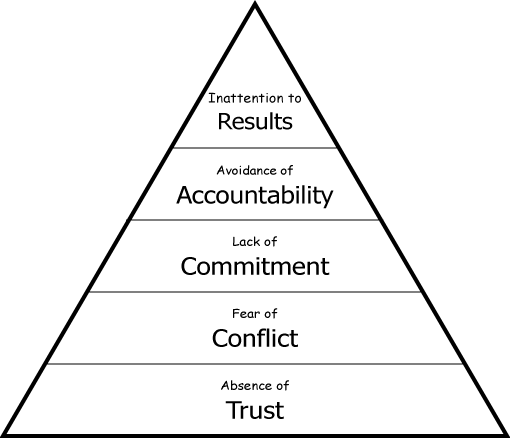
The heart of the book is illustrated in the diagram below.

5dysf

I see much in the book that my own church could profit from. We’re a diverse group, not only in our backgrounds, personalities, and interests, but also in the way we relate to the church. I’m appointed by the bishop. We have one staff person who is full time and a member/participant in another church, 3 people who are part-time paid staff, active in our congregation, and one person (new to the staff) who is unpaid (though she was at one time – years ago – paid staff), but has longer tenure in the church than any of us. She’s the only one to join the staff from within.

My main gifts are in teaching and preaching – not leadership. While teaching and preaching are essential to the health of a church, so is leadership. That’s why I continue to work on my leadership abilities.

In this post, however, I’d like to comment on Annual Conference issues. If you’ve been a reader of this blog for a while, you know the Texas Annual Conference is going through a transformation process. Big changes are afoot. Reading Lencioni makes me wonder if we’re not starting at the wrong end of the spectrum.

If Lencioni’s theory is correct, the starting point for developing a healthy team is building trust. The end goal is to focus on team results. We’re doing the latter elements – increasing accountability, setting goals, etc. But do we have trust?

Lencioni’s book is based on his “fable” about the leadership team of a tech company. The story shows their new CEO leading them up the pyramid – in theory and in action. Surely a company leadership team – composed of fewer than 10 people – is more like the staff of an individual church or the conference cabinet than it is like the conference as a whole. Can we take his theory any apply it to such a large organization? If so, what adaptations do we have to make?

For as long as I’ve been a part of the institution, the UMC has been a top-down hierarchy based organization. The folks at the top have the power, and the folks at the bottom are expected to do what they’re told. At least three factors are eroding this command and control structure.

1. Our culture as a whole has moved away from command and control structures. While still powerful, strong forces for freedom and autonomy have contended against these structures at least since the 1960s. While some of these new forces have been co-opted – i.e., have themselves taken up command and control strategies, the impetus for freedom and individual innovation remains.

2. Over the past few generations pastors have been required to have more and more education simply to enter the ministry. For some time now, it has been a requirement to have at least a graduate degree in divinity. It has not worked well to tell pastors (a) You need to spend a decade studying and tens of thousands of dollars, and (b) Even though you’re so highly educated, we still don’t respect you enough to let you get by without detailed orders from above. (Or, in plainer language, “We don’t trust you to be able to use the education we commanded you to get.” Surely they’re not saying, “Even though we required you to get this expensive education, it’s really not relevant to what you need to do?”)

3. The influx of more mature second career pastors with greater life experience has brought in people who are used to working in freer environments, or who have greater confidence in their own skills and wisdom.

If the traditional command and control structure is being eroded, what is the alternative? Here is where we can learn from Lencioni. The starting point is building trust. we have to do this on many levels. Pastors and congregations, pastors and DSs, churches and cabinets, need to learn to trust each other.

This trust is not just a happy smiley thing. Once real trust begins, then we can move to the next level – healthy conflict. I don’t know about other churches, but UMs are terrified of conflict. We think conflict is unChristian. We talk about wanting people to be “team players,” and by “team player” we mean someone who doesn’t rock the boat but simply (and happily) does what he or she is told to do. There are fewer and fewer people willing to operate that way (could this be why we have trouble getting and keeping younger pastors?).

Why doesn’t the Annual Conference learn from a model like Lencioni’s? My guess is that the main hindrance people would point to is the constraint of time. Some folks think (perhaps rightly) that the great Texas Conference is teetering on the precipice of calamitous decline. Desperate times call for desperate measures. While there are some that think that way, I think there is a another constraint we’re less willing to talk about. I’m referring to episcopal terms.

Building the trust and healthy conflict (so that we can reach greater commitment, accountability and results) in an organization as large as the TAC is a huge task. I doubt it can be done quickly. But BishopHuie is appointed as our episcopal leader for only 4 years at a time. Will she be back for another quadrennium? If she is, will she maintain her focus (some bishops do, some don’t)? If sheisn’t (or even if she is), what will the next bishop do? Will the transitions be affirmed – or jettisoned as too expensive or too painful? Perhaps some think that if we push hard enough we can make it to the point of no return before any changes at the top are made. (Yes, I realize that this is shaping up as an argument for longer episcopal tenure.)

Posted in church growth, Leadership, Texas Annual Conference, United Methodism | Leave a comment

At War?

Have you heard the saying – “America isn’t at war – America’s military is at war. America is at Walmart”? The implication is that we need to appropriate the World War 2 model of total war and mobilize the whole society to fight.

Here’s a picture from a society engaged in something much closer to total war:

 GAZA CITY, Gaza Strip (AP) – A Mickey Mouse lookalike who preached Islamic domination on a Hamas- affiliated children’s television program was beaten to death in the show’s final episode Friday. In the final skit, “Farfour” was killed by an actor posing as an Israeli official trying to buy Farfour’s land. At one point, the mouse called the Israeli a “terrorist.”

“Farfour was martyred while defending his land,” said Sara, the teen presenter. He was killed “by the killers of children,” she added.

The weekly show, featuring a giant black-and-white rodent with a high- pitched voice, had attracted worldwide attention because the character urged Palestinian children to fight Israel. It was broadcast on Hamas- affiliated Al Aqsa TV.

Station officials said Friday that Farfour was taken off the air to make room for new programs. Station manager Mohammed Bilal said he did not know what would be shown instead.

Israeli officials have denounced the program, “Tomorrow’s Pioneers,” as incendiary and outrageous. The program was also opposed by the state-run Palestinian Broadcasting Corp., which is controlled by Fatah, Hamas’ rival.

The war is so important that even little children must be mobilized. They must learn to see the enemy as totally evil, and to be opposed with all one’s might and resources.

I don’t want that. Total war, while it might be a step in the direction of effectiveness, is also a step in the direction of greater evil.

Posted in Current events | 1 Comment

Chicken

I live in Camp County, Texas. The World Headquarters of Pilgrim’s Pride Corporation is on the northern edge of the county. Lots of chickens live (and die) here.  Chickens are big business here. Pilgrims and the supporting industries are the major employers in the area.

There’s another kind of chicken. In modern English we say someone is chicken if they’re scared of something. Among kids at least, being called a chicken is a bad thing.

I’m a chicken living in the midst of chickens. There’s my confession.

As a pastor I’m torn between being the bold leader, fearlessly proclaiming God’s word, leading change in the church and being a “loving, kind person.” While the two are compatible in reality, I don’t see how you can do the first job and be seen as the latter in our culture. “Loving” means nice and non-confrontational.

I’m not a natural leader. My spiritual gifts are not in that area. My gifts are in teaching and preaching. The closest I get to a leadership gift is the gift of stubbornness.

Somehow, in spite of my lack of leadership gifts and talents, stuff happens. The church is growing. People are optimistic . Finances are up.

I guess maybe Paul was right. Weakness does have its advantages.

Posted in Leadership, Local church, Ministry, Spirituality | 2 Comments

Willow Creek Arts Conference

I’m a pastor of a small town church in the middle of nowhere (as far as conferences go). While I see dozens of theology, philosophy, ministry and leadership conferences I’d like to attend, my budget – time and money – allows me to attend very few. I’m sure many others (most?) are in the same position.

As a work-around, I’m going to try collecting blog reports from conferences that sound interesting to me. This first report, from the Willow Creek Arts Conference, is an area of weakness for me. Everyone in my family is more talented in the arts than I am. The best I can do is play a CD. (I can draw stick figures that are sometimes recognizable as depicting humans.)

Here are the reports I see this morning:

Dan Kimball of Vintage Faith Church, a presenter at the conference, reflects arriving at the Conference and some Black Converse shoes.

Paul as Cries of the Heart has a series of posts and photos. (The link is to the first of his posts – he has several.)

Sounds, Lights, Video: Technical Arts in the Church has a series of posts also. Here’s the part 1, part 2, part 3, & Part 4.

Here’s the first in Tim Steven’s series of posts. he continues here and here and here.

I’ll add more as I discover them.

Friday Morning Updates:

The Epic Beat has arrived at Willow Creek. The first post deals more with personal experience of the conference than any content of presentations.

I just found that there is an official blog done by the Willow Creek folks. Check it out.

Final Updates:

Maggie offers a personal summary at Magnanimity.

The AV Club has started posting (first is here) and plans to continue all week.

Tim Corder has also begun posting on the conference, as has Ryan D.

There are several posts at In the silence of my yearned-for-wholeness.

Chris Ridgeway  offers a photo album.

Posted in Current events, Leadership, Ministry, Worship | Leave a comment

How do you know good preaching when you hear it?

As a preacher, I have an ongoing concern for preaching well. Rarely do I think I’ve done well enough – I can usually think of something I should have left unsaid, or something I should have said, or said differently. But I can also remember many times when I had a great felling of inadequacy that someone commented to me that I had said just what they needed to hear.

I’ve had too many polite church members over the years to simply go by what they say. “Good sermon,” so many say as they depart on Sunday morning. They know they’re not supposed to say, “That was a real snoozer!” or “I don’t think I’ve ever heard a more incoherent sermon in my life!” I confess that I’ve had thoughts like that after hearing some sermons, but I, too, was too polite to say so to the preacher. I’d be surprised if no one had negative judgments about my preaching.

Maybe we could go by the numbers. If mroe and more people come to hear me preach, that must mean I’m doing it well. Sounds good to me. Except I’d have to judge Jesus as a preacher of many duds. Sure, the crowds sometimes grew. More often, it seems, they got angry and tried to kill him, publicly disagreed with him, or simply walked away from “that weird Galilean.”

What about our preaching professors? Though my style today is very different from what I was taught when I was in seminary, I think I would feel pretty good if my preaching professor showed up one Sunday morning and went away not too embarrassed to say he taught me.

Sometimes we preachers forget that we’re not the only actors in preaching. Though the spotlight shines on us, God and the congregation are also active in the sermon.I regularly pray for God to give me boldness and clarity so I can preach his word (not just my own). I ask that my intentions and content will be pruned and adapted as God sees fit. I even ask God to translate what I say into a language my audience can understand.

The congregation also has work to do – and that more than fighting to stay awake! Actively listening to preaching happens out of an intentional relationship with God and an intelligent engagement with the Word – the Word of God and the word of the preacher. While it is not always appropriate to ask questions during the sermon, one who listens in a way to seek understanding will continually ask questions – of the text, of the preacher, of application of the word in one’s own life.

So how do I know when I’m doing it right? Though my role is only part of the event of preaching, I think the best way to judge is long term. What happens in my life and the lives of my hearers as a result of my preaching? Such an evaluation takes time – time measured in years. The fruit of Jesus’ preaching wasn’t really clear until the next generation of preachers – his students – came on the scene. Will I be that patient? I don’t know.

Posted in Ministry, Spirituality | Leave a comment

God’s Call as Interruption

During May I preached a series on the call of God (you can hear them via a subscription at iTunes or at the audioblog listing).  In one of the messages I wanted to show the people how they could be prepared to receive God’s call. But I ran into a problem. Over and over again, God didn’t call people who were quietly sitting around waiting for a call. Instead, the norm proved to be a call that interrupted their lines, a call that was the last thing they expected.

My own call was unexpected. For most of my high school life, I had planned to go into physics or astronomy. During those same years, however, God was at work, drawing me in. In the fall of my senior year I finally responded to God’s call to a life with him (what we call becoming a Christian). Right about that same time came a call to ministry. I didn’t want anything to do with it. Surely God was confused. I had other plans. But God interrupted.

God seems to like doing that. Abraham, Moses, Gideon, David, Paul – all interrupted. So I had a set aside my yearning for a nice neat method I could give my people to get involved with God’s call. There were no “Four Steps to Hearing God’s Call,” so I had to shift my focus.

You who are preachers or teachers, does God – or kingdom reality – ever mess with your messages?

Posted in Spirituality | 1 Comment

My First Church Job

The summer of 1983 was my last summer before Seminary (I was finishing college in December, and starting seminary in January). Since I was headed to a career in ministry, I figured I ought to get a ministry job. Everyone else seemed to be doing it. Youth Director seemed to be the most common option.

So I did a little research (I knew almost nothing about finding a ministry job). I interviewed at a church in Houston, but they didn’t hire me. I needed a job, so I went back to McDonalds. I worked there since 1978, so it was easy to get my job back.

About a week later I got home from work in mid-afternoon. My mom (I was still living at home) told me Ed Robb had called. He had a job for me. Ed was – and is – the pastor of The Woodlands United Methodist Church, my family church. I was excited. Finally, someone recognized my abilities!

So I called Ed. “Ed. I hear you have a job opening. Tell me about it.”

“Yes, Richard, we do have a job opening this summer.We need a janitor. Would you like to try it?”

So I was janitor at The Woodlands UMC that summer.  Maybe not the most glorious ministry job out there, but I learned a lot about ministry that summer. (Sometimes when I tell the story I tell people I was “Minister of Sanitation.”)

Our annual conference is meeting at TWUMC this year. The church has changed tremendously since I worked there. They moved a few years ago, and have continued to build on ever since. While I did the janitorial work on my own in the summer of 1983, the work this summer is way beyond anything one person could do. The team they have doing the work is doing a great job.

As for the meeting, things are going well. Bishop Will Willimon was our guest preacher – check out Guy Williams for a report.

Posted in Spirituality, United Methodism | 2 Comments

Oil Change Woes… & Good News

Chris & DavidI got an oil change Saturday before driving off to Annual Conference in Houston. Ordinary auto maintenance. I do it every 3000 miles. So I drove off to Conference.

Today as I went to pick up my dinner, I heard some odd sounds from my engine. Opening the hood I observed that the oil cap was missing and the engine was drenched with oil that had spewed out. What fun. I had the same thing happen with an oil change years ago, but I’d let down my guard and not checked the work of the shop in Pittsburg that did my oil.

It was almost 6, so I whipped out my map of The Woodlands. I found the Pinecroft Express Lube (just north of Lake Woodlands Rd. on the west frontage road of I45. Though it was almost closing time, Chris and David graciously gave me aid. They stuffed a rag (temporary gas gap) in my filler hole, and cleaned my engine. They didn’t charge me a dime. I told them their time was worth something, by they still insisted the work was free.

I don’t find that kind of service every day.

Posted in Blog post | Leave a comment