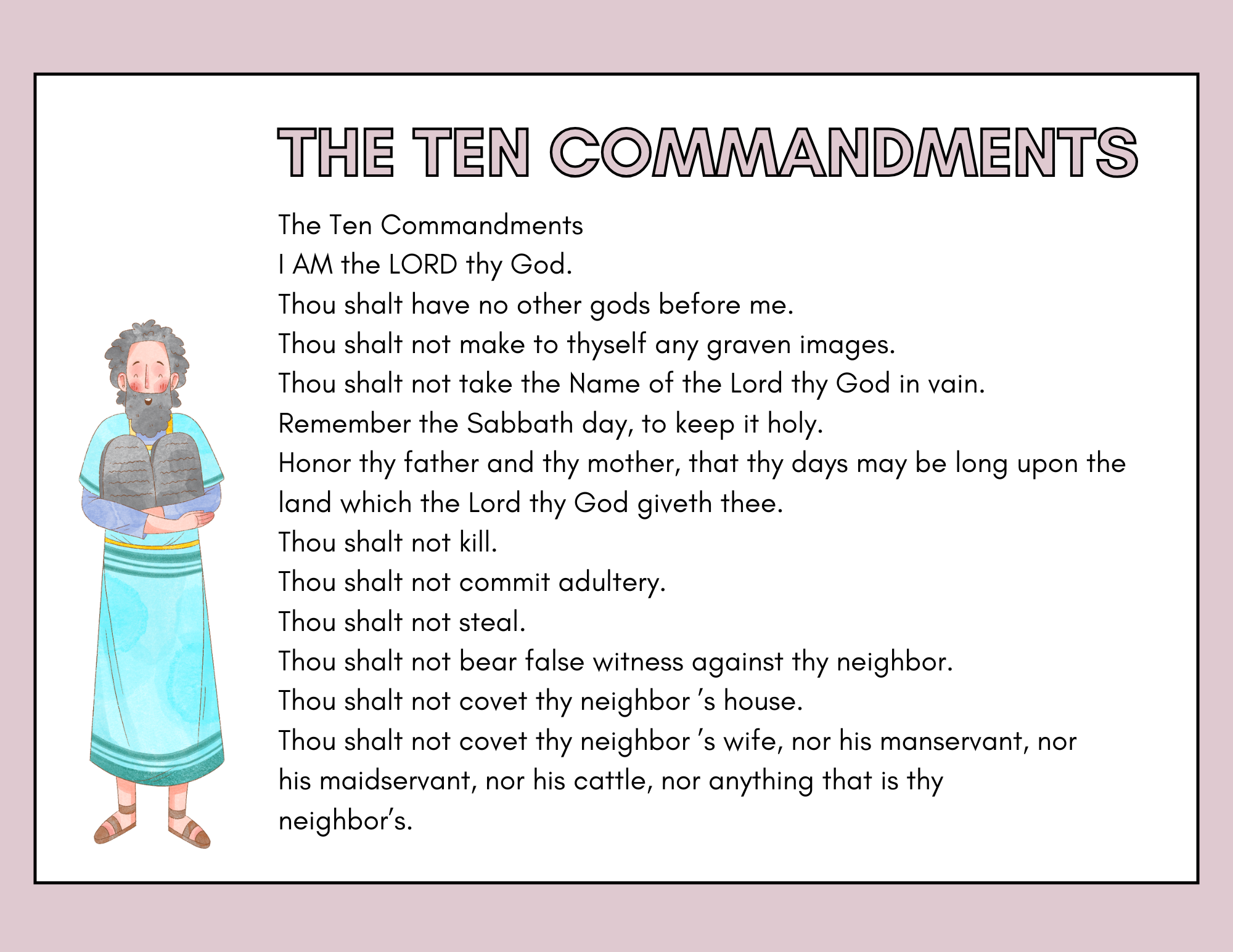
English is the required language, even though the Commandments did not originate in English.
They must be posted in the early modern English of the King James Version of the English Bible. Does this indicate that the King James Version is the most authoritative translation available? Does it suggest that one must apprehend the commands via archaic language? Does this make it more or less likely that any students reading the Commandments will take them seriously?
The legislature has taken it upon itself to edit the text to (a) decontextualize it, thereby (possibly) (b) making it fit better a model of generic morality, theoretically applicable to all people everywhere.
Beyond the fact that non-Christians are taking this action as the state imposing a religion on students, it is this last aspect that bothers me the most. The bill’s text abbreviates “I am the LORD thy God which have brought thee out of the land of Egypt, out of the house of bondage” to “I am the LORD thy God.” Whose God? To whom is this God speaking? Everyone on earth, every human? With the state’s excision of “which have brought thee out of the land of Egypt, out of the house of bondage,” one gets that idea. Read in context and unedited, however, the Commandments are clearly addressed to those the LORD has rescued from bondage in Egypt,” i.e., the Israelites. By this clear act of self-identification – which, again – the state has edited out – the Commandments are framed as a response to a prior act of gracious deliverance. We’re left with bare commands, no grace, no prior action of God. If we have a simple Divine Command theory of ethics this decontextualized set of edited commands may be enough to make proponents of generic religion happy, but it falls short of biblical Christianity.
As a Christian, I’d rather entrust witness for Christ to his disciples that are in the schools: students, teachers, staff, volunteers, who can demonstrate God’s reality, character, and intentions through the way they live and what they say. I don’t trust the state – and its authority – to faithfully represent Christ and his ways.
7 Therefore Jesus said again, “Very truly I tell you, I am the gate for the sheep. 8 All who have come before me are thieves and robbers, but the sheep have not listened to them. 9 I am the gate; whoever enters through me will be saved. They will come in and go out, and find pasture. 10 The thief comes only to steal and kill and destroy; I have come that they may have life, and have it to the full.
11 “I am the good shepherd. The good shepherd lays down his life for the sheep. 12 The hired hand is not the shepherd and does not own the sheep. So when he sees the wolf coming, he abandons the sheep and runs away. Then the wolf attacks the flock and scatters it. 13 The man runs away because he is a hired hand and cares nothing for the sheep.
14 “I am the good shepherd; I know my sheep and my sheep know me— 15 just as the Father knows me and I know the Father—and I lay down my life for the sheep. 16 I have other sheep that are not of this sheep pen. I must bring them also. They too will listen to my voice, and there shall be one flock and one shepherd. 17 The reason my Father loves me is that I lay down my life—only to take it up again. 18 No one takes it from me, but I lay it down of my own accord. I have authority to lay it down and authority to take it up again. This command I received from my Father.”
Having a door is essential! We can have a great house, but if there’s no door it won’t meet our needs.
Likewise, if all we have is a door and no house, we’re also short of what we need.
Sometimes we focus so much on the door we neglect the house.
I ran across this piece at Mere Orthodoxy today. As far as “AI Coming” for transmission of information, I’m sure he’s right. He’s also right that there needs to be more to pastoral education than transmission of information. But our current reduction of education – any kind of education – to transmission of information – is a deep mistake. Information is not separable from the people, the embodied voices that bear it.
If ordinary American Christians know anything about Phillips Brooks today, they know him as the author of the words to the Christmas hymn O Little Town of Bethlehem.
In my very first preaching class, taught by Dr. Don Demaray, I learned of Brooks’ claim that preaching is “truth through personality.” That claim has stuck with me ever since. The truth we deal with as preachers is a not abstract, mere information. It is a truth embodied in the preachers and teachers called and equipped by God through the ages.
You may have noticed that I snuck in the word “teachers” there. I’m taking the claim beyond Phillips Brooks’ maxim. My first formal teaching experience (I’m not counting teaching children’s Sunday school – though I could!) was as an adjunct at Azusa Pacific University. Over the years I’ve taught both in person and online. Some of the classes I’ve taught dealt with matters Brooks would have considered “truth;” but others haven’t. In each and every case, however, my teaching, like my preaching, has been in the context of a personal relationship. The content – the “truth” – matters to me. Producing understanding and uptake in my students matters just as much. I care what my students – me people – learn and that they learn. It’s never been just a job for me.
I use AI. AI is useful, we can use it for many things. I’m sure we can even have these Large Language Models that can “converse” with learners in such a way that the learners come away with increased knowledge.
Will learners be able to see what the truth looks like in the life of the AI teacher? AI is not alive – it doesn’t have a life, so no, that won’t happen. Will AI care about student learning – about uptake of the content? I have no experience of AI caring about anything. It may be a faithful servant, but it doesn’t care about anything.
Delivering information via AI surely looks to be cheaper than by using humans. I’m not convinced that going that direction is overvaluing cheapness at the cost of living interaction with and appropriation of truth.
Though I’d attended my grandparents’ 50th anniversary party as a child, I was too young to be aware of what was happening. The first big anniversary I remember celebrating was the US Bicentennial in 1976. I remember celebrating the 200th anniversary of the Methodist church in America in 1984. The 500th anniversary of the start of the Reformation in 2017 seemed muted to me, but I still put out my own 95 Theses.
This year’s celebration of the 1700th anniversary of the Council of Nicaea is upon us. In 325 leaders from across the Christian world met to discuss just what it was we believed about Jesus’ identity vis-à-vis God the Father. Rejecting what came to be known as the Arian position – that Jesus is some sort of secondary god (“there was a time when he was not”) – the church confessed:
We believe in one Lord, Jesus Christ, the only Son of God, eternally begotten of the Father, God from God, Light from Light, true God from true God, begotten, not made, of one Being with the Father; through him all things were made.
The identity of Jesus has been important to Christians since the very beginning. Jesus himself asked his disciples, “Who do you say I am?” eliciting Peter’s reply, “You are the Christ, the son of the living God.” Others had other thoughts, some accusatory as in the Sanhedrin, “false prophet,” “Blasphemer;” some ironic, like Pilate’s “Jesus of Nazareth, King of the Jews.” Pilate’s titulus nailed to Jesus’ cross was true, even though Pilate himself thought it was a joke.
A 4158
Who Jesus is, is foundational to our take on what Jesus does. His taking our sin upon himself, dying for us on the cross, rising from the dead, and ascension to rule at the right hand of the Father, is effective for us because he is the eternally begotten Son of the God become human.
Since the Council of Nicaea met in 325, the church has had to deal with other important issues (including the Council of Constantinople in 381 that tweaked the creed of 325), but we never get past the basic confession of Jesus’ identity. This same Jesus invites us to become willing participants in what he’s doing, fully allegiant citizens of his kingdom.
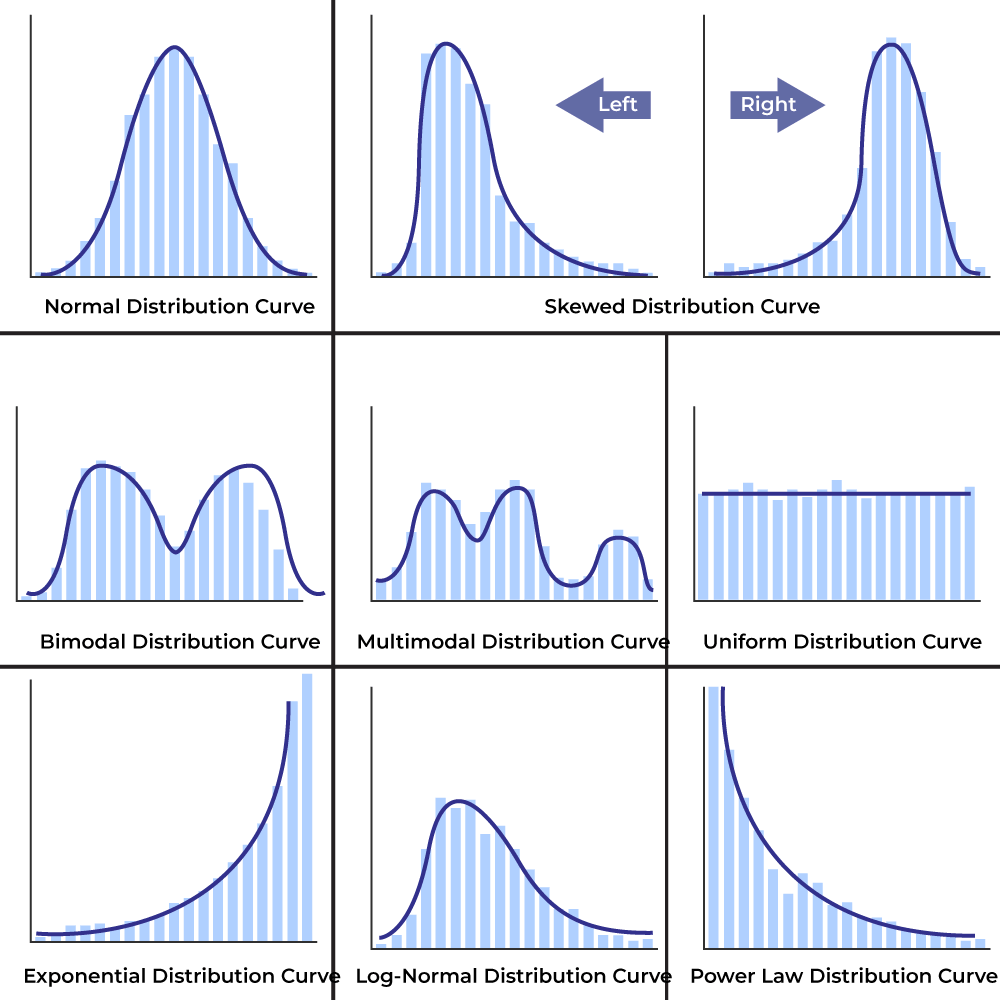
Each one of us is susceptible to a variety of ways of categorization/inclusion in various populations. There is commonly variation within every population when it comes to some characteristic.
Consider the variation of “height” within the population of “10 year olds,” or the variation of “luck” within the population of “people who play roulette.” Variation is NORMAL.
Thinking ALL people in ANY population, merely because we’ve lumped them into that population, must be the same with regard to a particular characteristic (or set of characteristics) will inevitably lead us astray.
My initial thoughts were that this book was not for me. First, I’ve never been confident that I understand the whole “right”/”left” way of sorting things. Sure, it might have worked when it was first introduced during the French Revolution, but that was a culture distant from us in time and space. Just when I would begin to think I understood what the distinction meant, I’d run across something that put me back at my starting point. The recent book, The Myth of Left and Right by Verlan and Hyrum Lewis fit better with my inclinations. The Lewis brothers argue that the packages of beliefs and positions that have been called “left” and “right” have shifted too much for the terms to be very useful.
Second, since at least my late teens I’ve thought of myself as a “conservative,” and I’ve been told that “conservatism” is a thing of the “right.” Why would I want to consider an argument that I should consider becoming a “leftist?”
On the other side, I also had reasons to read this book.
First, I am a Christian, and want to be a Christian first. My allegiance to Jesus and his kingdom is higher than and takes priority over every other allegiance in my life. Being faithful to Jesus and his ways counts for more than be a “conservative” or having any other political or ideological banner flying over me. To the degree that I take some other ideology or its exponents as more important in my life or more definitive of my identity than Jesus, I am giving in to idolatry. I recognize, with Christman, things we value like “law and order” and “national security” have often become idols we serve in ways that have crushed other people in our acts of worship. If I take Christman’s account of leftism as accurate, however, I can also see destructive idols on the left, such as the full acceptance of sexualities & their performance multiplying in the past few years (and yes, Aphrodite and her brood are idolized in other forms on the right as well).
Christman writes as a Christian for Christians. Telling his own story he says of an occasion he was confronted with Jesus’ Sermon on the Mount in college:
That afternoon sealed my fate…Once I had, even for a moment, imagined the possibility of living in that kind of feeling permanently, I was doomed to be some kind of leftist. For me, the fate of being a Christian and being on the left politically are, if not one and the same fate, at least closely linked. In other words, ideas of Jesus’s divinity and incarnation – the central claims of Christianity, along with the resurrection – are linked with the idea that human beings should try to live together in a radically unselfish way, that we can and must try to do so. Ultimately, my Christianity has led me out of conservatism [the environment of his upbringing], past liberalism, to the left.
Second, I want to be right. Being right, isn’t the same as feeling right. I know both from my own experience and from observation of others that feeling right is very pleasant. As long as I feel right, I can look smugly down on the others around me who are WRONG! Again, from my own experience and from observing others (in my own time and others in history), feeling right is entirely compatible with being wrong. If I want to be right, I need to continually submit my beliefs and knowledge claims to scrutiny. This isn’t pleasant – well, learning that I’ve been wrong isn’t pleasant – but basic epistemic standards require it. Connecting my first reason with this second one, repentance is a normal part of the Christian life. If I’ve been wrong, I need to repent.
As one who wants to be right, I must read and consider people I anticipate disagreement with. If all I read are people who I am confident will affirm what I already believe, I’ve surrendered to confirmation bias and am living in an echo chamber.
I do realize that “right” and “left” are commonly used as terms of insult. For those on the “right,” being a “leftist” is evil at worst, stupid at best. After all, Stalin, Mao, and Pol Pot were leftists! Likewise, for those on the “left,” being on the “right” is also evil at word, stupid at best. After all, Hitler was a man of the right!
If you are a Christian and open minded, regardless of what you take your political inclination to be, I encourage you to consider Christman’s book. It’s an easy read. As a defender of leftism, Christman manages to write with both confidence and a measure of humility. (Just one example of the humility: “Holding left convictions, like holding Christian convictions, doesn’t automatically make you a good person. It should help you see, rather, why you need grace.”)
Christman’s Aristotelian definition of politics as seeking good ways for people to live together is essentially the same as mine. If ethics is the inquiry into the nature of the good life and how to achieve it, politics can be taken as the modification of ethics as the inquiry into the nature of the good life for us and how we can achieve it together.
Much of the discussion around “left” and “right” has to do with power and its role in society. With those on the left (like Christman), I’m disinclined to trust the rich and their allies with the power they have held throughout history and hold in our society today. I also recognize that the power of policing has not been and is not now always benign. Also with those on the “left,” I recognize the number of people whose lives seem built around a sense of powerlessness. They lack the power to make it economically or to chose and achieve the good life for themselves. With those on the “right,” I’m disinclined to trust government and self-appointed experts with the power they want to control my life. Christman recognizes the problems on both these sides, though as a “leftist” he comes down wanting to entrust more power to government than I’m willing to grant. In his bilateral critique he lifts of “anarchism” as one of the “tendencies” on the “left” (alongside “socialism” and “communism”). I’d not be so quick to make this move. In my experience, people on both the “right” and the “left” want to resist the power that says, “Sit down, shut up, do what you’re told,” whether that voice of command is the rich, capitalists, experts, police, or the government. We all want the freedom to “do our own thing.”
Christman sees value in “the market,” but as a leftist sees it falling well short of the esteem with which those on the “right” hold it. He sees Hayek as leading the “right” toward an absolutizing of the market in way that leads to destruction. I’m far from a Hayek expert, but the main thing I’ve gotten from him is the critique of the “knowledge problem” that’s expressed in attempts to bring markets under government control. For Hayek it’s not just that governments do not know what they take themselves to know when it comes to managing the market; they cannot.
As a Christian, I take it as my responsibility to bless and encourage people, to lift them up and help them advance. Some of the people who look to need this are in their current position due to something particular to them: lack of intelligence, poor decisions, bad health, mistakes, family suffering; others might be in such a position because of their position relative to others in society. There have been times in our history (I speak here as an American) that being Black, a Woman, an Immigrant, etc., have put a person in a position of deprivation, powerlessness, and hopelessness, apart from anything action or character quality of the person in question. To the extent that I have power, whether political, economic, or personal, I am called as a follower of Jesus, to help people improve their lives and advance.
Being a Christian means that my vision of the good life, the “better life” and the “advance” that I am trying to help people achieve, is connected with Jesus and not just a maximization of profit or utility. Does the leftist vision put us in a place where no such truth can be admitted? In its radical egalitarianism, is all hierarchy to be abolished? Christman’s commitment to Christ as expressed in this book doesn’t seem to allow for such an abolition, but his commitment to leftism pushes that direction.
As a Christian, I find myself in alignment with most of Christman’s account of Christian ethics. If I were a Christian nationalist of a certain sort I’d want to push my government to enact these Christian ethics, making them law and policy. If I were – but I’m not.
Finishing the book I’m left wondering how to describe myself. I trust government more than those currently on the “right,” but less than those on the “left.” I trust the market more than those on the “left,” but less than those on the “right.” I’d love to see our country become more welcoming not just to immigrants but to more immigrants (I think that would be good for us, good for them, and a way for us to honor what the scripture says about how we treat the foreigner in our midst). I’d prefer to see billionaires (whether of the “right” or the “left”) with less power. I’d like to see policies in place that recognize that “success in life” is not just a matter of hard work and determination, meaning that many will need help along the way.
If you’re a leftist and wonder how you could be a Christian too, read the book. If you’re Christian and assume that requires you to be on the “right,” read the book. Either way, you’ll find value in it.
We continue our work through the Gospel of John, getting in to chapter 3:
May 4 – We look at the connection between the end of chapter and the conversation with Nicodemus at the beginning of chapter 3.
June 1 – We continue in John 3, focusing on Jesus’ conversation with Nicodemus and the necessity of being “born again,” “born from above,” and the work of the Spirit.
June 8 – We continue in John 3, picking up at v. 12. We consider the chronology of John, the nature of the New Birth, and Jesus as the bridge between heaven and earth.
June 22 – We pick up at John 3:16 and work through the end of the chapter.








 Bandits No More