Improving the Economic Lot of the Bottom 75%

Scott Burns, a financial columnist for the Dallas Morning News always writes interesting and practical pieces, sometimes on personal finance, sometimes on bigger issues. Today’s column was on the declining buying power of the lower 75% of the American populace. Here are some snippets of what he has to say:

According to the most recent IRS statistics on tax returns (for 2003), households needed at least $295,495 to be in the top 1 percent, $130,080 to be in the top 5 percent, $94,891 to be in the top 10 percent and $57,343 to enter the top 25 percent.

Yes, you read that right. If your household income is over $57,343, you’re well toward the front of the line when the checks are handed out. If your income is below $29,019, you sink into the bottom 50 percent.

Increasingly, those in the bottom 75 percent – households with incomes below $57,343 – are looking like a long, slow train wreck….

Over this period [1993-2003], the dividing-line income for the bottom 50 percent has risen from $21,179 to $29,019, rising 4.3 percent a year. Had the income line only risen with inflation, it would have climbed to $26,504.

And that’s an important fact: Even the bottom of the income scale has gained purchasing power over the period – about $2,515.

Combine that additional income with declining interest rates on home mortgages, a period of weak to declining rents for apartments, a multitude of low-interest and no-interest offers from stores and automakers, and the people who do a lot of the heavy lifting in our society have gotten along.

Meanwhile, those with more earning power have done a lot better than just get along.

Earners at the top 1 percent line have gained $63,040 in purchasing power. Earners at the top 10 percent line have gained $12,198 in purchasing power, while seeing the portion of income they spend on income taxes decline from 20.2 percent to 18.5 percent. Earners at the top 25 percent line have gained $5,570 in purchasing power.

Unfortunately, gains for the bottom 75 percent are vaporizing.

It would take a major hit to destroy the $12,198 gain for those at the top 10 percent line.

That isn’t the case for those in the bottom 50 percent. Their entire $2,515 purchasing power gain since 1993 may already be history.

Will a tax cut solve the problem? Burns says,

If the federal income tax was simply eliminated for every household in the bottom half, it would liberate only about 3.5 percent of their income – less than inflation for one year.

Doesn’t sound like a lot of help to me.

I’m inclined to think this is a problem – and not only because I’m in that lower 75%. I think it would be a good thing for people in the bottom 75% of the economic scale to do at least as well, percentage-wise, as those in the top 25%.

How is that going to happen? I don’t know. A raise in minimum wage would help a few, but not the majority. In the olden days an increase in unionizing seemed to have helped, but I’m doubtful that’d work today. First, the nature of jobs has changed. Industries are more varied now. Second, we’re even more individualistic than ever. Unionism seems to depend on denying yourself more than we’re used to. Third, at least for me, unions don’t have a great reputation. I’m sure many are just fine – maybe even most – but I’ve read too many stories of union bosses who are every bit as mean, controlling, greedy and corrupt as some of the worst business people they oppose.

Here are a few ideas, though they maybe too idealistic:
1. Find a way to bring CEO pay & expectations in line. Their huge packages ought to embarrass businesses. But you’d think the businesses would be embarrassed by hiring leaders who fail to lead and destroy their companies. It would seem companies need smarter boards to do this.
2. Think up ways to make it so work and not just wealth can build wealth. Right now, wealth has great leverage. As far as work alone goes, you can work all day every day, and still not get ahead. Completely unrealistic, I know. The underlying requirement seems to be moving away from a culture built on gambling – and I don’t mean what they do in Las Vegas & state lotteries. Right now money makes money better than work because our culture sees investors as taking a risk in their investment. We’ve developed ways of quantifying and measuring these risks (markets, stock exchanges, etc.). That’s great. Since people want a big return, they’re often willing to take big risks. But is work seen as a risk? Short term, unless you have a dangerous job, it’s often not. But economically with our economic structure, yeah, working for a lifetime and not getting ahead sounds like a risk to me. But we have no institutions that quantify this risk. I’m not an economist so I haven’t a clue how to do this, but I’m inclined to think it’s not impossible.
Posted in Uncategorized | 3 Comments

Orientation and Practice

At the risk of being labeled a homophobe, I have to make a confession here. There is something about the current debate over sexual orientation and practice that confuses me. For many, it seems, once sexual orientation is declared to be determined rather than chosen, it follows that acting on one’s orientation is therefore acceptable, even recommended.

For instance, the Reconciling Ministries Network’s mission statement is: “Reconciling Ministries Network is a national grassroots organization that exists to enable full participation of people of all sexual orientations and gender identities in the life of the United Methodist Church, both in policy and practice.”

Actually, so far so good. But from here is where, for me anyway, the problem starts. As one pursues an understanding of the position of the Reconciling Ministries folks, one becomes familiar with “LGBT,” or Lesbian, Gay, Bisexual and Transgendered.

Is my point of confusion clear? I have no desire to argue here the various points on orientation versus practice of “lesbian” or “gay.” It seems to be pretty clear, though, that when one moves into “bisexual,” one moves to a place where there is an obvious and necessary distinction between orientation and practice.

Whether or not there is justification for a sexual orientation called “bisexual,” it is obvious that bisexual practice is inappropriate for Christians because Christians are in broad agreement, as far as I know, that appropriate sexual behavior is “celibacy in singleness and fidelity in marriage.”

(This is one reason those on the Reconciling side of this argument fight for homosexual marriage; as it currently stands, church law and civil law forbid them from practicing fidelity in marriage.)

So here is my problem, and it is one that will undoubtedly have some on the “left” side of this issue banding me a homophobe. It seems to me that there is necessarily a difference between sexual orientation and sexual behavior. There is no law, either in The United Methodist Church or in the United States, that directly refers to, limits, or addresses sexual orientation.

Since we necessarily have the ability to differentiate between orientation and behavior, the standard argument identifying orientation and behavior is specious. Specifically, how does “fidelity in marriage and celibacy in singleness” not preclude bisexuality being acted out?

Posted in Uncategorized | 3 Comments

New Tragedy, Old Question

Why does God let bad things happen to good people?

The Reverend Kyle Lake, pastor of the University Baptist Church, was electrocuted this past Sunday while preparing for a baptism. Why would God allow such a horrible thing to happen?

From what I have read, Rev. Lake felt called to take the Gospel to people who were not comfortable with traditional church. What a wonderful calling! The institutional church has injured so many people over the years there is a huge mission field among those who feel they cannot be a part of traditional churches!

I think the Good News of Jesus will help us understand why bad things continue to happen to good people. It will also help us see why the opposite, and just as frustrating, also happens: why good things happen to bad people.

In creating the world, God desired fellowship with creation. As such, from the outset people were given the freedom and opportunity to choose to live in fellowship with God, or not to. How meaningful would a relationship be if it was not entered into freely?

In allowing us the freedom to choose a relationship with him or not, God also allows us freedom to live and move as we decide, not as he decides. Scripture tells us that God is “not willing that any should perish….” (2 Peter 3:9).

God gave up controlling the world that he had made so that we might indeed have the opportunity to choose him. Because God gave up this control, things happen that would not happen if God were running every event.

The real Good News of the Gospel is that in spite of all the things that happen due to our freedom, God has established that all who choose him can have a relationship with him forever; in this life and the next.

Posted in Uncategorized | Leave a comment

Judicial Council Decisions

The Judicial Council of the United Methodist Church has announced its decisions on the the Beth Stroud & Ed Johnson cases. In the first case, the findings of the original trial court – that Beth Stroud as a “self-avowed practicing homosexual” could be removed from ordained ministry – were affirmed. In the second, the decision of Bishop Kammerer to suspend Rev. Ed Johnson was reversed. The root cause of his case was a refusal to take into membership an allegedly unrepentant homosexual. Both of these cases are getting lots of publicity. I haven’t seen any comments on Decision 1020, however.

Decision 1020 is about the California Nevada Annual Conference’s inclusion of two items in their proceedings:

Item 26: The California-Nevada Annual Conference hereby defines the word “status” as including sexual orientation such as heterosexuality, homosexuality, bisexuality and transgendered.

Item 27: The California-Nevada Annual Conference hereby specifically refuses and declines to define the word “practicing” or Practicing homosexual.”

The Cal-Nev AC doesn’t approve of the denominational position regarding the exclusion of self-avowed practicing homosexuals from ordained ministry. This looks like a strategy to allow them to retain the Discipline while acting in accord with their conscience. A member of the conference raised the question about whether Item 27 made ¶ 304.3 unenforceable. Bishop Shamana ruled that the Items were in keeping with the Discipline, and thus acceptable. On appeal, the Judicial Council has approved the Bishop’s ruling.

Now I understand the Council’s ruling, but I don’t understand their statement (the part I’ve put in bold):

Question 3 concerns the annual conference’s refusal to define the word “practicing” or “practicing homosexual.” An annual conference may not adopt any item that purports to void and/or violate the enforcement or enforceability of ¶ 304.3 of the Discipline. Refusal to define has no effect on the enforceability of ¶304.3. The Bishop’s decision of law for Question 3 is affirmed.

How does “refusal to define” not have any effect on enforceability? How can an undefined condition be enforced? Someone help me out here. Also – am I wrong to assume that the Cal-Nev Conference was trying to make the statute unenforceable?

Posted in Uncategorized | 2 Comments

Are we running out of Church in the US?

Tertullian wrote, in the second century, that “the blood of the martyrs is the seed of the church.” If this is so, what are we to make of the Church in the United States, that suffers no martyrs?

Posted in Uncategorized | 2 Comments

On Not Answering Questions

Have you ever noticed that our elected representatives aren’t very good at responding to questions? At least not answering questions they themselves haven’t proposed. Here’s the response I go to my recent letter to Senator Kay Bailey Hutchison:

Dear Dr. Heyduck
Thank you for contacting me regarding Hurricane Katrina. I welcome your thoughts and comments on this issue.
In the midst of this tragedy, my heart has been warmed by the many Texans who opened their arms and their homes to our fellow Americans. Approximately 80% of the city of New Orleans has been covered in water, and thousands of people suddenly found themselves homeless with nowhere to turn. Flood waters in Alabama left 325,000 homes and businesses without power. In Mississippi, hundreds of waterfront homes, businesses and community landmarks were obliterated by a storm surge that reached 30 feet. In the wake of this, I am proud of how our state has responded.
Thanks you for taking time to write your suggestions regarding the current relief efforts. While we cannot undo the losses to the victims of this devastation, working as a nation we can help them to regain some sense of normalcy in their lives.
I appreciate hearing from you and hope that you will not hesitate to keep in touch on any issue of concern to you.

I’d written Senator Hutchinson asking about what adjustments in the Federal Budget she’d be proposing to cover the expenses of Hurricane recovery. I guess she didn’t want to answer that question.

Posted in Uncategorized | 5 Comments

Milwaukee, we have a problem

Major League Baseball needs a real Commissioner. Not just an owner of one of the teams who is willing to make an appearance at it. The fact that the Milwaukee Brewers are not in the World series proves this point.

Though the Brewers are not in the World Series apparently hasn’t occurred to “Commissioner” and Brewers owner Bud Selig.

Minute Maid Park, the homefield of the Houston Astros, was built with a retractable roof. Selig’s office determined that the roof would be open for the World Series games to be played in Houston this week.

Was it Selig’s call? According to the rules of MLB, yes. But was Selig in a position to make the call? I don’t think so.

Commenting on his decision about the roof, Selif said, “We’ve studied weather, winds, we’ve studied humidity. There isn’t a cloud within 800 miles of here. In Milwaukee, you don’t get a day like this until July Fourth.”

I’ve got news for you, Mr. Selig: this game wasn’t played in Milwaukee. This game was played in Houston.

The Houston Astros ought to be able to configure their stadium as they see fit.

After all, the Milwaukee Brewers aren’t in the World Series.

Posted in Uncategorized | 1 Comment

General Population to Membership Comparison

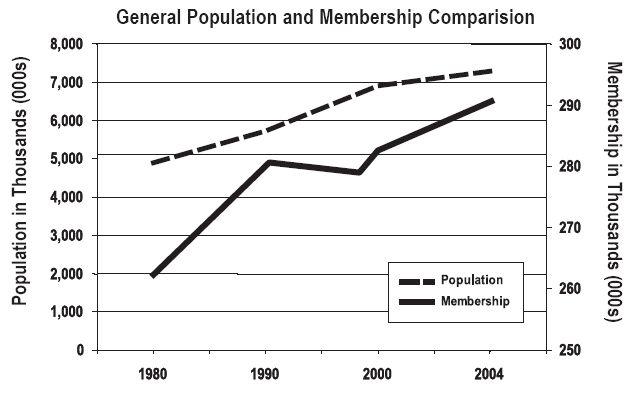
The second graphic in the Pre-Conference Journal aims at the heart of the problem we’re facing. The population of out part of the state continues to rise – and we’re not keeping up. The graph included in the report might lead one to believe we’re doing ok.

A careless reader would look at 1980 and see a big gap between membership and population and then look at 2004 and see a much smaller gap. How many people will notice that the scale for each line is quite different – one (the Population) varying by 1,000,000, the other (Membership) by 10,000? Is our general math literacy better than has been reported?


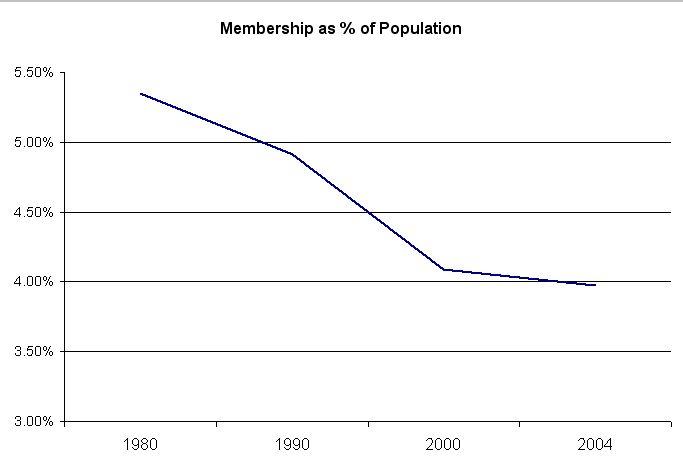
Let’s look at the same numbers differently. This figure graphs the percentage of the population reflected in the membership of the church. I believe this depicts the decline much more clearly.

Posted in Uncategorized | Leave a comment

Texas Conference Population Growth


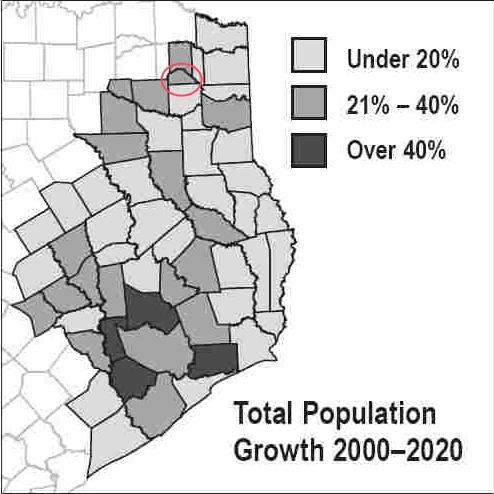
The Pre-Conference Journal for our upcoming special session is now available online. Over the course of several posts I will be commenting on the proposals we’ll be addressing. The first graphic in the presentation is a map showing the counties contained within the TAC. To my surprise Camp County (the county we’re in – circled on the map to the left), the third smallest county in Texas, is projected to grow 21% – 40% by 2020. Growth in Upshur, Smith & Gregg counties, wouldn’t suprise me – but they’re not projected to grow as much as we are.

If these statistics are correct, we will have to work harder to be ready for growth. As United Methodists we’ll need to find better ways to accommodate growth and change. SOunds good to me.

Posted in Uncategorized | Leave a comment

Thinking About Proposition 2

Marriage will be on the ballot election day in Texas. Proposition 2 reads:

“The constitutional amendment providing that marriage in this state consists only of the union of one man and one woman and prohibiting this state or a political subdivision of this state from creating or recognizing any legal status identical or similar to marriage.”

If all we’re doing is saying that marriage is between a man and a woman, and that any other pretended acts of marriage, whether polygamous or same-sex or multi-species (or whatever) are not to be considered marriages in the State of Texas, it would seem fairly obvious.

But not much is obvious any more.

The Texas Conference Board of Church and Society has come out against the proposition, seeing it as being in conflict with the civil rights the church believes people are due. I’m not at all surprised the BCS would take such a stand. In my experience they’re usually against the idea that homosexuality is a sin. They have not yet (fortunately) succeeded in changing the United Methodist position, however.

For different reasons I’m uneasy about the Proposition. I have no doubt marriage should be between a man and a woman. I don’t think marriage is a civil right – though civil society has long claimed jurisdiction over marriage. I’m uneasy with the proposition that law should (or can) cover everything. Since our legal culture has decided that the State – the maker, implementer and judge of the law – is to be completely secular, I don’t want to surrender any more power to the State than it already has.

By forcing the legal issues, we’re put in the position of appearing to say EITHER marriage is a legal relationship only between a man and a woman OR marriage is a legal relationship between any two (or more?) individuals who are (currently) lovingly committed to each other. As one who supports a traditional understanding of marriage, I’m not sure what to do in a situation where I seem to be forced to choose between two evils – the complete transfer of marriage to the arena of law or the denial of the traditional concept of marriage.

Any ideas?

Posted in Uncategorized | Leave a comment