Are we running out of Church in the US?

Tertullian wrote, in the second century, that “the blood of the martyrs is the seed of the church.” If this is so, what are we to make of the Church in the United States, that suffers no martyrs?
Posted in Uncategorized | 2 Comments

On Not Answering Questions

Have you ever noticed that our elected representatives aren’t very good at responding to questions? At least not answering questions they themselves haven’t proposed. Here’s the response I go to my recent letter to Senator Kay Bailey Hutchison:

Dear Dr. Heyduck
Thank you for contacting me regarding Hurricane Katrina. I welcome your thoughts and comments on this issue.
In the midst of this tragedy, my heart has been warmed by the many Texans who opened their arms and their homes to our fellow Americans. Approximately 80% of the city of New Orleans has been covered in water, and thousands of people suddenly found themselves homeless with nowhere to turn. Flood waters in Alabama left 325,000 homes and businesses without power. In Mississippi, hundreds of waterfront homes, businesses and community landmarks were obliterated by a storm surge that reached 30 feet. In the wake of this, I am proud of how our state has responded.
Thanks you for taking time to write your suggestions regarding the current relief efforts. While we cannot undo the losses to the victims of this devastation, working as a nation we can help them to regain some sense of normalcy in their lives.
I appreciate hearing from you and hope that you will not hesitate to keep in touch on any issue of concern to you.

I’d written Senator Hutchinson asking about what adjustments in the Federal Budget she’d be proposing to cover the expenses of Hurricane recovery. I guess she didn’t want to answer that question.

Posted in Uncategorized | 5 Comments

Milwaukee, we have a problem

Major League Baseball needs a real Commissioner. Not just an owner of one of the teams who is willing to make an appearance at it. The fact that the Milwaukee Brewers are not in the World series proves this point.

Though the Brewers are not in the World Series apparently hasn’t occurred to “Commissioner” and Brewers owner Bud Selig.

Minute Maid Park, the homefield of the Houston Astros, was built with a retractable roof. Selig’s office determined that the roof would be open for the World Series games to be played in Houston this week.

Was it Selig’s call? According to the rules of MLB, yes. But was Selig in a position to make the call? I don’t think so.

Commenting on his decision about the roof, Selif said, “We’ve studied weather, winds, we’ve studied humidity. There isn’t a cloud within 800 miles of here. In Milwaukee, you don’t get a day like this until July Fourth.”

I’ve got news for you, Mr. Selig: this game wasn’t played in Milwaukee. This game was played in Houston.

The Houston Astros ought to be able to configure their stadium as they see fit.

After all, the Milwaukee Brewers aren’t in the World Series.

Posted in Uncategorized | 1 Comment

General Population to Membership Comparison

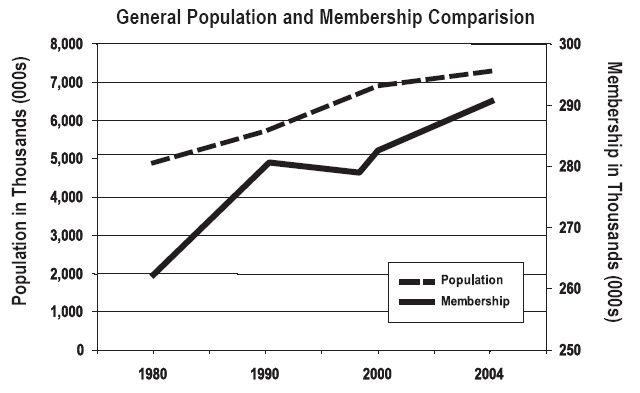
The second graphic in the Pre-Conference Journal aims at the heart of the problem we’re facing. The population of out part of the state continues to rise – and we’re not keeping up. The graph included in the report might lead one to believe we’re doing ok.

A careless reader would look at 1980 and see a big gap between membership and population and then look at 2004 and see a much smaller gap. How many people will notice that the scale for each line is quite different – one (the Population) varying by 1,000,000, the other (Membership) by 10,000? Is our general math literacy better than has been reported?


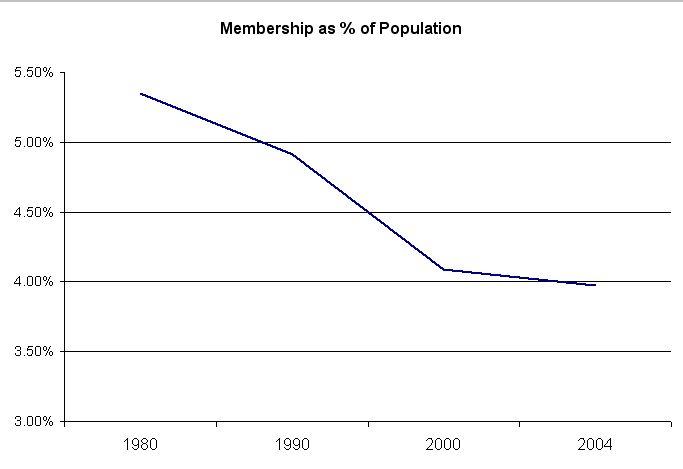
Let’s look at the same numbers differently. This figure graphs the percentage of the population reflected in the membership of the church. I believe this depicts the decline much more clearly.

Posted in Uncategorized | Leave a comment

Texas Conference Population Growth


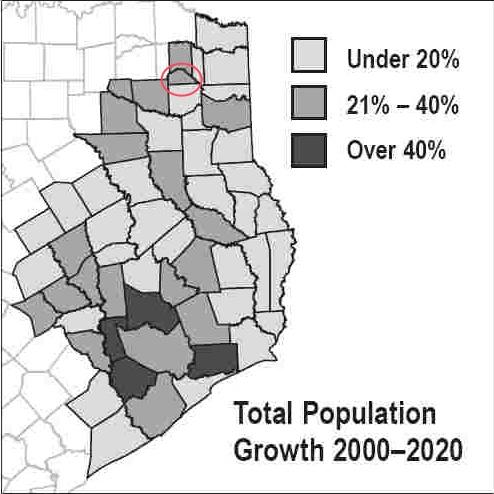
The Pre-Conference Journal for our upcoming special session is now available online. Over the course of several posts I will be commenting on the proposals we’ll be addressing. The first graphic in the presentation is a map showing the counties contained within the TAC. To my surprise Camp County (the county we’re in – circled on the map to the left), the third smallest county in Texas, is projected to grow 21% – 40% by 2020. Growth in Upshur, Smith & Gregg counties, wouldn’t suprise me – but they’re not projected to grow as much as we are.

If these statistics are correct, we will have to work harder to be ready for growth. As United Methodists we’ll need to find better ways to accommodate growth and change. SOunds good to me.

Posted in Uncategorized | Leave a comment

Thinking About Proposition 2

Marriage will be on the ballot election day in Texas. Proposition 2 reads:

“The constitutional amendment providing that marriage in this state consists only of the union of one man and one woman and prohibiting this state or a political subdivision of this state from creating or recognizing any legal status identical or similar to marriage.”

If all we’re doing is saying that marriage is between a man and a woman, and that any other pretended acts of marriage, whether polygamous or same-sex or multi-species (or whatever) are not to be considered marriages in the State of Texas, it would seem fairly obvious.

But not much is obvious any more.

The Texas Conference Board of Church and Society has come out against the proposition, seeing it as being in conflict with the civil rights the church believes people are due. I’m not at all surprised the BCS would take such a stand. In my experience they’re usually against the idea that homosexuality is a sin. They have not yet (fortunately) succeeded in changing the United Methodist position, however.

For different reasons I’m uneasy about the Proposition. I have no doubt marriage should be between a man and a woman. I don’t think marriage is a civil right – though civil society has long claimed jurisdiction over marriage. I’m uneasy with the proposition that law should (or can) cover everything. Since our legal culture has decided that the State – the maker, implementer and judge of the law – is to be completely secular, I don’t want to surrender any more power to the State than it already has.

By forcing the legal issues, we’re put in the position of appearing to say EITHER marriage is a legal relationship only between a man and a woman OR marriage is a legal relationship between any two (or more?) individuals who are (currently) lovingly committed to each other. As one who supports a traditional understanding of marriage, I’m not sure what to do in a situation where I seem to be forced to choose between two evils – the complete transfer of marriage to the arena of law or the denial of the traditional concept of marriage.

Any ideas?

Posted in Uncategorized | Leave a comment

The laugh is on whom?

We had a spirited discussion this past Wednesday at our Bible Study. Like I have done many times, I welcomed those present to discuss with me how we ought to interpret Jesus’ statement in Matthew 5:48 (Be therefore perfect, even as your heavenly Father is perfect.”

You see, adding words like “strive” or “do your best” don’t cut it. They don’t cut it simply because those words aren’t there.

But everyone knows, they always tell me, no one is or can be perfect. I challenge this assumption, and someone in the room automatically assumes I am thus declaring myself perfect. I am not; it’s just that I can’t imagine Jesus telling us to do something that we can’t do.

So, the morning following this great, lively discussion, I heard someone telling a friend about it. “Steve actually believes we can be perfect,” he said, half chuckling, half still in shock. The friend shared the humorous disbelief that I would make such an assertion.

I suppose they had a nice little chuckle. I can’t help but wonder what has happened to the church that laughs at the idea of taking Jesus at his word.

Posted in Uncategorized | 1 Comment

Inconvenient People

This past Sunday was Children’s Sabbath at our church. The Children’s Defense fund put out tons of material including statistics about the condition of children in America. Of all the statistics to choose from, they published the bad news. Here’s a sampling, under the heading Each Day in America:
4 Children are killed by abuse or neglect
8 Children or teens are killed by firearms
77 Babies die before their first birthday
177 Children arrested for violent crimes
390 Babies born to mothers who received late or no prenatal care
2076 Babies born without health insurance
2385 Babies born into poverty
3742 Babies are born to unmarried mothers

Instead of merely listing bad stuff – with the suggested idea that we need a bigger government to do something about IT – why not give a truer picture and list some positives? How many children are involved in Scouting programs every day? How many are staying in school and doing well? How many are visiting or volunteering in nursing homes, hospitals and the like?

Obviously, many children do have difficult lives. I challenged my people Sunday to consider Jesus’ relativisation of family and take responsibility for children who are not their own in a biological sense. That was Augustine’s motivation for suggesting Christians not have children: there are already enough people to evangelize without bringing more into the world (and that was in the 4th century).

I also added another statistic – I couldn’t find it anywhere on the Children’s Defense site so I had to go elsewhere for the data: Every day in America 3200 babies are aborted. This wasn’t what Augustine had in mind when he talked about already having enough people. In fact, the early generations of Christians stood against the pagan practice of exposing “extra” or unwanted children (to the elements and predators). The first Christian admonotion against abortion dates from the second century (unless you want to date the Didache earlier).

Patricia Bauer writes in the Washington Post about the contemporary “responsibility” to abort “defective” children. Since we have plenty of genetic tests today (part of the routine prenatal care many women lack?) that allow us to identify many of the defects of our children, we can make the choice to deliver them from certain suffering by killing them now. Bauer says that when people discover she has a daughter with Down Syndrome they tend to have one of two responses. They either assume that she didn’t have the proper testing before her daughter was born or that she is a raging fundamentalist pro-lifer.

Curiously, Bauer reports that her daughter’s life has not been filled with suffering. Of sure, she has challenges. Many things we take for granted are difficult for her. But much of the suffering she encounters is from living in a society that labels her defective and pronounces her “better off dead.”

We talk about wanting to put people “out of their misery.” What we too often mean by this is more akin to putting people “out of our misery.” We don’t want to look at suffering or be reminded of imperfection. We don’t want to experience the awkwardness of having to interact with “those kind of people.”

It’s just too inconvenient.

UPDATE: Here’s some comment on the article from someone who has been through the joys of genetic counseling.

Posted in Uncategorized | 1 Comment

Unifying vs. Divisive

In today’s column on Harriet Miers, David Brooks includes this comment on the difference between Rebublicans and Conservatives:

You know you are in establishment Republican circles when the conversation is bland but unifying. You know you are in conservative circles when it is interesting but divisive.

When applied to United Methodists, I’m inclined to think “establishment Republican” could be replaced by “establishment Methodist” (or Moderate) and at least in some cases UM liberals could be lumped in with the conservatives for generating “interesting division.”

Posted in Uncategorized | Leave a comment

ATS: fact or fiction?

I am at Asbury Theological Seminary this week for a gathering of the Alumni Leadership Community. I attended Asbury from 1985-89, when I graduated with an M.Div. degree. Those four years were among the most important in my life in forming me and preparing me for ministry.

I found the academics challenging, the worship energizing, and the community healing and supportive.

You can imagine my dismay at hearing that there are “leaders” in the Central Texas Conference of The United Methodist Church who tell ministerial candidates that “if you go to Asbury you will never get a good church in this conference.”

Would you “leaders” like to tell the churches to which I have been appointed they are not considered good churches? Would you at least explain to me, and to my face, why it is you say such things?

Ironically, it is often Asbury alumni who are accused of being exclusive and narrow-minded.

Posted in Uncategorized | 5 Comments