Two Commissions Coming out of the 2016 General Conference

Anyone who has been following GC news knows about the commission that will be studying issues of “human sexuality.” In the post-GC letter from the Council of Bishops  this is referred to as “a way forward, postponing decisions about sexuality matters and committing to having a different kind of global conversation that allows all voices to be heard.”
 
Something else mentioned in the letter, an item I never noticed in the reporting from GC, was (again using the language found in this link) a “churchwide study on our ecclesiology.” Here’s the language from the DCA:
482-FO22-R9999-A-G
Subject: Study of Ecclesiology
Petition: 60033-FO-R9999-G
Membership: 73; Present: 67;
For: 62; Against: 0; Not Voting: 5;
Date: 5/14
The Petition is amended by substituting with the following:
The Committee on Faith and Order proposes a period of study to stimulate and aid
theological reflection throughout the church on the identity and mission of The United Methodist Church. The Study and response process in the coming quadrennium will involve these elements:
1. A teaching document on ecclesiology will be made available electronically through
http://www.umc.org, http://www.gbhem.org, and http://www.gbod.org along with a brief study and response guide to facilitate study of the document. These documents will be translated into the language of the General Conference.
2. Each resident bishop will be asked to arrange for congregationally-based studies of
United Methodist ecclesiology between June 2016 and December 2017 involving approximately ten percent of both the laity and clergy of her or his episcopal area. Resources for the study will be provided by the Committee on Faith and Order.
3. Responses will be solicited from specific groups who may have particular expertise
in ecclesiology, including: faculty from United Methodist seminaries and schools of theology, general agency staff, pan-Methodist theologians and officials; and other selected ecumenical partners.
4. All United Methodists will be invited and encouraged to offer feedback on United
Methodist ecclesiology.
5. The Committee on Faith and Order will design processes to solicit and receive these
responses.
6. The Committee on Faith and Order will be responsible for evaluating the study process, considering the responses received, and will offer appropriate action to the 2020 General Conference. The Committee on Faith and Order will send to the 2020 General Conference a theological teaching document on ecclesiology for adoption as an official document of the church, comparable to By Water and the Spirit and This Holy Mystery.
 
I don’t know what is intended in this “study on our ecclesiology.” It may be that it is only aimed at indoctrination – something like, “Here is our ecclesiology, now you have a document you can study to learn about it.” On the other hand, it could be a work in constructive theology, studying scripture and tradition to discern where our thinking and practice with regard to ecclesiology should go.
 
We’ve been strong on polity (Methods!) – so strong that our polity has often substituted for deep work in ecclesiology. Yet it is exactly such deep work that the other more famous commission will require if it is to do more than just go with the cultural flow and the “demands of our age.” I’m hoping and praying someone will make the connection.
Posted in Doctrine, Ecclesiology, United Methodism | Tagged , , , | Leave a comment

The Context of Knowing

When I look at the current landscape of United Methodism in America (and beyond this ecclesial context), one of the divisions I see is about where our concepts find their definition. We Methodist Christians have some important vocabulary, mostly shared with other Christians. Concepts central to our way of talking include things like God, Love, Spirituality, Justice, and Peace. At least some of these, Love and Justice seem to be at the fore these days, are particular flashpoints for us.

How do we know what these words mean? One way to approach the definition of these terms is to burrow into the scriptures and the Christian tradition. When we examine those sources we find significant use of these terms and their cognates. We see them fleshed out in various ways over the last few millennia.

Another way to understand these words is in terms of our culture. These words all have a meaning in our culture (and except for Spirituality, have long histories of use). When we look at our culture we see a multiplicity of ways in which these words are used, with perhaps one or two uses coming to the front as most important.

If we take this second approach, a possible strategy is to say, “We already know what these words mean. When we turn to the Christian tradition we may or may not find them illustrated or instantiated.” Culture, for example, tells us the meaning of “God.” God is the supreme being, that which is of ultimate concern. When we turn to the Bible, we see that the God of Israel (in the Old Testament) and the God of Jesus (in the New Testament) are illustrations or manifestation of this god we know as “supreme being” or “ultimate concern.” We do not require the Bible or the Christian tradition to tell us about this god. This god has already made this god known to all people, to at least some degree.

One might take this approach with the other concepts mentioned. Our culture already knows what “justice” is. When we look at the Bible, both Old and New Testaments, we see a recurring concern for justice. At least sometimes the justice of the Bible matches up with our current understanding of the term.

At the point we can make a chronological assessment. History is going somewhere – it is going forward, it is advancing. It is obvious that we know more now than did our ancestors. We need go no further than the massive advances in science, though we can also point to advances in morality. Where the ancients, including those in the Bible, once put forward admonitions like “eye for an eye, tooth for a tooth,” we now recognize that as barbaric. We now know better than they did then.

That these two basic approaches exist is by no means new. In the late 18th century Friedrich Schleiermacher wrote a series of “speeches” to the “cultured despisers” of Christianity. They had taken the position that their generation, so far advanced in reason as it was, had advanced beyond the need for religion. Religion was for the primitives, the uneducated, the non-rational. Modern and rational people could not take it seriously. Schleiermacher (and later those who came in the tradition stemming from his work) asked them to hold up. The very values his enlightened friends took up, were the same values of the Bible. If they examined the Christian tradition the right way, they would find those values and truths illustrated there.

The Schleiermacherian position has not gone unchallenged. Most famously, Karl Barth subjected it to his general criticism of natural theology. Barth took a version of the first position I mentioned above. For Barth, we could not know God apart from revelation. We could not even know the meaning of God (if we can speak of God having a “meaning”) apart from God’s self-revelation. He would not allow that we bring to our study the concept – or even the question – of God, and then find that god instantiated in the Bible or Christian tradition.

We can imagine the same approach with regard to the other concepts I mentioned above. Following the Barthian track, we do not know what Love, Justice, Spirituality, or Peace are, apart from revelation, apart from the Christian tradition. Without deep centering in the Christian narrative and tradition, each of these remains an abstraction of vastly variable meaning.

Though our current United Methodist conflicts are ostensibly about other subjects, I believe this division lies, if not at the core, very close to it. Yet it is mostly unacknowledged. Those who adhere to the first position will say that those who hold to the second need to read their Bibles and the Christian tradition more carefully. But they are, at least for the most part, reading their Bibles and consulting the tradition. From what I see, however, they cannot imagine that meanings of these terms can find their ultimate rootings in ancient texts and the ancient (and unenlightened) cultures that produced them. On the other side, those who adhere to the second position, say that if the other side would read their Bibles properly, they’d see how important Love and Justice (in particular) are, and stop denying them to so many people.

If you’ve been following the discussion (heated arguments?), then you can see that I’m coming down with those who see the dividing issue as primarily hermeneutical. I differ from some, though, in that I don’t think it is the interpretation of particular texts that divides us (though they do) as much as it is the way our hermeneutical approaches (I use “approaches” rather than “theories” because I think the difference is more visceral than intellectual) to texts, concepts, and the cultures where they are found and where we live.

I realize I have not offered any solutions here. I don’t have any. But maybe I’ve shed a tiny bit of light.

Posted in Culture, Current events, Doctrine, Ecclesiology, Hermeneutics, United Methodism | Tagged , , , | Leave a comment

Fixing Politics?

I’ve heard many pine for a better practice of politics in our society. They’re tired of the gridlock, the bickering, the constant attacks. They want to make progress on issues that “concern us all.”

David Brook’s recent column is along these lines. He starts off with what he calls the “elite solution:”

The next president could get together with the leaders of both parties in Congress and say: “We’re going to change the way we do business in Washington. We’re going to deliberate and negotiate. We’ll disagree and wrangle, but we will not treat this as good-versus-evil blood sport.” That kind of leadership might trickle down.

Some of us are attracted to this kind of solution. We hunger for a fixer, nay, a Messiah, who will come and straighten us out through the use of charismatic authority and wisdom mixed with inherent goodness. I think that’s what Brooks hoped for from our current president. However much we want that kind of leader, and both parties offer fixers from time to time, it’s a dream that passes the buck.

Brooks continues:

In healthy societies, people live their lives within a galaxy of warm places. They are members of a family, neighborhood, school, civic organization, hobby group, company, faith, regional culture, nation, continent and world. Each layer of life is nestled in the others to form a varied but coherent whole.

I don’t know about calling these “warm places,” but that might just be due to my aversion to sentimentality. This minor complaint aside, Brooks is on track here. We do find ourselves inhabiting many sizes and types of overlapping community. By connecting to people in this multiplicity of contexts, we get a sense of “home.”

But the rot set in mid century, just after World War 2, when individualism took over. The desires, wants, opinions of the individual took precedence over any group, displacing multiple forms of traditional community – and the forms of authority that bound them together. As individuals, the most important thing became our rights.

Brooks addresses this pathology through the work of Marc Dunkelman, though he could have done so by looking at Robert Putnam’s classic Bowling Alone. But he’s done that before; it’s time now for a different approach.

He applies Dunkelman’s idea of the collapse of “middle ring relationships:”

With fewer sources of ethnic and local identity, people ask politics to fill the void. Being a Democrat or a Republican becomes their ethnicity. People put politics at the center of their psychological, emotional and even spiritual life.

This is asking too much of politics. Once politics becomes your ethnic and moral identity, it becomes impossible to compromise, because compromise becomes dishonor. If you put politics at the center of identity, you end up asking the state to eclipse every social authority but itself. Presidential campaigns become these gargantuan two-year national rituals that swallow everything else in national life.

Yes, we’re stuck with the individual and the state. The desiring individual and the state that proclaims and defends the rights of that individual crowd out the institutions in between. All those institutions, from family, to marriage, to church, to union – and onward – all are oppressive in some way, putting limits on the freedom of the individual. With the accumulation of power at the top, getting to the top and maintaining power there counts for more and more. The Supreme Court has come to matter so much because the justices alone have the authority to override the non-functional legislative branch and enact new rights for individuals.

Brooks concludes:

If we’re going to salvage our politics, we probably have to shrink politics, and nurture the thick local membership web that politics rests within. We probably have to scale back the culture of autonomy that was appropriate for the 1960s but that has since gone too far.

I’m more pessimistic than he is. I think the rise of the individual (over the past 500+ years) has become a juggernaut. We cannot even conceive of setting our individualism aside, even as our other cultural institutions are falling away. Our two major political orientations are both rooted in individualism, though they tend to emphasize different flavors thereof. A third orientation, libertarianism, is more radical still, in its extreme form, cutting off all but the individual. It will take either some sort of cataclysm to change things.

Some – in related contexts – have hoped for a “Benedict Option” – drawing from MacIntyre’s suggestion in After Virtue.  Others have decried this as an ill-conceived withdrawal from society. I’m not a fan of withdrawal, but I’m not seeing anything that convinces me that one can play the game without being co-opted.

What do you think?


Posted in Culture, Liberalism, Politics, Social Capital | Tagged , | Leave a comment

Christian Politics

We’re in a season where American Christians are thinking about politics. Well, maybe not. Maybe it’s truer to say we’re in a season where the politics of the current American polarizations have colonized Christian minds. Candidates and their flunkies are assuring us of the horrors that will come if their messiahhood is not affirmed by the electorate. As a result, we obsess: is the country – maybe the world – coming to an end?

Christianity is an intensely political phenomenon. Its politics has nothing to do with the politics of Democrats and Republicans (or Socialists or Libertarians), conservatives or liberals. That confuses us, because we haven’t been trained to think of politics in Christian terms, only American terms, so the polarities that we see in America have infiltrated the American church. If we’re political and Republican, we assume that the Republican platform (and candidates) represent the Christian faith. Likewise, if we’re political and Democratic, we assume that the Democratic platform (and candidates) hew most closely to the Christian faith. All the while we avoid thinking Christianly.

One of the books I’m currently reading is Michael Budde’s The Borders of Baptism. His overall thesis is that baptism is the initiatory rite into the Christian polis, and thus the sign that marks the borders for our politics. He quotes Joyce Salisbury:

“Christians were perceived by their pagan neighbors to be antisocial in the deepest meaning of the word. They were creating their own society within the Roman one, and their loyalties were to each other rather than to the family structures that formed the backbone of conservative Roman society. Their faith led them to renounce parents, children, and spouses, and Romans believed this actively undermined the fabric of society. In fact, it did.”

Can American Christians today dare to be considered antisocial? Can we even contemplate “undermining the fabric of society?”

When we think of these things, we stand aghast. Being antisocial is the last thing we would want to do. Undermining the fabric of society, that’s what those people in that other party are doing. We are the ones standing for the true promise of America, the true republic our founding fathers dreamed of and enshrined in the Constitution.

Perhaps we recoil at this subversive language because we hear it as preaching anarchy. While a few, when feeling the oppressive force of extreme archy (or, more commonly, merely finding that they aren’t allowed to do everything they want to do), think anarchy would be a good thing, most intuit the destructive and death-dealing forces that accompany it. We cannot fathom a Christianity that could be true to itself that would advance anarchy.

But when Christians like Budde and Salisbury talk this way, they’re not advocating anarchy. Like the early Christians, they aren’t saying, “Caesar is a menace, Roman culture is bankrupt, we prefer barbarism!” The first thing we intend to say is, “Jesus is Lord.” The necessary implication of the lordship of Jesus is the non-lordship of Caesar, whether we take Caesar in his ancient Roman guise or in contemporary political garb. The early Christians had the advantage over us that Roman society at large, to the degree they even knew about Jesus, knew him to be a messianic pretender, a crucified criminal. Now at least the non-Nietzscheans among us consider Jesus a great (and harmless) guy, ready for co-opting by our political movements.

Can American Christians remember Matthew 6:33 – “Seek first the Kingdom of God and his righteousness?” If we can remember that, can we recenter our lives so that we’re not filled with elation when our current chosen Caesar-wannabe is leading in the polls – or filled with despair when our Caesar is failing?

Two signs (there are more, but I want to keep this short) in our culture give me pause when I hope for a recovery of a Christian politics. Both have to do with our failure to relate to people as Jesus teaches.

First, the survival of any form of racism among Christians demonstrates our ignorance of the force of baptism. If baptism is only “my personal profession of faith in Christ,” or “my being marked as belong to Christ for eternity,” we will fail to develop a truly Christian politics. How can white churches and black churches stand apart as we do? How can we not care when our brothers and sisters are suffering and feeling excluded? To use a favored American analogy, how can we fail to see that we’re on the same team? And yet when we fail to even talk to each other or to build intimate bonds of fellowship, we are, in effect, sabotaging our own teammates.

Second, and looking outward where my first point looked inward, how can fear and caution be our primary motivation in relating to Muslims? A Christian who knows anything about the history of the effort to take the good news of Jesus to all nations, anything about geopolitics and international affairs, knows that the countries that are the current centers of Islam are not friendly to Christian missionary work. Here we are, called to make disciples of all nations, and American allies like Saudi Arabia won’t even allow Christians to bring personal Bibles into the country. We see the death-dealing chaos emanating from Syria, we see the floods of refugees, and our first thought is, “What if ISIS miscreants are hiding themselves among those fleeing the war? We need to be keep ourselves and our families safe. It is our Christian duty.” If we’re going to allow any of those people into our country, we want to make sure Christians are at the front of the line.

I get this. I want to stand in solidarity with persecuted Christians around the world. I want to see them and their families living in peace and safety.

But have we forgotten the doctrine of providence? Here’s Jesus, the very Jesus we say is Lord, commanding us to make disciples of all nations. There are some nations we can’t get into. Perhaps some of us sigh, thinking, “Oh well, I guess we can’t go to those places. Jesus’ command will have to wait until it’s safe for us to go.” Can it be that God heard our prayers of excuse and said, “Ok, if you can’t go to them, I’ll send them to you!” Can it be that God is the one who is leading millions of Muslims into lands where Christians live, specifically so they can see and hear the good news of Jesus? Yet because our politics are American before they’re Christian, we have trouble imagining such a thing.

As long as the fabric of society is oriented around something other than Jesus, my calling, my mission, is to join the first followers of Jesus in their politics. Their politics was not violent, coercive, or bombastically defiant. They quietly went about defining their life together in terms of the Lordship of Jesus, blissfully (yet carefully), ignoring the demands of Caesar.

Posted in Bible, Church & State, Clash of Civilizations, Culture, Current events, Ecclesiology, Politics, Uncategorized | Tagged , , , , , | Leave a comment

Jesus’ Stories

Jesus told stories to (a) show people what the Kingdom of God was like, and (b) move that Kingdom forward. Following his lead, we commonly call these stories parables.

Each parable tells us something important about the Kingdom. That is pretty clear. Each parable on its own, however, does not tell us everything about the Kingdom.

If you’re a preacher, teacher, or some other communicator, you know the problem. You have a big, complex message to get across. Getting it across matters. But you can’t say everything at once. We communicators take the risk every time we speak that our audience will take the small bit we can say while we have their attention right now for the whole of what we think needs to be said.

Some are excited by the little bits they hear. They latch on to the bit we’ve spoken, taking it as congenial with their own current beliefs and desires, and run with it. We’re on their side! Jesus had this problem in John 6. At the beginning of the chapter Jesus tells the people to sit down and eat. He feeds five thousand with only a few loaves and fishes. They’ve heard part of Jesus’ message of the Kingdom. They think “free food!” is all it’s about. By the time he has a chance to tell them more, most have left him, disillusioned.

Sometimes things work the other way. We speakers say something and the very first thing we say is rejected. Maybe it’s not just judged wrong, but it taken as a deep offense. Jesus runs into this in John 8. He starts with the innocuous, “You shall know the truth and the truth shall make you free,” and by the end of the chapter they’re ready to kill him.

We just can’t say everything at once. We finite followers of Jesus can’t do it. Jesus, God in the flesh, couldn’t do it.

So what are we to do if we want to get Jesus right? We listen to each story, one at a time. And we keep listening. Only as we keep listening will we get any where near hearing the whole message.

Posted in Bible, Jesus, Preaching, Uncategorized | Tagged , , , | Leave a comment

Atheism in the Church

The Christian church in America has enough of a problem with practical atheism, the phenomenon of saying we believe in God while living as if there is no God.

We also have a problem with clergy who have invested piles of money and years of their lives (sometimes decades) preparing for professional ministry, who come to a place where they discover they no longer believe. As to their career, they have huge sunk costs. They need to make a living and support their families. So they put on the act, and continue fulfilling the professional aspects of ministry, pretending the faith.

Now we have openly professing atheist pastors who not only take umbrage at the suggestion that their atheism could in any way disqualify them for ministry, but even seek to spread their “gospel.”

In an interview, Toronto pastor Gretta Vosper, after identifying herself as a non-believer in God, answers a question about her alternatives:

Wouldn’t an atheistic community be a better fit for you?
No. I want the United Church to accept that the Bible is not the authoritative word of God and that God is not where moral authority resides, and to recognize the innumerable divisions religion has created across millennia.

It sure looks like Rev. Vosper is wanting her denomination to support her effort to transform the church into her own image and likeness. Sounds like a sure way to kill a church.


Posted in Culture, Current events, Theology | Tagged , | 1 Comment

Wesley on Preaching Law & Gospel

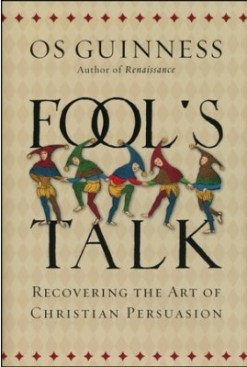
Fools TalkOne of the books I’m reading is Fool’s Talk by Os Guinness. It’s a good book for those involved in the work of apologetics. I want to be a little picky, however. He says at one point, ‘As John Wesley advised his young preachers in his day… “Preach the Law until they are convicted, then preach Grace until they are converted.”’

Methodists who know anything about Methodism will know Wesley preached grace. Methodists who have actually read Wesley know that he also valued preaching the law. This “quotation,” however, doesn’t reflect Wesley’s actual practice or teaching (sounds more like Luther to me). Here are some statements where Wesley brings the two together:

I think, the right method of preaching is this: At our first beginning to preach at any place, after a general declaration of the love of God to sinners, and his willingness that they should be saved, to preach the law, in the strongest, the closest, the most searching manner possible; only intermixing the gospel here and there, and showing it, as it were, afar off.

After more and more persons are convinced of sin, we may mix more and more of the gospel, in order to “beget faith,” to raise into spiritual life those whom the law hath slain; but this is not to be done too hastily neither. Therefore, it is not expedient wholly to omit the law; not only because we may well suppose that many of our hearers are still unconvinced; but because otherwise there is danger, that many who are convinced will heal their own wounds slightly; therefore, it is only in private converse with a thoroughly convinced sinner, that we should preach nothing but the gospel. (Works of John Wesley [Jackson Edition], 11:486-6)

He continues a couple of pages later in the same volume:

Not that I would advise to preach the law without the gospel, any more than the gospel without the law. Undoubtedly, both should be preached in their turns; yea, both at once, or both in one: All the conditional promises are instances of this. They are law and gospel mixed together.

According to this model, I should advise every Preacher continually to preach the law; the law grafted upon, tempered by, and animated with, the spirit of the gospel. I advise him to declare, explain, and enforce every command of God; but, meantime, to declare, in every sermon, (and the more explicitly the better,) that the first and great command to a Christian is, “Believe in the Lord Jesus Christ;” that Christ is all in all, our “wisdom, righteousness, sanctification, and redemption;” that all life, love, strength, are from him alone, and all freely given to us through faith.

The “preach the law and THEN only AFTER they’re convicted, preach grace,” is NOT the John Wesley methodology. It is that form of preaching that inclines us to read the New Testament and frame the doctrine of soteriology in terms of “plight to solution” reasoning. I’m not enough of a Wesley scholar to have investigated his analysis of plight and solution in salvation, but his theory of always combining law and gospel/grace in preaching shows that at least as far as communication strategy goes, the two are not best understood simply sequentially, as if we can truly grasp our plight without simultaneously hearing the solution.

Posted in Evangelism, John Wesley, Preaching, Salvation, Theology, Uncategorized | Tagged , , | Leave a comment

Jesus Welcomes You to __________

JesuswelcomeshawkinsHawkins, a town not to far from us, hit the news a few months ago when some started protesting a welcome sign. It wasn’t just a “Welcome to Hawkins” sign like you might expect to see in a small town. This one said, “Jesus Welcomes You to Hawkins.” The controversy was about whether such a sign was a breach of proper church/state separation etiquette.

I’m not really concerned about church/state separation issues here. As far as that goes, if some citizens of town decide to put up a sign that says, “Jesus Welcomes You to <Our Town>,” my first thought is positive. Maybe my fellow Americans haven’t forgotten Jesus altogether. In fact, as I drive to church each Sunday I pass through two other towns that feature similar signs.

I do feel uneasy about the signs, however, and am reluctant to put up a similar sign in my town or in the town in which I pastor. My uneasiness is not rooted in a lack of devotion to Jesus. Rather, I’m doubtful that we can live up to the message we’re giving in Jesus’ name.

What do people think when they come to a town and are greeted by Jesus himself? Will they be looking for people to act like Jesus? Represent him accurately? I don’t want people to hear the greeting and then judge Jesus in terms of what they see of our sin. I don’t want to be a part of turning people away from Jesus.

There is no biblical precedent for Jesus welcoming people to a particular town. In the years of his ministry that we see in the gospels, we see a man who was mostly homeless, wandering from town to town telling of the good news of the Kingdom. In some places he found a welcome; in others not.

Instead of welcoming people to a town or place, Jesus welcomed people to himself. He said, “Come unto me, all who are weary and heavy laden, and I will give you rest.” If I were to put up a “Jesus welcomes” style sign, that’s the kind of message I’d put up. I don’t want people to get the idea that we’re representing ourselves as especially holy or spiritual. We’re not. But we can extend Jesus’ invitation to himself, and welcome people to follow him with us.

Posted in Jesus | Tagged | Leave a comment

Dual Relationships

One of the books I finished last week was http://www.amazon.com/Emotionally-Healthy-Leader-Transforming-Transform/dp/0310494575/. You can read my review at NetGalley.

Scazzero suggests that one of the practices that helps leaders be more healthy is to minimize “dual relationships.” While the term might not be familiar, the reality likely is. A dual relationship is one where we have two kinds of relationship with the same person. For example, as a pastor, I might also be a friend to a staff member or parishioner. As a neighbor, I might also be a customer of the family next door.

Dual relationships create complexity and sometimes trouble. As the leader of an organization, I might need to take action to end the employment of a friend. And what about a family member? If a member of my family works for me, how do I balance the duties that come with my familial relationship with my duties to the organization I lead? Such conflicts often lead to emotional disturbance and even paralysis. To the degree that we want to minimize emotional disturbance and be free to act in the best interest of our institutions, we’re best off minimizing dual relationships.

Taking dual relationships to be a problem arises in modern society, particularly in more populous settings. In the big city (Scazzero lives and works in New York City, though cities a fraction that size face the same realities), differentiation is the norm. In large population areas we usually relate to people in simple relationships. The people we do business with are only the people we do business with. Otherwise they are strangers.

In small towns and in traditional communities, however, dual – and even multiple – relationships are unavoidable. Networks of relationship, whether kinship, business, church, or school, tie most people together. Conflicts of interest become ineliminable.

If we are best off avoiding dual relationships, then we are also best off keeping everyone at a distance, encouraging others to remain strangers. In some ways that might make Jesus’ command to “love our neighbor as ourselves” easier. Everyone is a stranger to us, so we love each stranger equally (even if fairly minimally). When some are not strangers, but come into the category “friend” or “family” the practice of “equal love” becomes nearly impossible.

But what about our selves? I play many roles. In my family I am husband, father, son, brother, etc. Professionally, I am teacher, pastor, and (now), Director of Church Relations for a college. I am also a Christian, a follower of Jesus. All of these roles – and others – contribute to making me what I am. I bring myself – in all this complexity – into all my relationships. While different relationships my require a different aspect of myself to be at the fore, I cannot, at that time, pretend that these other aspects do not exist. They shape how I live out my relationships with others. I find it emotionally unhealthy to suppress elements of my personality; in the first place, it seems fake, and thus dishonest, in the second, I like who I am. To the degree that I avoid dual relationships, I am also, at least minimally, practicing the fragmentation of my self.

Either way, whether we pursue or avoid dual relationships, there is a cost. Just knowing that there is a cost either way is a helpful starting point.

The reality of dual relationships has another benefit. When I am both boss and friend, for example, then I find myself in a situation where it is harder to treat my employee as a mere object, as a mere means to the ends of my institution or enterprise. This, I believe, is a chief strength in dual relationships. Of course, as we’ve already seen, this strength comes with a price. But most strengths do.

Our dual (or multiple) relationships, then, require management and attention, rather than elimination.

Posted in Ethics, Relationships | Tagged | Leave a comment

No Best Option?

One of the challenges of real life decision making is that the options before us might not include any ideal/right options. Some who are faced with cancer are given the option of (a) treatment that is incredibly painful and uncomfortable, and (b) a faster death. They’d like a third and better option.

I suspect the proposed “Iran deal” may be like that. It looks like we have two options: Do the deal or don’t do the deal. The deal looks bad, given our rational distrust for the current Iranian regime, so it’s easy to assume that not doing the deal is the better choice. But what if neither is a truly good choice?

What about the Rohingya women in this story? The introduction:

The young woman had been penned in a camp in the sweltering jungle of southern Thailand for two months when she was offered a deal.

She fled Myanmar this year hoping to reach safety in Malaysia, after anti-Muslim rioters burned her village. But her family could not afford the $1,260 the smugglers demanded to complete the journey.

A stranger was willing to pay for her freedom, the smugglers said, if she agreed to marry him.

“I was allowed to call my parents, and they said that if I was willing, it would be better for all the family,” said the woman, Shahidah Yunus, 22. “I understood what I must do.”

She joined the hundreds of young Rohingya women from Myanmar sold into marriage to Rohingya men already in Malaysia as the price of escaping violence and poverty in their homeland.

They appear to have two choices: (a) Stay in Myanmar and face death, or (b) escape to Malaysia and be sold into marriage? If I were in their place I wouldn’t count either option as good.

One of the advantages of being rich Americans is that we imagine that every option is always available to us. One of the disadvantages of being rich Americans is that we imagine that every option is always available to us – and it’s just not so. Our own prior decisions and actions, and those of others, have foreclosed many if not most options.

When it comes to understanding the Christian ethical stance in the world, I’ve been really attracted to Stanley Hauerwas’s work over the years. It strikes me as uncompromisingly Christian, and I like the idea of being uncompromising. But I’m not fully convinced we can pull it off. Am I compromising when I like John Stackhouse’s approach in Making the Best of It? If I am compromising, is it a bad thing?

Posted in Current events, Ethics | Tagged , | Leave a comment