A few thoughts & comments from The Chosen, season 3, episode 8.
– The episode is framed by the power of the Psalms in our handling life. Whatever we’re going through, we can find models & forms in the Psalms to help us call out to and engage with God.
– Jesus brought real healing to many. Jesus didn’t bring healing to everyone.
– Even the people we are convinced are absolutely against us (and wrong!) can change in the presence of sustained love and the work of God.
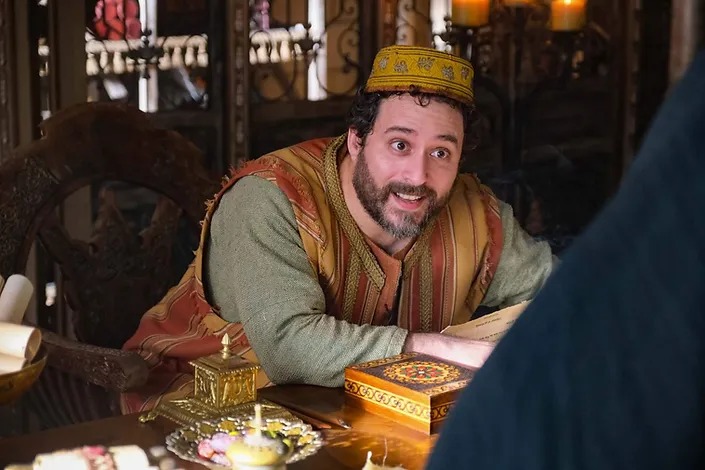
– The turning point for Shmuel seems to be when one of the people walking away from Jesus’ feeding of the 5000 says, “I tell you of a miracle and all you can think is ‘He ate with the wrong people.'”
– As Christians its’ become traditional for us to think of Pharisees as the “anti-Jesus” people. In their context they were some of the most “pro-God” people around. If we’re seen (and present ourselves) as the “pro-God” people in our context, we need to be wary lest we in our self-righteousness become “anti-Jesus” people.
– Jesus’ work in our lives takes time. That’s hard for people like us who want things to “work” instantly.
Pilate is talking to his wife about going out to meet with a friend. She claims he doesn’t have any friends. He counters that he has “useful contacts.” Do we take time to have friends who are more than “useful” to us?
We see several of the disciples sharpening knives. Apparently they’re worried about Jesus’s safety and want to be ready to protect him. Are you aware of a place in scripture where Jesus asks his people to protect him?
Simon the Zealot is acting nervous. A fellow disciple finally gets the explanation that he’s anxious because some of his old zealot buddies are in town, probably to kill him for betraying their cause. The disciple suggests he ask Jesus for help but Simon says “Jesus cannot be involved.” What areas of our lives do we try to keep Jesus out of?
The Roman boss in Capernaum, Quintus, tells centurion Gaius to “make things miserable” for people in the tent city that’s sprung up. In our desire to think of ourselves as “humane,” are there people we try to engineer misery for so they’ll go away (without wounding our conscience)?
Mary Magdalene and Tamar are uncomfortable with each other. The solution appears to be opening their lives & telling their stories to each other. I wonder if we’re willing to try that.
Tamar to Mary (who wallows in guilt & condemnation regarding her past): “Jesus forgave you but you choose to hold on to it.” What areas of brokenness and sin in our lives have become so important to our identity that we hold on to them even after Jesus has forgiven & delivered us?
Simon tells the zealots that have hunted him down that he can’t stay in their lifestyle because he’s found the Messiah. One retorts, looking around, “But there are still Roman soldiers; taxes are still being collected.” Simon’s answer, “Nevertheless, Kingdom of heaven is at hand.”
I’m continuing to share observations and questions from my viewing of The Chosen.
Zebedee, now that he has two sons who are following the Messiah describes his life and legacy as “waiting for the Messiah,” takes himself to be free to do something new. As the film imagines it, he sells his fishing boat and buys an olive grove.
The woman with an “issue of blood,” had been ostracized and alone for twelve years. The Law said that a person touching such a woman would become unclean. Jesus touched her, but because she had touched the hem of his garment she was already healed when he touched her.
One disciple asks another, “Now that Zee is no longer a zealot, do you think he still feels like murdering?” A question: in your life of following Jesus, how long does it take for your feelings to change so that they are aligned with Jesus?
This is also the episode where we finally see Jesus raise Jairus’s daughter. I’m reminded of the old Don Francisco song that tells this story. It’s still powerful.
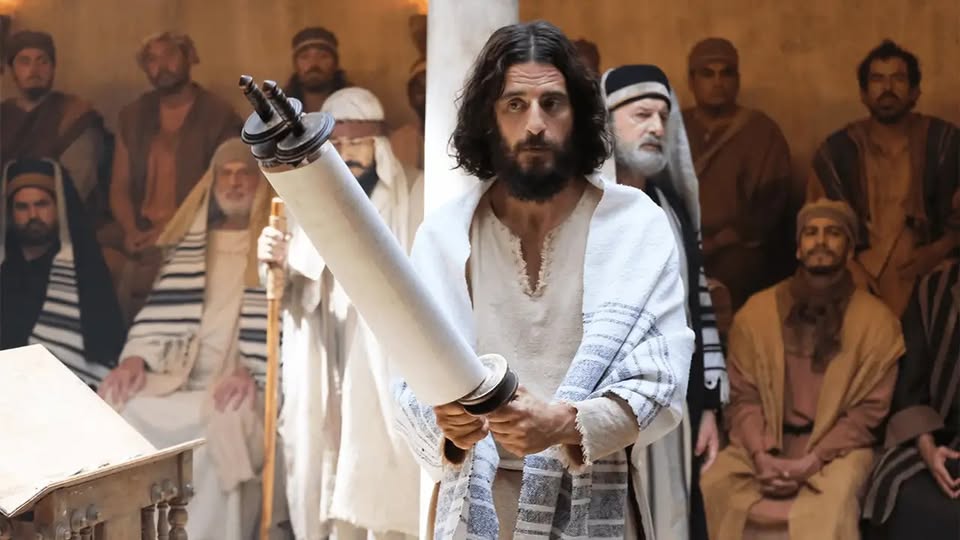
The central and most controversial claim Jesus made in the synagogue in Nazareth was “TODAY this is fulfilled in your hearing.”
The episode expanded on what Bible readers have long noticed about Jesus’ reading of Isaiah 61 – he left out the bit about the “day of the vengeance of our God.”
The story (to the degree it was drawn from the Bible, not the moviemakers’ imaginations) was from Luke 4. The strong emphasis on Isaiah 61 (and thus Jesus in preaching it) was talking about SPIRITUAL debt (rather than monetary) seems more in line with Matthew’s take than Luke’s.
In reference to the Widow of Zarephath and Naaman the Syrian, Jesus says that they were “hungry enough to know that they needed God.” My follow up question: How do we learn to recognize our need for God?
They have Jesus responding to the challenge that he is going against the Law of Moses with, “I AM the Law of Moses.” Using the “I AM” phrasing happens in the Gospel of John, though never in this particular way. If I were writing the movie script I would have left this out.
We’re watching The Chosen on Wednesday evenings at church. From time to time I think about sharing questions and notes.
What have you done that has helped you fully trust God?
“None of you are what you were.”
What is are things we care about that God doesn’t?
When Jesus shocks the disciples by telling them he was sending them out to do the kinds of things he’s been doing, they don’t know what to make of it. One reflects, “This is what we signed up for even if we didn’t know it at the time.”
There’s been much commentary about cutting government spending lately. I have a few thoughts:
Any large opaque organization is going to have wasteful spending and people who know how to attach themselves to profit off of it. The US government is no exception.
It’s comforting to believe that those who attach themselves to government & government entities to profit from it are ONLY from the Other Team and never from our team of Truth and Justice. Dream on.
Because it’s comforting to believe in the evil of people we disagree with it’s easy to believe every claim of evil made of them.
When it comes to government spending its worth asking, “Is this it in our country’s interest to do this?” Recognizing what is truly in our country’s interest is harder work than many assume.
Asking whether something is in our country’s interest should be asked when programs are started and regularly as they are continued.
As a Christian I can recognize that wealth, though often something that results from taking advantage of others, can at least occasionally be a blessing from God, and is something we’re accountable for. If a country takes its wealth to be a blessing from God, then reading the Bible leads me to believe that our wealth is not just FOR us to consume on ourselves but for us to be agents of blessing to those with less. I DO NOT expect non-Christians to think this way.
The annual budget deficit and the accumulation of our large national debt is not a good thing. Neither is it in our national interest. If this were the condition in my household the solution would be a combination of spending less and bringing in more.
What Yuval Levin calls the “Wilsonian” inclination (after Woodrow Wilson) to have a strong executive led by experts with the authority to Make The Right Things Happen has not been a good thing for our country, whichever party has been practicing it. That inclination ignores the fact that building trust across the electorate and among the citizenry as a whole – rather than just pleasing the base – is a good thing.
When we consider any population, characteristics are not equally distributed to ever member of the population. This is visibly obvious when it comes to height. Every person has some height – they can be measured. Perhaps its also obvious – though not visibly so – that not every person is equally intelligent. When we speak of a characteristic being “distributed” across a population this is not meant to be a claim that some agency has performed an act of distribution. It is the claim that when we look at the population in question we see difference quantities of the quality we’re considering.
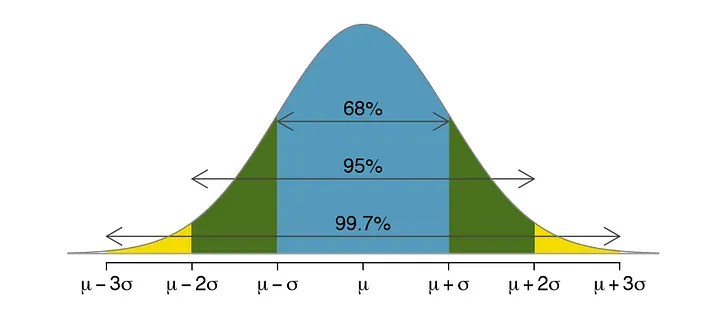
One way to picture the distribution of characteristics in a population is a “bell curve” (called that because it looks like a bell) or a “normal” distribution. I knew more details about exactly how this worked back in the previous century when I took statistics in college. In the sample graph below you notice that most of the population is in the middle, with smaller numbers at either extreme.
Chances are that the distribution of a characteristic in a population differs depending on the characteristic in question. Some distributions will look “normal,” with the bulk of the population in the center. Others may have bumps at either end and a low spot in the center. Still others may have the largest part of the population at some point other than the center.
I don’t think there is sufficient awareness of this distribution of qualities when we think about people around us and the policies we adopt. Let’s consider something called “success in life.” There are many ways to experience “success in life,” but each of those ways will be effected by a mix of multiple characteristics. I can imagine that characteristics like intelligence, luck, propensity to work hard, relational skill, and connections with other people are some of the characteristics that affect “success in life.”
Some of my assumptions at this point:
Quantities of each of these characteristics are not equally distributed in each population. People in my town, say, do not each have equal amounts of intelligence, luck, propensity to work hard, relational skill, and connections.
One’s measure with regard to one characteristic is not guaranteed to be equal to one’s measure with regard to another characteristic. We will tend to be higher in some, lower than others.
It is common for us to attribute our success in life to only a select number of characteristics. Perhaps these are intelligence and propensity to work hard. We look at our lives. We consider ourselves intelligent. We know that we work hard. Our “success in life,” therefore, must be because of these characteristics.
Continuing closely on number 3, we also make judgments about other people. If we see them experiencing a degree of “success in life” similar to our own, we easily assume it’s for the same reasons.
When we look at people who are not experiencing a degree of “success in life” as high as our own it becomes easy to think their failure is due to their lack of the characteristics to which we attribute our own success.
If we have power to determine how societal arrangements are made, it is wise to take these realities into consideration. This means that if someone is undergoing acute or chronic hardship we do them a disservice if we assume their hardship is due to a lack of intelligence or hard work. It might be that they are more intelligent than we are and even work harder than we do, but that they have had worse luck (loss of parents at an early age, poor health, lack of opportunity) or do have the same connections we do. I think of Robert Putnam’s metaphor of “airbags” in his book Our Kids. The idea is that some kids (usually middle class and above) have enough connections that if they make a mistake or suffer a disaster there are people who will come alongside them and help shield them from the full negative consequences of those actions/events. But what about people who’ve grown up without “airbags?”
Let’s think about Jobs. Is it a good thing to have a wide variety of jobs that are available to a wide variety of people? Should we look to build a society where only those with a certain level of intelligence can have a job that suits them? Should only highly intelligent people have a job that pays enough to support a family?
What do you think about the unequal distribution of characteristics in society? Do you think the picture I’ve developed has any applicability to our society and the way we do things?
When I was in college we had a large chapel choir. It was large enough, in fact, that I could be a member without noticeably impairing the sound quality. I gained much of my appreciation of historical Christian music from my experience there and from the Hymnology class I took with the director of the choir (If your eyes are especially sharp you can even find my picture from those days in the video here at the site for his obituary).
One year for our Christmas concert we did Benjamin Britten’s A Ceremony of Carols. The words to one of the songs in that chorale have stayed with me ever since:
This little babe, so few days old,
Is come to rifle Satan’s fold;
All hell doth at his presence quake.
Though he himself for cold do shake,
For in this weak unarmèd wise
The gates of hell he will surprise.
With tears he fights and wins the field;
His naked breast stands for a shield;
His battering shot are babish cries,
His arrows looks of weeping eyes,
His martial ensigns cold and need,
And feeble flesh his warrior’s steed.
His camp is pitchèd in a stall,
His bulwark but a broken wall,
The crib his trench, hay stalks his stakes,
Of shepherds he his muster makes;
And thus, as sure his foe to wound,
The angels’ trumps alarum sound.
My soul, with Christ join thou in fight;
Stick to the tents that he hath pight;
Within his crib is surest ward,
This little babe will be thy guard.
If thou wilt foil thy foes with joy,
Then flit not from this heavenly boy.
If you’ve ever heard Britten’s piece, you know it’s not easy. The words move very quickly and in the second and third stanzas the voice parts echo each other.
Britten didn’t write these words – he took them from a poem by Robert Southwell. Southwell was a Roman Catholic priest who died 1594 while still in his early 30s. He didn’t die peacefully, but by being hanged, drawn, and quartered by the regime of Queen Elizabeth. You might think that being a Protestant I’d be on the Queen’s side, but treating anyone (let alone a fellow Christian!) in such a manner is antithetical to the way of Jesus.
What Southwell has done with these words is cast the birth of Jesus in the frame of spiritual warfare. When we think about spiritual warfare images of mighty angels, swords, and clashing armies might come to mind. Southwell, however, is aligned with scripture seeing God’s entry into our broken and sinful world as a defenseless baby as the true reality. Our way of taking up that warfare, similarly, is not employing violence and coercion “in the name of Jesus,” as Christians have been tempted to do through the ages. Instead, we walk in the ways of Jesus (“Stick to the tents that he hath pight”) and live as joy-filled redeemed people in the face of any and all opposition.




 Bandits No More