



I usually read multiple books at once, alternating between them. This is one I’m reading at home this month.

What’re you reading this month?
In Luke 5:1-11 we see a story of Simon coming to his senses. By acting on Jesus’s word (against his inclination) and experiencing the work of Jesus in his life, Simon came to see himself as a sinner. Up to that point this professional fisherman has likely taken himself to be a good reasonable person. He was a good fisherman. He worked hard. He supported his family. He was a good Jew. He honored God in appropriate ways. If you’d have asked him, he probably would have admitted that he wasn’t perfect – but who is? Surely God takes that into account.
As a result of this encounter, Simon learns to see himself as a sinner. In his book Good, Reasonable People (at the moment I write this, the Kindle version is on deep discount) Keith Payne writes about the “Psychological Immune System.” This is our natural human inclination to defend our root assumption that we are good reasonable people. Considering how many people have been beaten down and abused, we see that such an immune system is important. It can prevent us from despair and hopelessness. But the psychological immune system can also be a defense against gaining self knowledge and against engaging with God. In this story the breaking of Simon’s psychological immune system allowed him to discover that he was a sinner.
The result of the breaking of his psychological immune system was not the disaster it could have been. In the presence of Jesus, that immune system was reconfigured. He was able to see that he, though a sinner, was important to Jesus. Jesus loved him. Jesus invited him, sinner that he was, to join in his work. It was only after Simon came to his senses and recognized that he was a sinner that Jesus was able to work in his life.
In this era of exaggerated self-righteousness – even in the church! – there is a deep need for us to have the kind of experience Simon had. Until our assumption that we are good reasonable people can be broken down so that we come to know ourselves as sinners, we will be of no use to Jesus but instead a force for chaos and destruction in the world.
As a preacher, I’m often encouraged to preach “relevant” messages. When I look at those who subscribe to the ethos of “relevance” I see messages based on wisdom. Surely people do need wisdom: wisdom on how to have a marriage, how to raise kids, how to get and keep a job, how to manage all relationships, how to be happy and healthy. All that is desirable, and in an age that has, in many ways, rejected wisdom, is needed. But none of those things are particularly Christian.
Elizabeth Bruenig writes in The Atlantic of an apparent Christian revival happening in Silicon Valley. She doesn’t mention the recent revival of Stoicism, but her description puts it in the same context. In their eyes, she says, “Religious faith is a tool for keeping people productive, in other words, a private code of ethics that enforces the kind of activity that lends itself to producing wealth.”
She recognizes that using Christianity – or God – as a tool is not what Christianity is about.
In that sense, Silicon Valley Christians perhaps see Christianity as a kind of technology, which is to say a product used to accomplish human purposes. Granted, Christianity promises certain benefits to its adherents, such as inner peace, eternal salvation, the comfort of community, and prosocial ethics. That said, Christianity at its core is not a religion that can reliably deliver socially desirable outcomes, nor is it intended to be. In Matthew 19:21, a disciple asks Jesus how to live as a model Christian, to which “Jesus said to him, ‘If you wish to be perfect, go, sell your possessions, and give the money to the poor, and you will have treasure in heaven; then come, follow me.’” Christianity disrupts life as we know it rather than reinforcing a self-serving status quo. It venerates generations of Christian martyrs whose examples are prized precisely because they placed obedience to God before more advantageous beliefs or activities. The formation of their faith was contingent not on temporal success, but rather on another principle altogether: that Christianity is worth following not because it has the potential to improve one’s life, though it can, but rather because it is true.
It may be a good thing for these Silicon Valley folk to gain a positive assessment of Christianity, but I’d rather it was a positive assessment of Christianity, and not some other phenomenon that just happens to use some of the same words.
Last night we watched the “season ending cliffhanger” of season 4. Well, if you know the story in the Gospels you know that once Jesus has mounted his donkey and the crowds have their palm branches in hand, it’s time for his “triumphal entry.” The episode is all about that triumphal entry, what it is and what it isn’t.
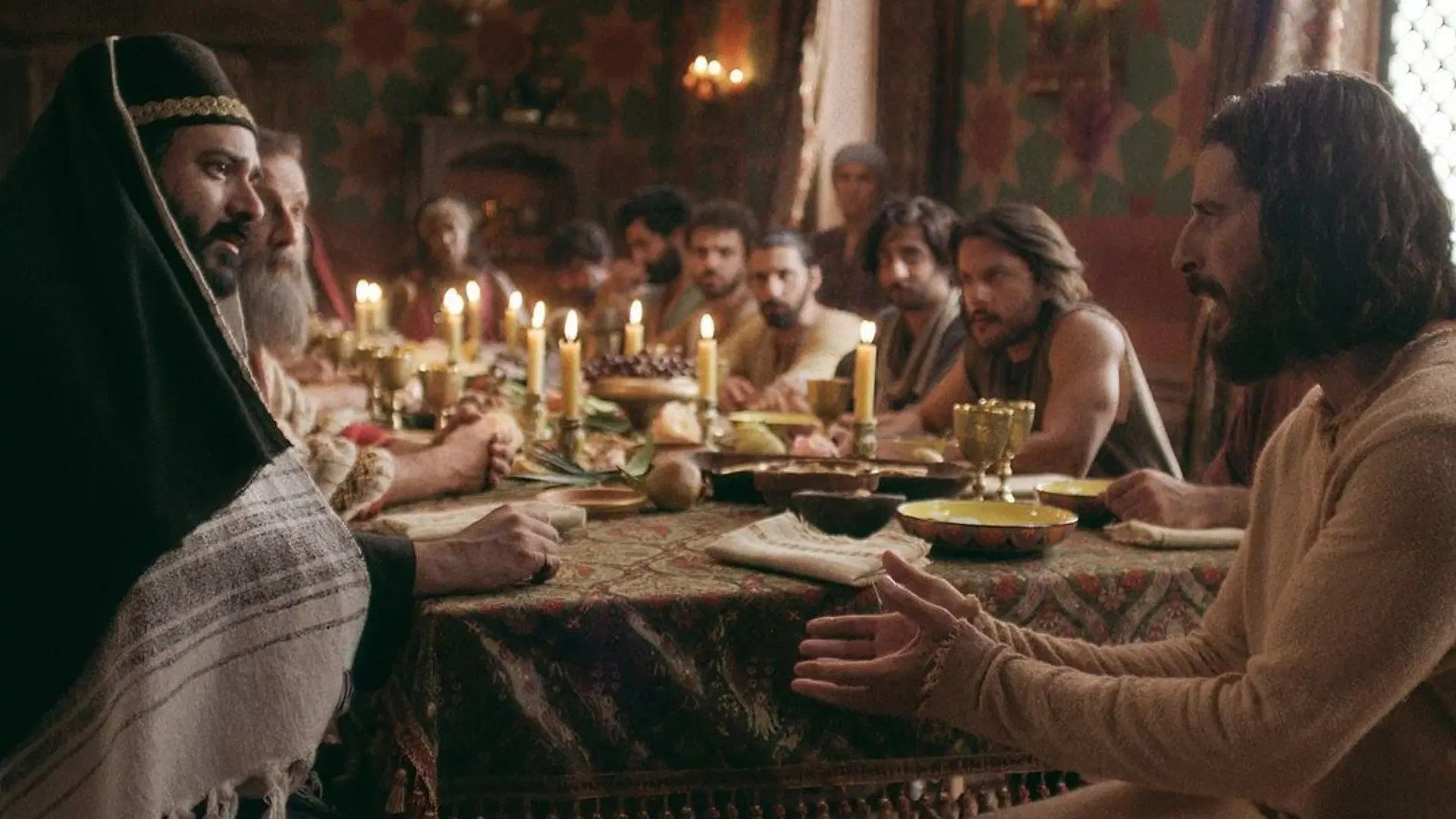
The episode opens to a flashback to the time of King David, showing us what a real triumphal entry looks like. David rides into Jerusalem on a war horse surrounded by other soldiers. They’re all decked out in military attire. They’ve won a victory over the Ammonites and everyone is excited. That‘s the kind of triumphal entry people are expecting Jesus to do.
We see Veronica (the name given to the woman Jesus healed) and the lame man from the pool of Bethesda (also healed by Jesus) giving their testimony in the temple courts. They can’t answer all the questions about Jesus that the religious official is throwing at them, but they can say, “I know what happened to me.” The power of testimony is still effective today.
Pilate is shown talking to his roving Roman investigator Atticus. Given the ubiquity of sacrifices in pagan religion, I was surprised to hear Pilate complaining about all the sheep being sacrificed. Given the way the phenomena we call “religions” manifest around us today the idea of animal sacrifice may sound odd, but it was anything but odd in ancient times. That’s why Paul had to take up the issue of Christians eating meat from animals sacrificed to idols.
Atticus has heard some of Jesus’s teaching and seen some of the things Jesus has done. He’s seen things he can’t explain. He tells Pilate that he has to “Decide if it matters.” Another indicator that that there is no necessary connection between seeing and believing.
We shift to the Sanhedrin where there is deep concern about the “signs” or “performances” Jesus is doing. They are deeply worried that Jesus will provoke a riot which would in turn provoke the Romans to destroy the temple and their nation. Better that one man die for the nation, thinks Caiaphas.
Not everyone at the Sanhedrin is ready to join in railroading Jesus to a Roman cross. Shmuel and Yussuf have been around Jesus enough to know something more is there. They want to go investigate more and give Jesus a chance to explain himself.
Yussuf and Shmuel visit Jesus at Lazarus’s house in Bethany. Judas is excited to see them, commenting that it looks like a perfect occasion for Jesus to make a “strategic alliance.” Noting the opposition of Caiaphas, Shammai, and other Sanhedrin leaders, Shmuel notes that when Jesus makes his move he’ll have more than just Rome to overthrow.
Jesus asks Shmuel what he’s looking for in a messianic kingdom. He’s looking for a restored Davidic kingdom, with all enemies overthrown and glory again coming to Israel. Judas loves it – he and Shmuel are on exactly the same page.
But Jesus isn’t. He tells the parable of the sheep and the goats. Shmuel is confused. He expects Messiah to identify with highly moral and deeply religious people, people of high character – people just like him! Instead, Jesus is telling of a Messiah who identifies with the poor and outcast. It’s all wrong! It sounds to him like the messianic kingdom Jesus is talking about would have no place for all the things he holds dear: the temple and its rituals, the Law, the feasts.
It’s at this point that Mary comes in and everything comes crashing down. She anoints Jesus’s feet with expensive perfume. Shmuel is horrified – horrified that Jesus lets this woman do this to him, that he would allow himself to be spoken of as if he were God! Judas is horrified that such expensive perfume was wasted when the money could have been put to good use. Everyone else is horrified to hear Jesus refer to the act as her anointing him for his burial.
Shmuel leaves, declaring that he had wanted to believe, but Jesus made that impossible. Judas still believes that “we have an opportunity this Passover to unite over a million of our people” – to overthrow Rome, is the rest of his thought. But now he’s shaken and confused.
Matthew and Zee are sent to get the foal of a donkey for Jesus. The episode shows them making the connection with this animal they are getting for Jesus and the prophecy of Zechariah.
As Jesus prepares to set out for Jerusalem, he asks the disciples if they’re willing to go with him. They are, Peter says, because who else has the words of life (the writers put Peter’s statement from John 6 in this spot).
The episode ends with almost everyone confused, though only a few know they’re confused. Herod and Pilate and the Sanhedrin are worried about an uprising that will cause riots, death, and destruction. The people of Jerusalem, along with (most of?) Jesus’s disciples are expecting an uprising that will overthrow the evil Romans. Atticus and Yussuf don’t seem to know what to expect. Jesus alone knows that he’s heading towards his death.
I don’t think the desire to see a messianic kingdom along the lines Shmuel and Judas look for has receded in succeeding ages. We imagine other enemies of God to be overthrown – the Nazis, the Commies, the Democrats, the Russians, the Republicans, the Woke, the Immoral, etc. But in seeking that kind of Messiah the danger is that we miss Jesus.
We watched this episode last week. Here are my thoughts and questions.

The news of Lazarus’s death comes immediately on the heels of Jesus and his disciples being stoned and run out of Jerusalem. They’re still operating on adrenaline. The disciples are confused, not sure what is happening. Whatever is happening, they’re sure that going back across the Jordan into Judea right now is a bad idea. And yet, that’s what Jesus says they’re doing, so along they go.
Hearing the summons to go to dead Lazarus, Thomas says (accurately reflecting what we see in John 11), “Come, let us die with him.” Thomas, like other disciples, is feeling like death awaits them. Unlike the other disciples, he’s wanting to embrace death, still ruled by his broken heart.
Judas Iscariot, perhaps the single disciple at this stage who expresses utter certainty that Jesus is the Messiah, sounds confused too. He says, “Shouldn’t we be winning, and not constantly losing?” This idea is rarely absent from Christians. Paul said in 2 Timothy 3:12, “All who desire to live godly in Christ Jesus will suffer persecution.” This Pauline teaching is in line with what Jesus had taught when he first sent the disciples out (Matthew 10) and in what we call his “Upper Room Discourse” (John 15-16). If Jesus is who we believe he is, we ought to be winning – we ought to be in charge. This line of thought leads naturally to the idea of a Christian Emperor (like Constantine and Theodosius) or some of the Christian Nationalisms of the past couple centuries.
Little James imagines that Jesus might raise Lazarus, but he’s not sure what to make of the possibility.
In the midst of the disciples’ talk of their confusion and the contrast between light and dark, Mary Magdalene talks about her experience of both in her time with Jesus.
Matthew, often one who is willing to say what is on his mind, says to Jesus, “Are we supposed to be understanding what you are saying?” I’ve felt that way sometimes.
Confronted by Lazarus’s sisters Mary and Martha, Jesus weeps. Having more insight into Jesus’s thoughts (and having read John 11), we know Jesus plans to raise Lazarus. We know he wants to and will succeed in doing so. Why does Jesus weep if he knows Lazarus is, reducing the metaphorical force of what he told the disciples, in a sense, really sleeping, not truly and finally dead?
When Jesus does raise Lazarus, Judas is over the moon with excitement. “This miracle will bring everyone to Jesus. No one can deny him now!” Judas is disastrously wrong. Some of the other disciples do understand what Judas does not: Jesus’s opponents are so dead set against him that even raising the dead will make no difference.
We see Jesus do many miracles in the Gospels. Some people believe as a result of the miracles. Some of that belief lasts, but some is fleeting. Some see and yet that seeing never leads to believing.
Judas himself is one of those who saw and believed. We’ll see how his seeing holds up.



 Bandits No More