Beware! Watch out for this evil villain!

Back when I was a kid we wandered the neighborhood far and wide. Sometimes my parents knew what I was doing, sometimes not. I certainly didn’t have them accompanying me on all my adventures.

Today we worry about our kids. If they’re only walking down the street we feel the need to keep an eye on them. The world seems full of dangers we weren’t aware of 30 years ago.

Thirty years ago we worried about communist bombs and missiles. Now we worry about terrorists blowing themselves up in our midst.

Even college campuses aren’t safe. After last Spring’s  Virginia Tech shootings we wonder if we need to send our kids to school in a kevlar vest.

The Chronicle of Higher Education highlights a new danger:

Iowa State University’s president announced last month that the athletics department would be allowed to engage the services of a chaplain — or a “life-skills assistant” — as long as the counselor was a volunteer, did not favor one faith over others, did not promote religion over nonreligion, and did not make use of any state or university funds.

The department’s plan to appoint such a counselor drew criticism from more than 100 Iowa State professors, who declared in a petition that the post would violate the constitutional ban on state establishments of religion. In a written statement, the university’s president, Gregory L. Geoffroy, said that the counselor’s work would be closely watched, and that athletes would be questioned about it.

Whoa. Can you imagine that? A state school allowing someone as dangerous and pernicious as a chaplain on campus? Well, maybe not quite a chaplain. That’d be playing with fire for sure (“Here, kiddie, want to try my assault weapon?”). They’ll settle for a “life-skills assistant.”Maybeeven a life-skills assistant can bring a harmless smidgen of spirituality (left safely undefined so as not to injure the easily tainted youngsters). At least some people will keep a close eye on the “life skills assistant” (modern surveillance equipment is readily available on the internet, and remarkably affordable). Who knows? Maybe they’ll pick up somje useful life-skills in the process.

So what are Christian athletes (I’m making an assumption that a majority of the athletes seeking a chaplain are Christians – they may not be, but surely some state school has a a majority of its “religious” athletes as Christians) to do, if they want a chaplain and Big Brother thinks they can’t handle it? I can think of a couple of options.

First, these athletes might decided that a thin veneer of religion on the top of sport doesn’t make much difference. They can pray in their own locker and go bash people’s heads (or try to whup them in some other sport) without anyone in the audience (except for Big Brother who has a presence in the locker room to keep a leash of the “life skills assistant”) knowing anything about it.

Or they could decide that the goddess of sport (is that Nike?), like mammon, cannot be served alongside the real God so easily. Maybe they’ll have to go to a school that believes a real chaplain – someone clearly outed as a representative of a particular god – is a good thing, not something comparable to having Osama bin Laden on campus. Sure, most of those schools don’t have leading sports teams, and aren’t stepping stones to the pros. But athletes are used to sacrificing. Maybe they can handle it.

Posted in Current events, Higher Education, Public Schools, Spirituality | Leave a comment

Leadership Myths

Here’s my article from this week’s church newsletter:

Charge Conference comes around every year (ours is October 7). One of the duties of this meeting is to select leaders for the coming year. Here are some of the confusions I’ve seen regarding leadership in the church.
It’s about power. The job of the church leader is not about power. It’s not primarily about decision making. Instead, the leader gathers people together to help fulfill the church’s mission of making disciples.
It’s about me. While a few people may have gained fame being a church leader, if that’s your goal drop it now. Christian leadership is one element of following Jesus. Thus serving others is more important than having our own way.
I know it all so I should be a leader. If you know it all, church leadership is definitely not for you. Leading in the church requires constant learning – about God (his purposes and callings), the people of the church, our community (the people we’re trying to reach), and techniques of effective ministry. If you’re not willing to learn, church leadership is not for you.
It’s a cushy job. Perhaps you’ve been a leader before. When the Nominations committee (now called “Lay Leadership”) or pastor approached you, you asked, is it difficult? What will I have to do? Maybe they answered something like, “Oh, don’t worry about it. It’s not very demanding. Just come to a few meetings.” Christians leadership is hard work. It takes dedication. The eternal destiny of thousands can be at stake. We’re not playing games here. The responsibility of being a Christian leader will push you to continually deepen your relationship with God and your reliance on him. You won’t be able to sit on the sidelines like some folks – you’ll be on the front lines setting an example. Your character matters.
I’ve been a member a long time and I deserve the honor. Unfortunately, tenure is not s sure indicator of competence or faithfulness. Sometimes long time members are awesome leaders. Sometimes new people are awesome leaders. If you think you are entitled to lead because of your tenure or connections, then you’re probably not the right person for the job. You might be reading this and thinking, “I’m not a member yet – what about me?” Many ministry roles are available to people regardless of their membership status. Most leadership roles, however, require you to have made the formal commitments involved in membership.

If being a Christian leader is so difficult, why do it?
You can make an eternal difference in the lives of people. There’s nothing more exciting than seeing God work in someone else’s life through your life. As a leader you help that happen. The result is joy.
You get to see Christians grow in their faith. As a leader God will regularly lead you into situations you can’t handle on your own or using only your own resources. You and those you lead will have to trust God or you will fail. When you do that – and see God come through – your faith grows.
The need is tremendous. If you’ve been here for a while you know the financial challenges we’ve faced – and overcome by the grace of God. Our leadership challenges are even greater. We have a continual need to identify people for ministry, equip and deploy them. Our biggest holes now are in the area of evangelism: the segment of our ministry that focuses on reaching people who have no regular church connection. To put it simply, people need Jesus. We’re here to help them meet Him.
God has called you. If God has called you, He knows what He’s doing. He’s brought you to this point because you are just the person he wants.

Pray for the Lay Leadership Committee as they meet. Pray for their wisdom and guidance. Pray for yourself and others that you might have discernment regarding your own role, whether in a formal leadership position or an informal one. There’s plenty of ministry to go around. The best preparation for leadership is to keep developing your relationship with Christ.

Posted in Leadership, Local church, Ministry | 1 Comment

A Great Victory!

When I came home from vacation last week, I came home to a dead computer. I ran some tests and determined that the problem was with the power supply. So I called HP and ordered a new one. I’d never installed a power supply before – but I was able to do it with no problems at all! It was much easier than the hard drives, video cards and other upgrades I’ve done in the past.

Not such a great victory? For a non-mechanical type like me, this little thing gave me a great sense of satisfaction.

Posted in Blog post | Leave a comment

Innovative Churches

Tony Morgan asks what makes a church innovative. My response:

The most innovative churches (or organizations) are those that employ the most discontinuous methods/practices/strategies to fulfill their mission. Therefore, some of the churches we judge “innovative” are simply so in comparison with the mass of churches out there. If we’d like, we can say that’s enough – just do something that can’t be arrived at via a straight line from what everyone else is doing.

But I’d argue that the most innovative churches are those that are pursuing discontinuous change, i.e., not in a straight line from what they’ve been doing, in relation to themselves. Of course the disadvantage of measuring innovativeness this way is that it is extremely difficult to be discontinuous all the time (and retain any kind of coherence).

The primary model for the church in this kind of innovation may or may not cause a church to appear innovative. If all we do is what we’ve always done, we’re clearly NOT innovative. But if we are moment by moment following Jesus, who is always trying to reach an ever changing set of people, our pathway – from the perspective of someone not observing either Jesus or the group pursued – may seem purely chaotic.

Posted in church growth, Leadership, Ministry | Leave a comment

Emergent Rejection of Christianity? Not Quite

Frank Pastore (who, according to the author info, has a graduate degree in philosophy of religion) has a stilted view of Christianity. In this weekend’s column – the second he’s written against the Emergent Movement – he says:

If Christianity is not objectively true, if the Bible is not the inerrant Word of God, if the Cross is not the greatest expression of Divine Love but an example of “divine child abuse,” if one can merit heaven without a having a saving relationship with Jesus Christ, if God doesn’t hate sin, if wrath is not an attribute of God, if there is no personal devil and if a conscious and eternal hell is not real, then… Why be a Christian?

In other words, if “my personal list of most important doctrines is not right,” there’s no point in being a Christian. Let’s examine his list.

“If Christianity is not objectively true” – If this means something like, “Is true regardless of my opinion,” then I don’t have much problem with it. Neither God nor the universe is a projection of my mind or desires. I often find that the world does not fit with my desires and expectations, giving me the choice of pain or adapting. God’s the same way. I’m not sold on the word “objectively,” however, so maybe Pastore will assume I’m not a real Christian. But then the notion that something, whether Christianity or something else, needs to be “objectively true” is of fairly recent vintage. Surely there was a point to being a Christian before we starting worrying about “objectivity.” We might say that concern for the objectivity of the faith is peculiar to our modern context, but that would surely sound too much like relativism for Pastore’s taste.

“if the Bible is not the inerrant Word of God” – Here’s another modern Shibboleth. While the notion of the perfection of the bible is fairly old and wide spread in Christian history, the epistemological theory that seems to require inerrant propositions for doctrine to work properly is fairly recent. As before, was Christianity pointless before the Princetonians originated this way of understanding scripture? Personally, I’m afraid I lack both a theory of inerrancy and errancy. When I preach and teach I do so from the perspective that the bible is God’s word, and an authority over me, not merely an objective text below me.

“if the Cross is not the greatest expression of Divine Love but an example of ‘divine child abuse,'” – I’ve never heard any Emergent speaker call the Cross an example of “divine child abuse.” Now some may say a particular explanation or theory of the Cross sounds like “divine child abuse,” but that is talk about a theory, not about the cross. Surely Pastore cannot be thinking of that since he says the Cross is the “greatest expression of Divine Love,” not that a particular theory of the cross is the greatest expression of divine love.

“if one can merit heaven without a having a saving relationship with Jesus Christ” Pastore’s confused if he thinks one can merit haven by having a saving relationship with Jesus Christ. Merit is irrelevant. Even with Christ we do not merit heaven. When we come to faith in Christ we are gifted with the Holy Spirit, the down payment of eternal life. We deserve neither the Holy Spirit nor eternal life. God simply gives to those who believe. Can a person “merit heaven” apart from Jesus? Of course not. No one “merits heaven.”

“if God doesn’t hate sin” – Where did this come from? Surely the bible presents a God who hates sin. But how would the lack of this truth make Christianity not worthwhile? Have some Emergent folks been saying that God secretly likes sin? While some of the Emergent folks might have different sin lists than Pastore in their front pocket, I haven’t heard any say God is soft on sin.

“if wrath is not an attribute of God” – Ok, the bible depicts God as sometimes being angry, and sometimes exercising judgment in reaction to his anger. But God is not a cosmic grouch. I’d rather say God exercises wrath than that wrath is an attribute of God.

“if there is no personal devil” – Is a “personal devil” like a “personal savior,” a supernatural being of my very own? This strikes me as the oddest item on the list. How could the lack of a “personal devil” make Christianity not worth while? I don’t have difficulty believing there are spiritual forces of wickedness in high (and some low) places, but such a belief is no where near the center of my faith. I have several concordances and I have yet to find a reference to a “personal devil.”

“if a conscious and eternal hell is not real” – Again my concordances fail me. Surely there are pictures of hell in scripture that depict inhabitants being aware (if this is the same as “conscious”) of their being there, and of a hell that lasts forever. But why is this a core doctrine of the faith? I think Pastore is looking at doctrines attacked by people he disagrees with and then deciding whatever they attack must be essential. I don’t find that to be a very useful strategy.

The key doctrines of historic Christianity have almost no place in Pastore’s list. Where is the Incarnation? The Trinity? The resurrection of Jesus? The forgiveness of sins? The church? But then these doctrines might get in the way of Pastore’s main concern: finding the salvation of America (and the world) in political conservatism.  I’m generally more conservative than politically, but I find the notion that we should look to conservatism for our salvation as blasphemous as the notion we should look for our salvation in liberalism. His claim that the Emergents side with Al Qaeda because they don’t stand entirely with political conservatism is nonsense.

If Pastore wants to find the real culprit in the war against war he should look not to the Emergents but to Jesus. Jesus – at least the one described in the bible, the “inerrant word of God,” wimped out against Rome and the Jewish terrorists (Zealots) who sought their demise. Instead of fighting, he offered no resistance. He let himself be arrest, tried and crucified. He went like a lamb to the slaughter.

While one might make arguments – even good ones – for the necessity of fighting Al Qaeda and their ilk, I think Jesus and faith in him stands as more a hindrance than a help to such an effort. If Pastore wants a tough god, one who will back up his political ambitions and quest for national salvation, he’ll simply have to look somewhere other than Jesus.

Posted in Al Qaeda, Current events, Emergent, Emerging Church, Politics, Theology, War | 3 Comments

We Didn’t Make It

It happened yet again – we didn’t make the list of America’s 50 Most Influential Churches.  Tim Stevens, on staff at one of the churches that did make the list, isn’t very excited. He thinks it’s mostly irrelevant. He says,

I’m concerned about getting our eye off the ball. The goal is not to move higher on a certain list. The goal is not to edge out another church. The goal is to be effective in helping people take their next step toward Christ. The goal is to make disciples.

I like his attitude.

From what I’ve seen, most churches have gotten their “eye off the ball.”  Most live as if church is about taking care of members.  If “taking care of members” means winning them to Christ, helping them walk as faithful disciples, and taking up God’s Kingdom agenda for themselves, then it’s the right way to go.

I have a list of churches and leaders I learn from.  Some are on the list of 50, some aren’t. I want to learn from the people and churches who are reaching people for Jesus.

Posted in church growth, Leadership, Ministry | 1 Comment

Study Questions for First John – Chapter 1

One of the classes I teach is doing an occasional study of I John. It’s occasional in the sense that these are the notes I leave for them when I have to be somewhere other than teaching the class.

I John 1:1-4 questions

NIV 1 John 1:1 That which was from the beginning, which we have heard, which we have seen with our eyes, which we have looked at and our hands have touched– this we proclaim concerning the Word of life. 2 The life appeared; we have seen it and testify to it, and we proclaim to you the eternal life, which was with the Father and has appeared to us. 3 We proclaim to you what we have seen and heard, so that you also may have fellowship with us. And our fellowship is with the Father and with his Son, Jesus Christ. 4 We write this to make our joy complete.

NRS 1 John 1:1 We declare to you what was from the beginning, what we have heard, what we have seen with our eyes, what we have looked at and touched with our hands, concerning the word of life– 2 this life was revealed, and we have seen it and testify to it, and declare to you the eternal life that was with the Father and was revealed to us– 3 we declare to you what we have seen and heard so that you also may have fellowship with us; and truly our fellowship is with the Father and with his Son Jesus Christ. 4 We are writing these things so that our joy may be complete.

Start at the end of this paragraph, v. 4. What reason does John give for writing? Note: There is a textual variant here. Some Greek manuscripts have your joy while others have our joy. (It’s the difference between humon and hamon.) Most of the newer translations consider our joy to be the better reading. As you read this book, ask the question, “How might what is written here increase the joy of the writer” (or the recipient)?

Back to the beginning: What is John talking about? He seems to be talking about “the eternal life which was with the Father.” What is this “life?” It seems natural to take it to be a reference to Jesus. Why might one talk about Jesus as eternal life? What is the difference between speaking of Jesus as eternal life and speaking of him as giving eternal life?

What is John’s relationship with this “Eternal Life?” He’s heard it, seen it, looked at it, touched it. That sounds like a close relationship – the relationship of an first-hand witness, not merely someone who has heard second or third hand. If he’s talking about a person, he’s talking about someone he knew intimately, face to face.

Now John is proclaiming this “life.” Why might he do that? Do we do that? Why or why not?

How does v. 2 indicate that John came to know this life? Observe that the life is revealed or manifested; it’s not just something John or the other disciples dreamed up for themselves. Some have suggested that the Christian teaching of eternal life is merely wish fulfillment: We dislike the idea of death, so we dream up some way to avoid it. Here the repetition is a way of emphasizing that John and his companions did not make this stuff up. It was revealed to them. Maybe it isn’t the right word – after all, Jesus – a person – seems to be who is in view here. It’s not just some vague life out there, it is a person who has come and is life.

Where was the life before it came to be with John and his companions? What does it mean to say this eternal life was “with the Father?” Who is “the Father?” Why would the “Life” leave the Father? Some parallel texts to consider are John 1:1-18 (on being with the Father) and John 5:19-30.


NIV 1 John 1:5 This is the message we have heard from him and declare to you: God is light; in him there is no darkness at all. 6 If we claim to have fellowship with him yet walk in the darkness, we lie and do not live by the truth. 7 But if we walk in the light, as he is in the light, we have fellowship with one another, and the blood of Jesus, his Son, purifies us from all sin. 8 If we claim to be without sin, we deceive ourselves and the truth is not in us. 9 If we confess our sins, he is faithful and just and will forgive us our sins and purify us from all unrighteousness. 10 If we claim we have not sinned, we make him out to be a liar and his word has no place in our lives.

NRS 1 John 1:5 This is the message we have heard from him and proclaim to you, that God is light and in him there is no darkness at all. 6 If we say that we have fellowship with him while we are walking in darkness, we lie and do not do what is true; 7 but if we walk in the light as he himself is in the light, we have fellowship with one another, and the blood of Jesus his Son cleanses us from all sin. 8 If we say that we have no sin, we deceive ourselves, and the truth is not in us. 9 If we confess our sins, he who is faithful and just will forgive us our sins and cleanse us from all unrighteousness. 10 If we say that we have not sinned, we make him a liar, and his word is not in us.

NLT 1 John 1:5 This is the message he has given us to announce to you: God is light and there is no darkness in him at all. 6 So we are lying if we say we have fellowship with God but go on living in spiritual darkness. We are not living in the truth. 7 But if we are living in the light of God’s presence, just as Christ is, then we have fellowship with each other, and the blood of Jesus, his Son, cleanses us from every sin. 8 If we say we have no sin, we are only fooling ourselves and refusing to accept the truth. 9 But if we confess our sins to him, he is faithful and just to forgive us and to cleanse us from every wrong. 10 If we claim we have not sinned, we are calling God a liar and showing that his word has no place in our hearts.

Who is the “him” from whom they have heard this message? When and under what conditions did they hear it? Do we see anything like this in the Gospels, i.e., in the recorded teaching of Jesus? [Consider John 1:4-5; 3:16—21; 5:24; 8:12; 12:35-6]

What’s the difference between “light” and “darkness” in this text? Does this kind of language work in our setting? Why or why not?

What does it mean to “walk in darkness?” What reasons might one choose to walk in darkness? Can one walk in darkness and not know it? How might you tell if someone is walking in darkness? What does it mean to “have fellowship” with him? [If you’ve heard the word “koinonia” before, it’s a transliteration of the Greek word used here for “fellowship.” It has the idea of having things in common.] Why might someone who was walking in darkness claim to have fellowship with Jesus? Is it possible to “walk in darkness” and have fellowship with Jesus? Why or why not?

v. 7 offers a contrast with v. 6. In this verse we see someone who walks in the light as “he” is in the light. Do you think there’s any significance to the fact that all these verbs are present tense? What are the consequences of walking in the light? Are these consequences good or bad? Notice how these consequences pertain not only to our relationship with God, but also our relationships with other people. What are the qualifications for walking in the light? Since we’re cleansed from sin when we walk in the light, apparently lacking sin isn’t a requirement.

How do we handle the time relationships between v. 7 & v 8? V. 7 tells us that the blood of Jesus cleanses us from “all sin.” By v.8, we’re told we’re deceiving ourselves if we say we have no sin. Can one be cleansed/purified of all sin and still “have” sin? What’s the difference between sinning and “having” sin?

We often associate being “just” with holding people highly accountable. In v. 9, however, Jesus is described as “faithful and just” and this is directly connected not with him demanding full payment form us for our sin, but with forgiving us when we confess. This word “just” (dikaios) is often translated “righteous.” The “unrighteousness” from which we are cleansed is closely related – adikias – literally we might call it, “not just” or “not righteous.” Note that the offer is to cleans us from all unrighteousness, not just some. Why might God offer this to us?

Is confession hard to do? How do you do it? Is it really that simple? One way to take the word here is that when we confess, we “say the same thing” that God says – in this case, the same thing God says about our sin. God says:

  • This sin is bad (“bad enough for me to send my only Son”)

  • You actually did this, it’s not a mere mis-perception on my part.

  • You are responsible for it.

Turned around, when we confess sin, we’re saying:

  • This was truly a sin, something bad and destructive.

  • I actually did the deed (though sometimes the “deed” is actually an instance of not doing something I should have done)

  • I am responsible for it. Neither my parents, my environment, nor the devil made me do it.

When we confess this way – not just a “Ok, I did X, now forgive me so I can get back to doing what I want to do (which may include sinning in exactly the same way)” – but a real repentance and turning away from sin – we experience real forgiveness. This is another opportunity to remember Isiah 43:25.

How does v. 10 differ from v. 8? How does it expand and move beyond v. 8? What are its practical consequences?

What is the role of faith in this section? We don’t see the word – except for it’s use describing Jesus in v. 9 (“Faithful”). If we consider that faith has at least three elements (a) believing something to be the case; (b) trusting; (c) obeying – do we see these elements in this chapter? If so, where do we see each, whether implicitly or explicitly?

 

Posted in Bible | 1 Comment

Which Church Would You Rather Attend?

From the Wall Street Journal [“In Europe, God is (Not) Dead,” by Andrew Higgins]:

Consider the scene on a recent Sunday at Stockholm’s Hedvig Eleonara Church, a parish of the Church of Sweden, a Lutheran institution that until 2000 was an official organ of the Swedish state. Fewer than 40 people, nearly all elderly, gathered in pews beneath a magnificent 18th-century dome. Seven were church employees. The church seats over 1,000.

Hedvig Eleonara has three full-time salaried priests and gets over $2 million each year though a state levy. Annika Sandström, head of its governing board, says she doesn’t believe in God and took the post “on the one condition that no one expects me to go each Sunday.” The church scrapped Sunday school last fall because only five children attended.

Just a few blocks away, Passion Church, an eight-month-old evangelical outfit, fizzed with fervor. Nearly 100 young Swedes rocked to a high-decibel band: “It’s like adrenaline running through my blood,” they sang in English. “We’re talking about Jesus, Jesus, Jesus.”

Passion, set up by Andreas Nielsen, a 32-year-old Swede who found God in Florida, gets no money from the state. It holds its service in a small, low-ceilinged hall rented from Stockholm’s Casino Theatre, a drama company. Church, says Mr. Nielson, should be “the most kick-ass place in the world.” Jesus was “king of the party.”

If you were raised in a traditional church, my guess is that you’d chose church #1. It’s stable, it’s traditional. Chances are that its worship style is thoroughly traditional, with the focus on quiet reverence.

However, if you weren’t raised in church, or were at the place in life where you were convinced that church was “boring, untrue and irrelevant,” you’d be more likely to go for Passion Church.

Purists on either side can argue that the other church is compromised by its attachment to mainstream culture. The Hedvig Eleonara Church, though apparently traditional, sees the leadership of the church as sufficiently secular to accommodate leadership from atheists. The Passion Church, though apparently counter-cultural, uses the language of pop-cultural hedonism.

Getting beyond the verbiage and hype (“The church is run by an atheist” or “Jesus was ‘king of the party'”), and questions as to who is more compromised by culture, we need to ask questions of life change. Which church is reaching people for Jesus? Where are sinners coming to faith? We’re not told about what’s happening at the traditional church, but we hear a story from Passion Church:

The message has lured some unlikely converts, including a heavily tattooed, self-described former mobster. “I’ve gone soft,” says Daniel Webb, the son of an English father and Swedish mother, who spent five years in jail for illegal arms possession and assault. He was baptized, like most Swedes, in the Church of Sweden but never prayed. He went to church for the funerals of fellow hoods but scoffed at Christian sympathy for the meek.

Mr. Webb first went to Passion Church three months ago with a female friend. Expecting to be bored, he got hooked. “An ocean of anger has calmed,” he says. His ex-wife, he says, “thinks I’m ridiculous.” He says he’s turned his back on crime.

What are we more concerned with – getting everything right, or seeing lives changed? While being right is not unimportant – after all, Jesus didn’t just seek life change in general, but life change oriented to the Kingdom of God – the New Testament pictures Jesus majoring on the latter, the Pharisees on the former. We can say that Jesus got things right by focusing on people and reconciling them to God (think Luke 15 here).

As a UM Pastor, I go where I’m sent. I don’t get to chose what church I go to. As a leader, I’d like to lead my church so that it’s more like Passion Church than Hedvig Eleonara Church. I want to bring people to Jesus, not just do what we’ve always done.

Posted in church growth, Current events, Ministry, United Methodism | 1 Comment

Learning from Five Dysfunctions of a Team

I first heard Patrick Lencioni at the Willow Creek Leadership Summit a few years ago. He spoke then on the content of his book, The Five Dysfunctions of a Team. Well, I’ve finally read the book.

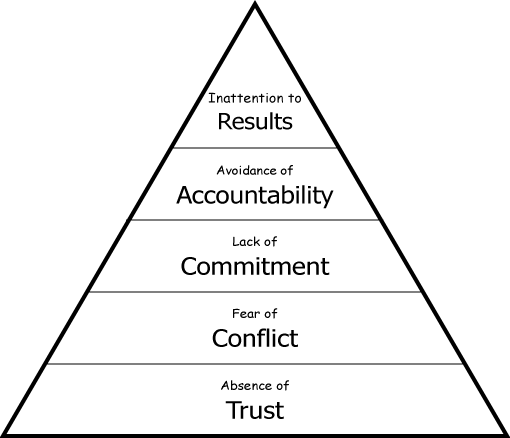
The heart of the book is illustrated in the diagram below.

5dysf

I see much in the book that my own church could profit from. We’re a diverse group, not only in our backgrounds, personalities, and interests, but also in the way we relate to the church. I’m appointed by the bishop. We have one staff person who is full time and a member/participant in another church, 3 people who are part-time paid staff, active in our congregation, and one person (new to the staff) who is unpaid (though she was at one time – years ago – paid staff), but has longer tenure in the church than any of us. She’s the only one to join the staff from within.

My main gifts are in teaching and preaching – not leadership. While teaching and preaching are essential to the health of a church, so is leadership. That’s why I continue to work on my leadership abilities.

In this post, however, I’d like to comment on Annual Conference issues. If you’ve been a reader of this blog for a while, you know the Texas Annual Conference is going through a transformation process. Big changes are afoot. Reading Lencioni makes me wonder if we’re not starting at the wrong end of the spectrum.

If Lencioni’s theory is correct, the starting point for developing a healthy team is building trust. The end goal is to focus on team results. We’re doing the latter elements – increasing accountability, setting goals, etc. But do we have trust?

Lencioni’s book is based on his “fable” about the leadership team of a tech company. The story shows their new CEO leading them up the pyramid – in theory and in action. Surely a company leadership team – composed of fewer than 10 people – is more like the staff of an individual church or the conference cabinet than it is like the conference as a whole. Can we take his theory any apply it to such a large organization? If so, what adaptations do we have to make?

For as long as I’ve been a part of the institution, the UMC has been a top-down hierarchy based organization. The folks at the top have the power, and the folks at the bottom are expected to do what they’re told. At least three factors are eroding this command and control structure.

1. Our culture as a whole has moved away from command and control structures. While still powerful, strong forces for freedom and autonomy have contended against these structures at least since the 1960s. While some of these new forces have been co-opted – i.e., have themselves taken up command and control strategies, the impetus for freedom and individual innovation remains.

2. Over the past few generations pastors have been required to have more and more education simply to enter the ministry. For some time now, it has been a requirement to have at least a graduate degree in divinity. It has not worked well to tell pastors (a) You need to spend a decade studying and tens of thousands of dollars, and (b) Even though you’re so highly educated, we still don’t respect you enough to let you get by without detailed orders from above. (Or, in plainer language, “We don’t trust you to be able to use the education we commanded you to get.” Surely they’re not saying, “Even though we required you to get this expensive education, it’s really not relevant to what you need to do?”)

3. The influx of more mature second career pastors with greater life experience has brought in people who are used to working in freer environments, or who have greater confidence in their own skills and wisdom.

If the traditional command and control structure is being eroded, what is the alternative? Here is where we can learn from Lencioni. The starting point is building trust. we have to do this on many levels. Pastors and congregations, pastors and DSs, churches and cabinets, need to learn to trust each other.

This trust is not just a happy smiley thing. Once real trust begins, then we can move to the next level – healthy conflict. I don’t know about other churches, but UMs are terrified of conflict. We think conflict is unChristian. We talk about wanting people to be “team players,” and by “team player” we mean someone who doesn’t rock the boat but simply (and happily) does what he or she is told to do. There are fewer and fewer people willing to operate that way (could this be why we have trouble getting and keeping younger pastors?).

Why doesn’t the Annual Conference learn from a model like Lencioni’s? My guess is that the main hindrance people would point to is the constraint of time. Some folks think (perhaps rightly) that the great Texas Conference is teetering on the precipice of calamitous decline. Desperate times call for desperate measures. While there are some that think that way, I think there is a another constraint we’re less willing to talk about. I’m referring to episcopal terms.

Building the trust and healthy conflict (so that we can reach greater commitment, accountability and results) in an organization as large as the TAC is a huge task. I doubt it can be done quickly. But BishopHuie is appointed as our episcopal leader for only 4 years at a time. Will she be back for another quadrennium? If she is, will she maintain her focus (some bishops do, some don’t)? If sheisn’t (or even if she is), what will the next bishop do? Will the transitions be affirmed – or jettisoned as too expensive or too painful? Perhaps some think that if we push hard enough we can make it to the point of no return before any changes at the top are made. (Yes, I realize that this is shaping up as an argument for longer episcopal tenure.)

Posted in church growth, Leadership, Texas Annual Conference, United Methodism | Leave a comment

At War?

Have you heard the saying – “America isn’t at war – America’s military is at war. America is at Walmart”? The implication is that we need to appropriate the World War 2 model of total war and mobilize the whole society to fight.

Here’s a picture from a society engaged in something much closer to total war:

 GAZA CITY, Gaza Strip (AP) – A Mickey Mouse lookalike who preached Islamic domination on a Hamas- affiliated children’s television program was beaten to death in the show’s final episode Friday. In the final skit, “Farfour” was killed by an actor posing as an Israeli official trying to buy Farfour’s land. At one point, the mouse called the Israeli a “terrorist.”

“Farfour was martyred while defending his land,” said Sara, the teen presenter. He was killed “by the killers of children,” she added.

The weekly show, featuring a giant black-and-white rodent with a high- pitched voice, had attracted worldwide attention because the character urged Palestinian children to fight Israel. It was broadcast on Hamas- affiliated Al Aqsa TV.

Station officials said Friday that Farfour was taken off the air to make room for new programs. Station manager Mohammed Bilal said he did not know what would be shown instead.

Israeli officials have denounced the program, “Tomorrow’s Pioneers,” as incendiary and outrageous. The program was also opposed by the state-run Palestinian Broadcasting Corp., which is controlled by Fatah, Hamas’ rival.

The war is so important that even little children must be mobilized. They must learn to see the enemy as totally evil, and to be opposed with all one’s might and resources.

I don’t want that. Total war, while it might be a step in the direction of effectiveness, is also a step in the direction of greater evil.

Posted in Current events | 1 Comment