WYSIWYG?

Check out the picture at Bad Astronomy.

What do you think of it? Do you see the blue and green spirals? Did you read the explanation that both spirals are really the same color – that our senses are deceived by the proximity of the other colors?

At the end of the post the author says,

“So the next time someone swears they saw Jesus, or a UFO, or a ghost, show them this picture. What you see in life is absolutely and provably not what you get.”

It is true in this case that what you see – blue and green spirals – is not what you get. Assuming, of course, that by “get” you mean something like “an accurate representation of reality,” or “what is really there.”

We have enough experience with optical (and other kinds of) illusions, that we know that sometimes our senses are fooled. But are the reports of our senses “absolutely and provably” illusory all the time? Do we never get what we see?

When my wife cooked dinner last night, the results sure looked like sausage, sauteed squash, salad and pieces of fruit. My sense of touch – through the instrument of my fork – gave further evidence supporting my sight. As I put pieces of the food into my mouth I received confirmation of what I had seen. This was indeed sausage, squash, salad, and fruit.

But perhaps that’s not the level on which I should look for an illusion. I didn’t actually see my wife cook anything. Well, I saw her stirring the squash for a moment, but I didn’t see her cut it up, apply the heat, and bring it from beginning to completion. Maybe it was only an illusion that she cooked it. Maybe it was really one of the children.

We had a surprise birthday party for my son last summer. One of his friends is named Jesus. I have seen Jesus on more than one occasion. I have spoken with Jesus on several occasions. I have seen pictures of Jesus. Am I delusional? Is he illusory? Am I not “getting” what I see when I’m in the presence of Jesus?

But then maybe he means the other Jesus – Jesus of Nazareth, the fellow born in Bethlehem, who gathered disciples, died in Jerusalem, rose from the dead, ascended to the Father. Is he suggesting that that Jesus  is an illusion? Or is he claiming that any seeing of this Jesus is necessarily an illusion? Or perhaps he would limit the illusiveness of Jesus to current seeings of Jesus. Perhaps folks like Peter and Pilate really did see Jesus. But since he isn’t here now, we can’t see him now, therefore any purported seeings of Jesus are illusory.

Is the optical illusion mentioned at the Bad Astronomy site naturally occurring – or was it purposefully created to be an optical illusion? If I look at that and see an optical illusion, am I getting what I see? Is there a difference between seeing an optical illusion and seeing a picture of an optical illusion?  If I look at a tortilla and see a pattern of coloration that makes me think of Jesus, am I seeing Jesus? Or am I seeing a pigmented tortilla? If I look at a canvas and see a pattern of coloration that makes me think of Jesus, am I seeing Jesus? Or am I seeing a pigmented canvas?

I reason that the optical illusion at Bad Astronomy was humanly constructed. I reason also that the article/discussion accompanying it was humanly constructed. If I see these as humanly constructed am I seeing an illusion? I certainly don’t see a person in the act of composing either, but given the effects I take them to be the work of some human, just as I took last night’s dinner to be the work of my wife. Just as I take some of the things I’ve seen in life as the work of Jesus. If I can do the former two, why can’t I do the latter?

I am part of a socio/temporal system in which I understand how internet content happens. I have seen spam and filler that is computer generated. In its form it looks real. But if I try to make sense of it, the best sense is as spam or filler. It’s not “real” content. Lots and lots of us inhabit this socio/temporal system and have no trouble sharing an assessment of these kinds of things.

Fewer people share the socio/temporal system of my household. Given the ages of my children (21, 18, 13) it would not be unreasonable to think that one of them actually cooked last night’s supper. But since I am an inhabitant of that system, I know that my wife and I cook more than 99% of the meals. Since I did not cook the supper, my inference that she cooked the meal is not shocking. Since many other people inhabit similar socio/temporal systems, I’d guess my inference is not shocking to them either.

But what about seeing Jesus? I confess that I don’t inhabit a socio/temporal systems that inclines me to see Jesus in tortillas, fried eggs or clouds. While I can imagine looking at each of these, observing patterns of coloration or shaping, and thinking, ‘That looks like Jesus,” I would take this experience as more aptly called an act of imagination than an act of seeing Jesus. Again, because of the socio/temporal systems I inhabit, if I see patterns of coloration on a canvas and say, “I see Jesus” – as opposed, for instance, to saying “I see George Washington,” or, “I see a horse,” or “I see a gently flowing river.” At the same time, depending on the context that asks me to make a report of what I see, I might be happier to say “I see a picture of Jesus,” or “I see Jesus in that picture” than “I see Jesus.”

As a follower of Jesus and as an inhabitant of the socio/temporal system we call the Christian tradition, I sometimes see Jesus. I have not (yet) to my knowledge (I have to be wary considering what Jesus says in Matthew 25) seen Jesus the person as Jesus the person. But because of the judgments and patterns of perception built into this socio/temporal system, I have no trouble saying, “I have seen Jesus,” when I speak of effects that I take to be caused by Jesus’ acts.

Can I be wrong? Or can I have absolute certainty that I have seen Jesus? I don’t think so. I have a pretty high capacity for doubt. Like Descartes, I can imagine circumstances that cause my perceptions to be inaccurate. But I can do that for just about everything. Given my socio/temporal location, I have no reason to take my assessment that the post on the Bad Astronomy site was produced by anything other than a human agent.  Given my socio/temporal location, I have no reason to take my assessment that dinner last night was cooked by my wife as illusory. In the same way, viven my socio/temporal location, I have no reason to take my assessment that I have seen Jesus as illusory.

In the future I might come to judge a particular event that I took to be a seeing of Jesus (or my wife, or of a rainbow, or of a dog) as no such thing. But that would be no reason to eliminate altogether the class of all such seeings.
Posted in Epistemology, Jesus, Perception | Leave a comment

Listening to John Ortberg

The last workshop I went to at the Renovare Conference in San Antonio this past week was a conversation with John Ortberg. I first heard of Ortberg when he was on staff at Willowcreek church. He’s now served as pastor at Menlo Park Presbyterian for a number of years.

Two questions in particular interested me. One person asked how you hold Willowcreek and Renovare together, that is, how do you hold together a hard-charging emphasis on leadership and evangelizing seekers with a deep commitment to spiritual formation? The ethos seems to be very different.

I agree with Ortberg that both emphases are valuable. We need to lead change in organizations: quantitative change that brings people to faith, and qualitative change that leads to holiness and mission. We also need personal growth – in holiness and obedience to Jesus. It’s the feeling broadly associated with each that is most different. We think spiritual formation is nice, emphasizing grace and faithfulness, while leadership is tough, emphasizing effectiveness and results. If our spiritual formation is merely nice, it’s not spiritual formation in the way of Jesus. If our leadership is merely tough, it’s not Kingdom style leadership.

A second, a related question came to Ortberg: “What do you know now that you wish you knew thirty years ago?”  The main point he emphasized in his answer was a freedom to not be primarily a leader. Though his gifts lie elsewhere, he’d been taught that if he’s a pastor, he’s supposed to be a (if not the) leader. But he lacked leadership gifting. Looking back he would have honored and employed his wife’s leadership gifts much sooner.

It seems like a luxury of larger church environments to be able to allow job specialization along lines of gifting. As pastor of a small church, I have to do many things – some I’m good (gifted) at, some I’m not. Otherwise essential functions won’t get done. Perhaps as our smaller churches migrate from the engrained clergy/laity dichotomy to a spiritual gifts understanding of ministry, we’ll be able to do more specialization.

Posted in John Ortberg, Ministry, Renovare, Spirituality | Leave a comment

Some thoughts on a Biblical Worldview

Much has been said in recent years about a “biblical worldview.” Here are some aspects of such a worldview that I include in my teaching and preaching:

  • The centerpiece of God’s activity is Jesus. As God incarnate, Jesus in his life, death, and resurrection gives us the best picture of who God is and what God is up to.
  • God was, is and will be an active agent in the world (conta deism).
  • God is not the only effectual agent in the world (contra determinism).
  • God’s activity is centered on healing/restoring Creation and overcoming sin and all its consequences. (A view of Christian Perfection writ large)
  •  Jesus’ ministry (i.e., the total of his life) was spent in identification with and suffering for undeserving sinners, a truly amazing act on the part of the sovereign, almighty, God of the universe.
  • God’s purpose, at least since the call of Abram, has been to produce a people who are his very own, and the salvation God seeks to work out is most clearly expressed (at least in this age) through that people. (contra individualism)
  • Through the presence of the Holy Spirit in every believer individually and in the church corporately, we are equipped to be the people God wants us to be. However intelligent, skilled and practiced we become, we never get to the point where we can be the church apart from the activity of the Spirit. (contra Max Weber’s theories of the routinization of charisma)
  • God’s call to the church to be a suffering people echoes through the ages from Jesus’ invitation to his disciples to take up their crosses all the way to us today. (contra the modern practice of the comfort centered life)
  • The salvation Jesus offers is for all people (contra five point Calvinism), they will probably never know unless we tell them, and it will cost them if we do not tell them and they do not come to faith in Jesus (contra universalism, laziness and smug self-satisfaction).
  • The church’s story line (as well as the story lines of individual believers) are extensions of the biblical story line. In Christ, God invites us to become willing participants in that story line.

Posted in Uncategorized | 1 Comment

Books I’ve just finished

I read a fair number of books in the course of a year.  Here are a couple I’ve just finished.

Bill Hybels, Just Walk Across the Room: Simple Steps Pointing People to Faith.

You’ll have to look a long time to find someone with greater evangelistic passion than Bill Hybels. Beyond modeling this value (and practice) for his congregation the past few decades, he’s written books and developed video courses to help others join the adventure. This book focuses on simple things ordinary Christians can do to help people connect with Jesus. At the heart of evangelism, Hybels suggests, is a love for people that compels us to build relationships. In some of these relationships we might have the privilege of seeing someone come to faith. In others – probably the majority – we’ll simply have the role of introducing some questions or providing resources. We can be certain there will be no harvest without sowing, watering and cultivating.

Timothy Keller, The Reason for God: Belief in an Age of Skepticism

Keller is pastor of Redeemer Presbyterian Church in New York City. Far from the religious safety of the bible belt, Keller has planted this church in the largest city in America and seen it grow to several thousand (while assisting in the planting of numerous other churches in the region). His primary audience is composed of young, educated people, many with little or no Christian background. This book addresses many of the questions he’s heard people asking over the years. Having read the book, I can attest that I hear the same questions here in Pittsburg. Some of the challenges he addresses include, “There Can’t Be Just One True Religion,” “How Could a Good God Allow Suffering?” and “How Can a Loving God Send People to Hell?” Keller handles these and other issues with a well-reasoned, biblical and gracious approach. Though he is a Presbyterian of a strong Calvinist bent, he succeeds in his aim of writing in the context of what C.S. Lewis called “Mere Christianity,” the faith shared by mainstream Christians throughout the ages and around the world.

Posted in Books | 2 Comments

Those were the days

And now for something completely different…

Posted in Uncategorized | Leave a comment

What does it take to Grow a Great Church?

Many things have been suggested over the years. Here’s my list – these are the things I pray for:

The Manifest Presence of God. The bible tells us God is omnipresent (everywhere). We believe God is with us every time we gather. So what is this “manifest presence of God?” By that I mean that we are aware of God’s presence – that God is changing lives in such a way that there is no other explanation but God. We can do the best preaching, music, programs, architecture, and friendliness in the world. But without God it won’t amount to anything in the long run.

A Willingness to Do Hard Things. Going with the crowd is easy. Living a life indistinguishable from the world is easy. Rationalizing our own righteousness and refusing to forgive those who have hurt us? Perfectly normal. But we’re not called to be normal, we’re called to follow Jesus. Because Jesus gives the Holy Spirit to those who believe we are equipped to do awesome and amazing things. But most of those things aren’t easy. Many won’t be popular.

Openness to Failure. I learned a long time ago to ask a key question of each person seeking employment: ‘Tell me about some of your failures in ministry.” If they’ve never tried anything that didn’t work they don’t get the job. People matter so much to God that it is worth our while to be willing to fail if it means some might come to faith. I pray for a church full of people who are not only willing to fail, but willing to extend grace to others when they fail, so they’ll have the courage to get up and try again.

Jesus-Like Love to Rule. Jesus said, “By this will all people know that you are my disciples, by your love for one another.” He clarified this by telling us our love is to be modeled on his love. I pray for a church where people genuinely love each other, a church where when we have problems – and we will! – we have a deep enough commitment to Jesus and to each other that we are willing to work things out.

A Greater Concern to Serve than to be Served. Jesus said, “The Son of Man has not come to be served, but to serve, and to lay down his life as a ransom for many.” I pray for a church that is passionate to reach out to and draw in those who are on the outside. I want a church that attracts sinners—to be a place where they see a hope for deliverance.

Posted in church growth, Local church, Spirituality | 1 Comment

Relevant or Dissonant

I’m better at asking questions than I am answering them. Today’s poll at Christianity Today asks us to decide whether the church is doing its job when it’s (a) culturally relevant or (b) culturally dissonant. My answer is, “Yes.”

We are called to be culturally relevant enough that people in the world can get some idea what we’re saying. We’re called to be culturally dissonant enough that people in the world can get the idea that we’re not just an echo chamber for what everyone else is saying.

Unlike Islam, Christianity is committed to translation. We believe the bible can be translated into every language, and that the reality of the gospel can be incarnated in every culture.

I like the way Michael Slaughter put it years ago (I paraphrase): “We want to speak clearly enough so people can understand enough so they can know when to be offended.” we’re not called to go sit in our little spiritual fortresses and do our own little spiritual things. We’re not called to go out there and dance to the world’s tune. We’re called to represent Jesus in a world of lost, broken and hurting people. Some will rejoice in what we do and find life. Some will be scandalized and seek to restrain us. Some will find us boring and ignore us. Some will be curious and want to know more.

So which is it: relevant or dissonant? Yes – though with both qualities defined in terms of the gospel.

Posted in Evangelism, Local church | Leave a comment

“Let them eat cake”

The last couple of issues of the United Methodist Reporter have featured articles on GracePoint UMC, a recent church plant in Wichita, Kansas, that grew quickly, but let the denomination this spring. It’s depressing to invest so much money, energy and excitement only to lose the fruit. But it shouldn’t be surprising to people familiar with the way the UMC tends to operate. With few exceptions, we don’t know what to do with high energy innovate leaders. High energy leaders who excel at working within the system, yes, we have plenty of places for them. But people who push hard and are non-conformists? Our system pretty much pushes them elsewhere.

The Reporter spoke with Dan Dick, a UM leader (soon to be on staff at the Wisconsin Annual Conference):

He feels the denomination got off track in the 1990s “when we veered off and started pursuing the church-growth movement” so popular among nondenominational churches. He likens that model to a new business start: Select a location in a growth area, get a dynamic CEO-type leader and find “two or three very deep pockets to draw from, to be able to launch a really nice facility, good parking, good equipment and technology.”

While that formula may work in a congregational setting, he said, it’s not especially beneficial to a connectional system like the United Methodist Church, which seeks to create communities of faith that are accountable within a denominational structure.

Focusing on numerical growth and expansion isn’t really central to the Methodist identity, Dr. Dick argues. And while United Methodist churches want to reach as many people as possible, the Wesleyan focus is instead on building communities that equip people to live as Christian disciples.

“That’s a very different thing,” Dr. Dick said. “It’s one of the reasons why we are traditionally and still are fundamentally a small-membership denomination.”

Most successful United Methodist church starts, he said, tend to have three things in common: They are a satellite of an existing congregation, they have a committed core group of leaders and they are designed to meet a specific need, such as a different racial or ethnic demographic.

GracePoint was a fairly good model, but its expansion was “poorly executed,” Dr. Dick said. Though the church plant sought to launch satellite campuses to reach different audiences, he said “they operated congregationally in a vacuum” and weren’t as concerned about where other United Methodist congregations were present. “They were going into a head-to-head competition rather than seeking ways to be collaborative and connectional.”

I read this and hear that (1) we need to keep our churches mono-cultural and (2) work hard to make sure everyone is happy. If Dr. Dick’s theory is correct that would explain why our denominational membership and evangelistic efforts boomed through the 1970s and 1980s, only to crater in the 1990s when we started to pay attention to the Church Growth Movement. But if that’s the case, why have we had so many books and articles before the 1990s decrying our lack of evangelism and our failure to reach people and grow churches?

I am in a position of no authority in the denomination. I pastor a small church in a small town. I am not charismatic in any sense of the word. My gifts are more in teaching and academia than in growing organizations. But I do know a few things.

1. We need to repent of our compulsion to keep people happy. In our local churches we work so hard to keep the long time members happy that we’re unwilling to make changes that might reach new people – even if those “new people”are our own children and grand children.

2. We need to be more concerned about people becoming followers of Jesus than we are concerned about them becoming OUR followers of Jesus.

3. We need to not only say we want young people in our churches, but we need to stop making them act like retired folks before we allow them to have a say in what we do.

Posted in church growth, United Methodism | 4 Comments

Three Lines

One of the illustrations I use when I teach on discipleship is the image of three lines. The first line we cross is the line of commitment to Christ. We come to a point where we become followers of Jesus. Crossing the second line is the act of taking responsibility for our own spiritual growth, not expecting it to happen automatically. The third line signifies a commitment to the spiritual well-being of others. That’s the general picture. Now for some more detail.

First, these three lines are ideal. Though they represent a hypothetical normal order of Christian maturity, some people differ. God’s grace works in the life of all people before they come to faith. While it might be most logical or most common for a person to begin by crossing the first line – commitment to Christ – I have seen people who were brought to cross this line by means of taking up spiritual disciplines, the normal way a person takes responsibility for his or her spiritual life. BY grace a person catches a vision for a life with God, and, finding that vision attractive, develops (again by grace) the intention to pursue that vision, and takes up practices through which God then draws him or her to faith.

Likewise, in others God graciously imparts a deep love for people. This love is more than just a feeling of warm affection, but a deep and genuine desire to see another (or others) flourish. At this point there is need for another clarification. When I teach on the third line, taking up a commitment to the spiritual well-being of others, I am taking “spiritual” more broadly than some others. When I seek the spiritual well-being of another person, I am seeking to do my part to help them flourish in God’s Kingdom. This attentiveness seeks to help them experience the fullness of salvation, a healing not only in their relationship with God, but also their relationships with others, with themselves, and with creation. When someone who has not crossed the first or second line begins with this commitment, chances are that such a person will lack the full vision of human flourishing within Kingdom dimensions. Nevertheless, their commitment to the well-being of others (perhaps not even yet conceived as spiritual well-being), is pleasing to God. Once such a person crosses the first line of commitment, the addition of more specifically spiritual dimensions will be a natural addition.

While all three of these types of commitment are necessary steps in Christian maturity, it is not uncommon to find individuals (or even movements) that focus on only one of the three. Some individuals (and some traditions) focus solely on crossing the line of commitment to Christ. It is supposed that getting people to heaven (or into the resurrection life of the future) is the sole goal. Once a person crosses this line, he or she can then move on to the rest of life. Perhaps one’s faith is viewed as a sort of eternal fire insurance, a get into heaven free card, or an expression of personal choice. Crossing the line of faith is a good thing. But I’ve seen too many examples of people who settle for only crossing this line who later appear to give it all up, and lapse into nominal Christianity or even fall away altogether. In crossing the first line they have grasped that Jesus calls us to life. But in neglecting the other two lines they miss that he also calls us to a life, a way of living. A mere decision for Christ simply isn’t enough to sustain people in their faith over the long haul.

The three commitments represented by the three lines are so intertwined in the fullness of the salvation wrought in Jesus, that resting on any one commitment alone, not only causes one to miss the blessing of the others, but also produces a distortion of the one which one has crossed. If I settle for only crossing the first line, coming to faith in Jesus, I miss the true nature of that faith if I fail to take responsibility for living a life with Jesus or fail to recognize that that life with Jesus includes his invitation to become a willing participant in what he is doing in the world and the lives of its inhabitants.

John Wesley claimed that there is “no holiness but social holiness, no religion but social religion.” The context of this claim was an argument with people he termed “mystics.” The mystics taught that the best way to reach maturity in Christ was to go inward and go alone. Wesley, however, noticed in scripture that Jesus’ call, while directed at individuals, was not to a solitary life. He called Peter, James, John, Andrew, Thomas and the others to follow him together. Necessarily, therefore, when we cross the second line, there is a tie to a community, to an actual group of people (actual as opposed to theoretical, a visible fellowship of disciples, not merely an invisible church of true believers). Thus while crossing the second line entails personal practices and disciplines (worship, prayer, immersion in scripture, etc.), these disciplines are also best done when a living connection to other believers is sustained. This salvation we access by faith is something we live out together.

When we cross the third line, the step of taking responsibility for others, we are expressing a lack of willingness to hold the blessings of God for ourselves. We are acting on the recognition that part of what it means to be a Jesus person is to join in his mission (“as the Father has sent me, so I am sending you”). As God produces love in our hearts for our neighbors, we find a passion to see them come to know Jesus and experience the same life and love we have found.

Merit does not come into the picture – it is not the case that when we cross the third line we become worthy, either in advance or retroactively – of God’s grace experienced in crossing the first line. We cross the third line, not to earn God’s favor, but simply because living a life of active intentional blessing to others is part of our salvation. God has called us to much more than just going to heaven when we die – to more than living with Jesus for eternity.

A final observation. From one perspective it might look like crossing the line is understood as something we do. Here I am, I see the line, and in my wisdom decide to cross it. The New Testament perspective, however, compels us to see that the truer understanding recognizes the necessary action of grace throughout the process of recognizing there is a line, coming to the line, deciding the line can be crossed and that I ought to cross it, and then taking the step of crossing it. Every step of the way God is drawing me. Every step of the way God is enabling me to respond, yet at no step compelling me to take that next step. God’s loving grace is invitational more than compulsory.

Posted in Discipleship | Leave a comment

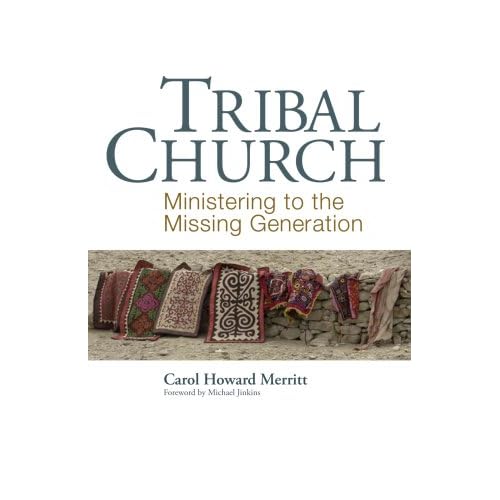
Reading Tribal Church

I just finished reading Tribal Church: Ministering to the Missing Generation by Carol Howard Merritt, the book we’re supposed to be reading for our next monthly district clergy gathering.

The book’s points can be summed up fairly briefly:

  • Young people are crunched from many directions today. They desperately need people to love them, accept them, and encourage them.
  • Most young people reject traditional sexual morality, if not for themselves, then for their friends. If we want to void alienating them, we will have to find ways to accommodate this rejection.
  • Most young people tend to be religious pluralists and soteriological universalists. We’ll need to respect and encourage diversity on all levels if we want to reach them. If we’re narrow-minded and preach/teach that Jesus is the only way, we won’t have younger people in our churches.
  • The church tends not to be very friendly or accessible to younger generations. We need to find ways to not only include people from younger generations in what we do, but actually give them power within our churches.

As one who would, in many settings, be labeled conservative, I find the first and last points more congenial to my convictions and approach to ministry. As one who used to be young, I know what it is to feel economic distress. I’ve been unemployed. I’ve had to move every few years. I do not own my own home and even with declining real estate prices see them as beyond my reach. In that context I know the pressure to have my wife and me both work full time “real” jobs so we can provide for our children and our future, and yet make the sacrifice to not do so for the sake of our children (one of whom has autism and needs and will always need special care).

I know how difficult the church can be for younger people. I’ve served churches where I get stern lectures for not kowtowing to racist attitudes and where I have the district superintendent called in to complain about my bringing in too many neighborhood kids. My wife and I have worked intensively with young couples to bring them into the church only to have them run off on their first visit to worship.

I know what it is to have church leaders consider “traditional” worship the only real (“reverent” is the commonly used word) worship, while folks from younger generations (including my own children!) yearn for a newer, livelier style. My own children are still a captive audience, but for how long?

The first generations of Christians were considered odd balls. They stood out in their communities. One characteristic that differentiated them was that they loved each other. This love was not merely in terms of kinship or blood relation. Well, it was blood relation – not their blood, however, but participation in a common redemption by the blood of Jesus. That kind of love across social boundaries attracted outsiders.

Christians in the ancient world were also considered odd for their exclusivism. When persecution arose, the authorities would have been happy to release their Christian prisoners – if only they’d add Caesar to their pantheon. It wasn’t like they’d have to actively worship Caesar or the gods of the state. Just a pinch of incense, just enough to fit in as good citizens. Those wacky Christians would rather suffer than honor any god other than the One incarnate in Jesus.

I suppose a difference between my position and the authors is that I see a need for Christians to be distinct from the broader culture. We need to be distinct from the broader “conservative” elements of culture (notorious for an emphasis on wealth, prosperity and economic freedom) and from the broader “liberal” elements of culture (notorious for an emphasis on sexual expression and freedom). The Christianity pictured in the New Testament was extremely diverse – but not diverse in every way. It wasn’t the diversity of say, having a pitcher, a goalie, a quarterback, and a forward on each team. Rather it was more like the diversity of having a pitcher, a catcher, outfielders and infielders on a team, playing a common game. The diversity of the church was also a transformative diversity – more than “let’s be friends and each pursue our individual projects and feel good together.” All were invited to Jesus. All were challenged to – and needed to! – repent. Some needed to change in their economic practices. Some needed to change in their sexual practices. Some needed to change in their relational practices.

I read this book as one yearning to reach the younger generation. But my call is to reach them specifically for the sake of Jesus, so they might become his followers. I know not all will initially be attracted. I’ll have to lovingly pursue them. I’ll have to befriend even people I don’t agree with. I’ll have to pray like crazy. But they’re worth it.

Posted in Books, church growth, Evangelism, Spirituality | 3 Comments