Hauerwas – Minds Worth Making Up?

We continued our discussion of Stanley Hauerwas’s essay from The Christian Century (1991), “Discipleship as a Craft, Church as Disciplined Community.” We spent most the time talking about our culture’s infatuation with autonomous individualism and how that infatuation shows up in church. Hauerwas uses the conclusion of Dead Poets Society to make his point.

He says,

Such a view of ethics [what we see in our culture, circa 1991] can appear quite anticonventional, but even the anticonventional stance gains its power by appeal to what anyone would think upon reflection. This can be nicely illustrated in terms of the recent movie, The Dead Poets Society. It is an entertaining, popular movie that appeals to our moral sensibilities. The movie depicts a young and creative teacher battling what appears to be the unthinking authoritarianism of the school as well as his students’ (at first) uncomprehending resistance to his teaching method. The young teacher, whose subject is romantic poetry, which may or may not be all that important, takes as his primary pedagogical task helping his students think for themselves. We watch him slowly awaken one student after another to the possibility of their own talents and potential. At the end, even though he has been fired by the school, we are thrilled as his students find the ability to stand against authority, to think for themselves.

Our culture assumes there are two options: either we “think for ourselves” or we “mindlessly give in to authority.” The first is obviously the right thing in our culture. That we should think for ourselves is true; that thinking for ourselves means thinking by ourselves, is a profound mistake.

The ethic of “thinking for ourselves” is related to the ethic of “being countercultural.” The culture, or to use a word we see in scripture, the “world,” is something we Christians differentiate ourselves from. We resist its guidance. There are two big challenges with this. First, all of us are in the world, being formed by the world. Second, the world is not monolithic. We can be counter to one part of culture while in complete captivity to another.

He continues:

This movie seems to be a wonderful testimony to the independence of spirit that democracies putatively want to encourage. Yet I can think of no more conformist message in liberal societies than the idea that students should learn to think for themselves. What must be said is that most students in our society do not have minds well enough trained to think. A central pedagogical task is to tell students that their problem is that they do not have minds worth making up. That is why training is so important, because training involves the formation of the self through submission to authority that will provide people with the virtues necessary to make reasoned judgment.

Hauerwas stomps on cultural orthodoxy here. How can we as Christian leaders have our minds formed – and contribute to the forming of others – so our minds can be relied upon to think well for ourselves? What he says here about “training” is essential – and we know it’s essential in other domains of life. Hauerwas is going to want to make these same claims about students in church, in Christian settings.

The church’s situation is not unlike the problems of what it means to be a teacher in a society shaped by an ethos that produces movies like The Dead Poets Society. Determined by past presuppositions about the importance of commitment for the living of the Christian life, we have underwritten a voluntaristic conception of the Christian faith, which presupposes that one can become a Christian without training. The difficulty is that once such a position has been established, any alternative cannot help appearing as an authoritarian imposition.

The simple “decision to follow Jesus” is a good starting point. That alone, however, won’t result in our being Christian disciples.

HERE’S the audio of our discussion.
Posted in Bible, Christianity, Culture, Discipleship, Ecclesiology, Stanley Hauerwas, Theology | Tagged , , , , | Leave a comment

The Chosen, Season 5 Episode 1

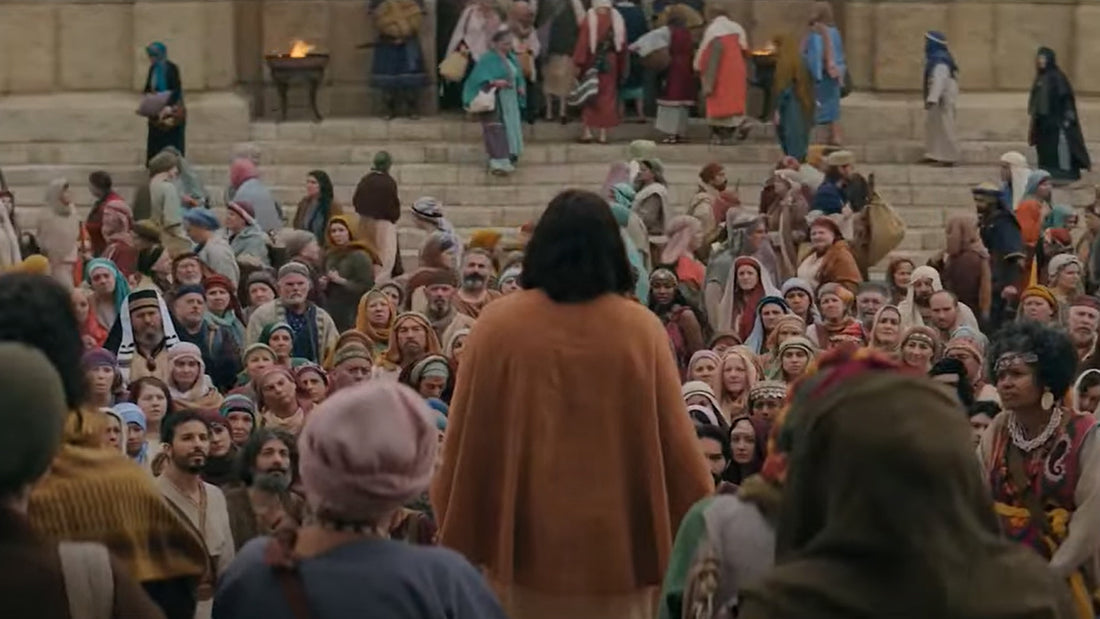
We’re back to watching The Chosen on Wednesday nights. Here are a few thoughts & observations from episode 1.

The biblical parts of the episode (as opposed to the imaginative parts) are mostly drawn from John 12, 16, and a bit of 17. The episode opens with Jesus talking to the disciples in the Upper Room and segues back to his Triumphal Entry a few days before. The disciples are alternating between feeling absolutely sure they know what’s happening to total incomprehension. Jesus, knowing exactly what lies ahead, doesn’t project the level of excitement the disciples do. The happiest we see him is when he stumbles into a betrothal ceremony.

Jesus’ friends among the Jewish religious leaders confront him when he’s on the verge of entering Jerusalem. They don’t think anything good will come from what he’s about to do. They fear for his safety. The biblical symbolism accompanying Jesus – the donkey he’s riding, the palm branches and cries of “Hosanna” – are speaking more loudly than he himself is. These guys sincerely wanted to help Jesus. I wonder how often we sincerely want to help Jesus but, like them, miss the point.

No one looks more excited than Judas. He is absolutely sure this is the time Jesus will openly claim the kingship.

The filmmakers get something right about the relationship between Pilate and Caiaphas: Pilate’s big concern was that there be no riots. Whatever else Caiaphas did, he needed to keep the peace.

There is a small group of anti-Jesus people who have arrived in Jerusalem shortly after Jesus and his band. They are absolutely sure Jesus is a false prophet who is leading the people astray. They are convinced that in opposing Jesus they are doing God’s work. I was reminded of Saul in Acts 9 “breathing out murderous threats.”

Posted in Bible, Jesus, The Chosen, Uncategorized | Tagged , , , | Leave a comment

Jesus vs. Mammon

Mammon (an ancient god of money/wealth) says, “You are somebody based on on your wealth or capacity for gaining wealth.” Jesus says, “I love you and bought you with my blood.” Though rarely mentioned by name these days, Mammon is still popular in our culture.

Posted in Consumerism, Discipleship, Jesus | Tagged , , , , , | Leave a comment

Tonight’s Sky

Posted in Nature, photography | Tagged , , | Leave a comment

Failure of “Liberalism” in Texarkana?

I see our town has made the OPED page of the NY Times. I see many scholars quoted (& I’ve read many of their books and value their perspectives), but I don’t see that they talked to anyone in Texarkana, whether in Bowie or Miller County.

I’ve lived in Texarkana for three years now (and have lived in the area in the past, going back nearly 40 years). I like this area. I see lots of progress and growth in Texarkana – and feel the pain (try I-30 sometime!) that growth brings. I see the dedication of city and community leaders. The big projects mentioned in the piece (and they miss the funding that went to our new airport) sound like good news for the community. But do we all experience all these projects in their fullness?

A generation ago the political slogan was, “It’s the economy, stupid!” The premise of Edsall’s piece is that since the Biden administration steered so much money, so many resources to the Texarkana area, residents ought to be grateful and give them votes. That’s not how either “the economy” or politics work.

Let’s say that a majority of voters in the region even know that all these projects are happening AND that it was “the Biden administration” more than their Republican representatives and senators bringing the largesse. Sure, imagining most know that is a leap – and a sure work of imagination. Even so, when does this take place? Are the projects fully up and running? Are members of the community experiencing them for themselves – and experiencing them as good things?

‘The economy” doesn’t happen instantaneously. Sure, politicians need to keep the focus on themselves to keep their ratings up and to get elected next time around, but the actions they take don’t immediately demonstrate their full results. And what do we mean by “the economy?” Do we mean the statistics and numbers we see on the business page and headline news? Do we mean what’s happening nationally? Do we mean what’s happening to our own jobs and finances?

Is the reason local voters go for Republicans over Democrats primarily economic? If so, which aspect of the economy are they voting on? Can the voters be bought? If they can be bought, do those doing the buying spend the time to find out what kind of buy out voters are looking for?

If I were a Democrat I’d get up close and personal with the voters. I’d ask, “What are you looking for? What is it about my brand that has caused my part to lose you over the past generation? What can we do to win you back?” Maybe the voters understand their reason for shifting to the Republicans. Maybe they can articulate their reasons. Maybe they’ll even tell the truth when asked by the opposing party.

I like the idea of elected leaders (on all levels) looking farther ahead than just the next opinion poll or election. I like to see them asking, “What is good for the country, for my region? How can I discern that good with my fellow citizens so I’m neither lording it over them with my superior wisdom nor pandering to their current desires?” I realize that our current political marketplace doesn’t reward that kind of thinking. That’s depressing (but not new).

Coming back home, I’ll say again that I appreciate our local leaders. I see them leading our city well. It’s not an easy job – and often a thankless job. Over the long haul, say, the next 20 to 30 years, I expect Texarkana to be much improved for all citizens. That improvement requires all of us to share in the work.

Posted in Culture, Current events, Economics, Politics | Tagged , , | Leave a comment

Thinking about BLS Statistical Reports

BLS reporting has been in the news lately. I only took one statistics class in college, so I recognize my limitations. Nonetheless, I have some “meta” questions:

Are “good” statistical reports ones that clearly “show my team’s policy to be right”/”show the other team’s policy to be wrong?” Or are “good” reports those that most accurately DESCRIBE economic reality? Given the way humans work, there is ample reason to assume these two approaches to defining a “good” report are not necessarily the same thing.

A follow up question, following closely on the first. Do we WANT “good” reports? If I were in charge of economic policy and could demonstrate some cause and effect relationships between a statistical report and the policies my team was enacting, I would seek to learn from that report so I could adjust our policies appropriately.

Knowing that every policy has near, medium, and long term effects, AND knowing that every report of this large complex system we call “The Economy” (or even the subset called “The Labor Market”) is only an approximation, I know there are always limits on my knowledge.

If I operated on the alternative understanding of what makes a report “good” and cared (publicly at least) only that it made my team look good or the other team look bad, then I if I were an objectivist in the sense of believing that the world is the way it is whether I like it or not, I would have to live with the fact that reality may come back and bite me someday. If I were a subjectivist, i.e., if I believed my beliefs about the world MADE the world the way I believed it to be, then, Hey – I could believe whatever I wanted with no consequences.

Scott Lincicome, an economist who knows way more than I do on the subject, has SOME THOUGHTS. (The image above is from Lincicome’s piece)

Posted in Culture, Economics, Epistemology, Market, Politics, Wisdom | Tagged , , , , , , , , | Leave a comment

Hauerwas – Beyond “Friendly” Church

We continued working through Stanley Hauerwas’s essay, “Discipleship as a Craft, Church as Disciplined Community.” (Link to audio) We began with a quick return to the second paragraph which we’d started on last week:

That the church has difficulty being a disciplined community, or even more cannot conceive what it would mean to be a disciplined community, is not surprising given the church’s social position in developed economies. The church exists in a buyer’s or consumer’s market, so any suggestion that in order to be a member of a church you must be transformed by opening your life to certain kinds of discipline is almost impossible to maintain. The called church has become the voluntary church, whose primary characteristic is that the congregation is friendly. Of course, that is a kind of discipline, because you cannot belong to the church unless you are friendly, but it’s very unclear how such friendliness contributes to the growth of God’s church meant to witness to the kingdom of God.

For the church to understand itself as a disciplined community is very difficult in our culture. When he describes us as having a “buyers’ market,” he’s making the claim that churches need to attract people. In order to attract people, we need to give them what they want. Most aren’t looking for transformation or discipline. Now more than ever, people are inclined to look at discipline as “oppression” or a restraint on their “freedom.” They’re looking for occasional help to meet their felt needs. If we are friendly, we can draw in people who are looking for friends, for people who will not only accept them but affirm them unconditionally.

Friendliness, like tolerance, is a good thing, but can easily be a watered-down substitute for love. Jesus commands us to love one another. Jesus demonstrated love for us not just by a pleasant, inoffensive amiability, but by calling people to repent and put their faith in him. He offered (and offers) unconditional love, but that love sets us on the path to become like him.

When we think about the true goods of “friendliness” in combination with Jesus’ love command, we come to friendship, which is a deeper thing than mere friendliness. Friendship pushes beyond the superficial, the veneer of inoffensive niceness. Real friendship acknowledges and works through issues of discomfort. Friendship takes work – even discipline.

In our discussion more points were raised:

First, friendliness may a starting place when we meet new people, at least when that “meeting” is an instance of their “visiting the church.” In such cases friendliness is necessary but not sufficient. We’re praying instead that God will be doing a work in and through us such that our life together – and our life expressed outwardly – is unintelligible to outsiders. That lack of intelligibility (seen in places like Acts 2 and 1 Peter 3) is an occasion for Christians (disciples!) to answer the questions and to point to Jesus.

Second, a question was raised from a presentation at our monthly men’s’ breakfast meeting that morning. Our guest speaker started by saying he’d just finished his doctoral research. In that research he’d discovered that something like 64% of kids raised in church left the church after high school. That statistic was the premise of his presentation of Bible classes being offered to kids in area schools. The question one of our men brought to our class was why the church is doing so poorly. The answer took two main tracks. First, we talked about how kids get so little teaching/formation time in church. If they are in Sunday school every week of the year and have substantive formation for a whole hour each time, that’s only 52 hours a year. But: Most church kids aren’t in Sunday school every week. Most Sunday school classes don’t have a solid hour of substantive formation each week. Also, even on a maximal conception, say the kids are “in church” three hours a week every week, if that is their only discipleship, that short amount of time is overwhelmed by a massive amount of “discipleship” offered by peers, on screens, or by the world. The missing link is parents and families. Churches and classes, whether classes overed by churches or by parachurch organizations like the one we heard about this morning, have much less time and connection with kids than do their parents.

Finally, we turned to a discussion of tradition. Receiving and transmitting tradition well is difficult. Jaroslav Pelikan’s famous comment is a useful starting point.

Posted in Bible, Consumerism, Culture, Discipleship, Secularization, Stanley Hauerwas | Tagged , , , , , , | Leave a comment

Willing Participants?

God invites people to be willing participants in what he’s doing in the world. Sometimes we join in… sometimes like Jonah, we prove to be unwilling participants. There is great blessing in store for those who join in God’s activity.

Posted in Bible, Christianity, Doctrine, Jesus, Old Testament | Tagged , , , , | Leave a comment

Hauerwas on the Church “Standing against the powers we confront”

We continued working through Stanley Hauerwas’s essay, “Discipleship as a Craft, Church as a Disciplined Community.” You can listen to the audio HERE.

Hauerwas is talking about the church of our age (he’s writing in 1991, but it seems still applicable 34 years later) focusing first on being a “community of care.” Because our initial (and primary) focus is on being “caring” we lack the ability to “build the church as a community capable of standing against the powers we confront.”

We spent most of our time today looking at “powers we confront.” We saw that while we can easily name the world, darkness, evil, and media as some of those “powers,” those powers are not just “out there.” There are significant ways Christians/churches have been infected by these powers. Too often we are blind to the ways we are infected. As we proceed in Hauerwas’s essay, we’ll see that becoming a “disciplined community” is a requirement for gaining the discernment we need to know what we’re confront, where it is, and how we do our confronting.

We looked at two verses in the Old Testament, Genesis 15:6 and Psalm 106:31. Both use the language of “righteousness being credited” to someone due to an act they’ve performed. In Genesis, the actor is Abram. Confronted by the reality of his childlessness, he cries out to God. God promises progeny. Abram’s action in response is “belief.” “Abram believed God and it was credited to him as righteousness.”

Psalm 106 recites stories of Israel’s rebellion in the face of God’s faithfulness during the time of the Exodus. In v. 30-31 we read, “Phinehas stood up and intervened, and the plague was checked. This was credited to him as righteousness for endless generations to come.” We have to go back to Numbers 25 to see what exactly Phinehas did that was “credited to him as righteousness.” Their we see his zeal for God and God’s honor led him to pick up a spear and skewer two blatant sinners. This story of zeal for God and the righteousness it produced was later significant in the self-understanding of the Maccabees and those who looked to them as heroes.

The person we know as Paul the Apostle was zealous for God. In his days as Saul of Tarsus he was zealous in the way of Phinehas, seeking righteousness by punishing those who were dishonoring God and leading Israel astray: Christians. After running into Jesus on the road to Damascus he shifted to a different way of righteousness, the way of Abraham, exemplified in the way of Jesus. Paul lays this out most explicitly (but not entirely explicitly) in Philippians 3. Both the ways of Abram and of Phinehas are biblical. Both are approved of in the Old Testament. It’s only in Jesus that we see the way of zeal becoming a way of taking up a cross, choosing suffering, and dying. Like Abraham, Jesus – and Paul – were in places that only the work of God could bring life out of death.

Posted in Bible, Christianity, Discipleship, Ecclesiology, Stanley Hauerwas, Violence | Tagged , , , , | Leave a comment

God’s Passion for People

In the book of Jonah we see God’s passion for people. That passion is demonstrated not just on behalf of “his own” people Israel, but even on behalf of their enemies in Nineveh, the capital of the Assyrian Empire. The book closes in chapter 4 with God showing even his passion for the reluctant prophet Jonah.

Posted in Bible, Doctrine, Evangelism, God, Jesus, Love, Old Testament | Tagged , , , | Leave a comment