The Chosen, Season 4 Episode 5

Last night we watched another episode of The Chosen. Jesus and his disciples are making their way from Galilee to Jerusalem. The action goes back and forth between Jesus and the disciples – altogether or in smaller groups – and a couple rabbis who find themselves in the turmoil of the San Hedrin after they’ve encountered Jesus.

As Jesus and his crew are on the road they encounter a company of Roman soldiers. The soldiers, as is their right under the law they’ve imposed, compel Jesus and the disciples to drop their own luggage and carry the soldiers’ loads for a mile. Jesus himself is compelled to carry a load and to wear the helmet of one of the soldiers. Seeing this, one of the disciples says to another that he is “murderously angry” about what the Romans are doing to Jesus. We don’t know enough about this disciple to know how much difference his time with Jesus has made in his life and whether his not acting on his murderous rage is a new thing or not.

How often do we find ourselves “murderously angry?” How often is our rage aroused by what’s been done to us? How often by what has been done to others? How often by what we perceive to be done to Jesus? What is Jesus’s will when it comes to existence and function of “murderous anger” in our lives?

When they finish their legally required mile, the disciples start putting down the loads they’ve been carrying. Jesus, however, keeps right on going. The disciples are confused. The Roman soldiers are even more confused. They initially even show some fear as if they’re wondering about Jesus being some revolutionary madman who has nefarious purposes up his sleeve. Jesus explains that they did one mile because of coercion, but now they’ll do a second mile out of volition.

How often do our actions as Christians – our obedience to the commands of Jesus – confuse the people around us? What advantages came from Jesus confusing people? What advantages might come from Christians living and acting in ways that don’t make sense to the watching world?

To what degree in in what areas are we willing to go beyond what is legally required of us? Do we adhere to the letter of the law and nothing more? Why would Jesus teach his disciples to “go the second mile?” Why would “going the second mile” make any sense when it is for the benefit of an oppressor, an enemy?

When they return to their own luggage Jesus’s disciples express their confusion to him. Jesus points back to his teaching they they themselves has heard. “When you are troubled, think back on my message.” Why do you think the disciples failed to remember what Jesus had said? Do you think they grasped this particular message when they first heard it? Do we have a practice of thinking back on Jesus’s teaching when we are confused?

After they’ve settled in at the house of his friends in Bethany, Jesus tells the parable of the workers in the vineyard (Matthew 20:1-16). Again, the disciples are confused. “Is the Kingdom unjust?” they ask. It sounds that way to them. Some people worked all day, others worked just an hour. Each received the exact same pay. They’re sure that’s not how the world ought to work. Jesus responds that the kingdom is not based on what we deserve.

How concerned should we be that Jesus’s teaching doesn’t confuse us as much as it did his first disciples? Showing their confusion and the degree to which they just don’t “get it” is a strength of The Chosen’s presentation of the disciples. Are we less confused by Jesus’s teaching because they and the generations between them and us have done such a good job forming us in the ways of Jesus? Or are we less confused because we’ve had generations to domesticate Jesus’s teaching so we now “know” that there is no real conflict between his ways and the ways in which our culture has formed us? What can we do so that Jesus’s teaching again has a sharp edge to challenge and provoke us?

We see Mary and Martha and their different approaches to serving Jesus. The episode puts his conclusion this way, “The best way to serve me is to pay close attention to my words.” That is exactly what Mary was doing. There is the background assumption, however, that paying close attention to Jesus’s words is more than hearing but also includes obeying and putting into action.

We see Jesus conversing with his mother, who has taken up residence there in Bethany. She senses that Jesus is frustrated. This is the same frustration that carries over from the previous episode. Jesus is concerned that his disciples just aren’t getting it. “They act in a way like they have not absorbed a word I’ve said.” The issue has not come up in The Chosen, but when we consider modern American Christianity the focus is commonly on being certain of our eternal destiny rather than on acting like we’ve absorbed Jesus’s teaching. It’s as if our Protestantism has forced us to think being a Christian is only about believing (because that is what it meant by “faith”) that life change is optional.

Jesus says (and this is The Chosen, not scripture), “The human desire to avoid difficult news sometimes makes one deaf.” If I don’t want to hear something, then I won’t hear it. If might be that it “goes in one ear and out the other” or that I intentionally(?) misunderstand it so that it doesn’t challenge me. How can we become people who “have ears to hear?” How can we learn to recognize our failures in hearing?

Judas meets up with his mentor Hadad. Hadad pushes Judas to assert himself and his worth. After all, Judas has special skills and he ought to be appreciated – and rewarded for them. Judas tells Hadad, “I’m new, so my opinion doesn’t count for much.” The context of this comment is the slowness with which Jesus is advancing his work. He’s encouraged to “Help Jesus act like a king.” Judas is absolutely sure Jesus is the Messiah. He is also absolutely sure he knows that “Messiah” means and therefore what Jesus is up to. We see the first signs that Judas will feel the need to push Jesus to move in the “right” direction, that is, toward raising an army and opposing Rome. In other words, Judas is on a par with the other disciples as “not getting it.” He has not understood that Jesus’s kingship (and his kingdom) does not work like the kingship/kingdoms he knows in this world.

Posted in Bible, Culture, Discipleship, Jesus, Kingdom, The Chosen, Theology | Tagged , , , , , | Leave a comment

An AI Test

AI TEST:
I gave this prompt to a few AIs this morning: “Can you create a list of daily reading assignments such that one can complete the whole New Testament, from Matthew to the end of Revelation, in the days between March 5 and April 19? The assignment each day should be a range of whole chapters but also trying to get as close as possible to equalizing the amount of text read each day.”

Copilot – I couldn’t get Copilot to do the whole New Testament, even with several attempts.
Claude – Of the various AIs I use Claude the most frequently. Claude took one look at the task and declined the opportunity.
ChatGPT – ChatGPT cheerfully took on the task and readily divvied up the whole New Testament between those days. It did it in such a way that it assigned 24 chapters for the final day. I prodded it a few times and it recognized its mistake and churned out a new list – exactly like the previous list, even telling it there were now fewer chapters in the final day. When I asked it to explain how the reading 2 John through the end of Revelation was only 18 chapters it quit.
Gemini – Gemini got it right on the first try.

Note: I was using the free version of Claude and ChatGPT.

Posted in Artificial Intelligence, Bible | Tagged , , , , , | Leave a comment

The Chosen, Season 4 episode 4

This episode was dense with stories drawn from the Gospels as well as advancing extra-biblical characters’ stories.

At no point do the disciples figure out exactly how and when Jesus heals a person. They never stop wondering how they can can a handle on Jesus so they can predict his actions. At one point one disciple comments to another, “We are his students, not his equals.” The desire to predict Jesus’s actions, to get him to reliably do what we want, has been a challenge for disciples from the beginning.

When reflecting on the death of one of the disciples Jesus says, “This is the way of all the earth. For now.” The recognition of the universality of death is necessary, but easy to make. If we take off our willful blinders we see death all around us. We know we will all die. It’s the second sentence where Jesus says the unexpected. Death reigns over us all – but its reign will come to an end. This saying of Jesus is not from the Bible, but it reflects his plan to deal death a mortal blow.

A disciple is grieving the death of another. Peter comes to Jesus wondering what he, The Rock, can say that will help. Jesus tells him that being with the friend who is grieving is more important than finding words to say.

Thinking back to his own grieving over the loss of a loved one, Peter mentions going through a time where he “Resented Jesus’s miracles for others” when he didn’t get one for himself. With the perspective of time Peter recognized that the time of loss “Made me desperate for him [Jesus].”

James and John reflect on their relationship. All their life they had been James AND John, a pair, not individuals. When Jesus sent them out two by two each one went out with another. During that time John bonded deeply with Thomas. We’ve seen the division Jesus creates within families elsewhere in The Chosen storyline. Here we see the flipside of Jesus’ devaluation of natural family bonds. New and deeper bonds are created between his followers based on their shared faith in him. This is still one of the hardest things for disciples to hear today.

Asked about his prayer life, the deeply grieving disciple says, “I do my prayers but its hard to mean them sometimes.” What’s the difference between saying something and meaning something? How are the two actions related? What is their relative value in our life as disciples?

In conversation with Little James and Thaddeus, Jesus observes of the disciples that they are expending great effort to either show themselves to be right or to show others to be wrong.” This expending effort to establish our self-righteousness has not lessened in all these years.

A Gentile who has come to faith in Jesus says to the disciples he is opening up to, “I have heard him say words that unscramble a lifetime of mystery.” This ought to be a common experience for new Christians, for people our churches are reaching through evangelism. If this is going to happen in our setting, we’ll need to offer more than an encounter with a voluntary organization that fills their lives with busyness and regular eating opportunities. Don’t get me wrong: I love the opportunities we have to eat together and see them as potentially being a way we copy Jesus’ own ministry (though as an aside, this aspect of Jesus’ ministry has not been highlighted yet in The Chosen). But what people need is an encounter with Jesus through the Holy Spirit. This Gentile experienced real life change and his world was turned over because of it. There’s great excitement that comes from seeing this happen. We’ll probably not experience that kind of excitement as long as we’re satisfied with shuffling sheep from church to church.

In conversation with Matthew and Peter the Gentile highlights a perceived barrier to his coming to Jesus: “I’m an outsider.” By that he meant a “non – Jew,” assuming that Jesus as Messiah was for the Jews only. Peter has learned enough by this point to tell him that as an outsider he’s exactly the kind of person Jesus would be looking for. Those who have been watching the program will know that Peter’s ability to say this is not just based on his knowledge of Jesus’ teaching, but on the fact that Peter himself had been building a relationship with this Gentile. He doesn’t know him as just “a Gentile” – or more pejoratively, “a Roman enemy,” but as “Gaius.”

As soon as the Gentile convert gets home from his encounter with Jesus the first thing he does is extinguish the candles at the household lares, the family altar to the gods. In so doing he is renouncing his allegiance to those gods.

Partially at the urging of their mother, James and John finally ask Jesus their question. After all, Jesus has told them to ASK, right? They ask, “When you come into your kingdom can one of us sit on your right, the other on your left?” To James and John this question makes perfect sense. They KNOW who Jesus is. They KNOW he is the Messiah. They KNOW the Messiah is bringing the kingdom. They KNOW what the kingdom is. Jesus is in shock that they could ask the question, telling them they have no idea what they’re asking for. The filmmakers bring together here the story of this encounter in Mark 10 with Jesus’ statement about what awaits him from Mark 8 (right after Peter’s confession of his identity). Jesus tells them that they’re “acting like Gentiles,” and acting on a Gentile presumption of what the kingdom is like. “This is not how it will be among you,” Jesus says.

In the next scene with Jesus we see him in mourning. The only words we hear are Jesus praying Psalm 38. In context, this is a Psalm of confession of sin. Jesus, however, is not confessing sin, but laying out his burden of failure before the Father. He’s spent so much time with the disciples, seeking to teach them his ways and impart his character. And yet even those he’s spent the most time with, those who have seen the greatest miracles, don’t seem to get it. As one who has felt a similar burden of failure in recent years I found this comforting.

Posted in Bible, Christianity, Death, Discipleship, Evangelism, God, Jesus, The Chosen | Tagged , , | Leave a comment

The Squeaky Wheel

What’s the problem with a squeaky wheel? Is it that it is squeaky, that it makes a noise we find unpleasant, perhaps even a noise that grates on our ears? Or is it that a squeaky wheel is in some sense a dysfunctional wheel, a wheel that no longer does what it was made to do?

In my thinking the two problems – the attention-getting sound and the dysfunction – that make the squeaky wheel a problem. “The squeaky wheel gets the grease” so that we can turn our attention to what we’re trying to accomplish rather than to the means by which we’re trying to accomplish it.

Reading Friedrich Hayek’s essay, “The Use of Knowledge in Society,” I ran across this quotation from Alfred North Whitehead. Normally, I’m not a fan of Whitehead (given his connection to process theology), but I find this exactly to the point:

It is a profoundly erroneous truism, repeated by all copy-books and by eminent people when they are making speeches, that we should cultivate the habit of thinking what we are doing. The precise opposite is the case. Civilization advances by extending the number of important operations which we can perform without thinking about them.

When I’ve driving down the road a (literal) squeaky wheel gets my attention. I start worrying about my car. Is something wrong with my tire? With my brakes? With the CV joint? Do I need to stop and get it fixed? Can I find a shop that can give me an accurate diagnosis in a timely and affordable manner? If I get a diagnosis, will they be competent to fix it? If I don’t stop and give it attention immediately, will my car break down so that I’ll be stuck far from any services?

All the time I am thinking about the squeaky wheel I am not able to give as much attention to other factors. Am I on the right road? Am I driving the legal speed limit? What are the cars around me doing?

Staying in my car we can take Whitehead’s observation a different direction (leaving the wheel behind). When I was first learning to drive I had to pay attention to every detail. My bodily attention was stressed by just a short drive: my attention is limited and having to give explicit and constant attention to so many things wore me out. With practice, however, I became a more skilled driver. Part of being a more skilled driver was making my driving more automatic, less needy of focused attention on so many things at once.

In the course of being a Christian over forty years now, I have had many occasions in which I experienced conviction of sin and the felt need for repentance. As I dealt with my sin I recognized the need to beware of temptation and the occasions for temptation that would lead me the wrong way. At first, this new awareness required close attention on my part. Over time the combination of three things lessened my need for close attention:

  1. A sustained desire to not sin.
  2. Practice resisting temptation, i.e., gaining experience resisting this particular kind of sin.
  3. The presence of supports that make sinning less natural. These supports might be practices I take up (prayer, engagement with scripture, serving others) or persons who come alongside me (fellow Christians, the Holy Spirit).

Resisting sin is not the end of the Christian life: life with God and living out love for God and neighbor is the point. The less focused attention I have to give on resisting sin, the more my resistance becomes automatic, the more focused attention I can give to my life with God and loving God and neighbor.

As a pastor, one of my jobs is to help my people experience these three things in their lives. Given that job, how does my being a “squeaky wheel” in their life help or hinder my work?

It might be that by calling for their attention, I enable them to focus on the message directed at them by the Holy Spirit. The more my “squeakiness” is about me, drawing attention to me or making me the center of attention, the less likely, however, that my “squeakiness” will be a help to them. If I truly want to help people, I will need to find ways to deal with my own issues, particularly my felt need for attention and affirmation, that don’t impair their ability to hear the Holy Spirit. Perhaps I can point at John the Baptist here. When people encouraged him to be envious of Jesus’s greater success in drawing a crowd John’s response was, “He must increase, I must decrease.” John’s purpose was to prepare the way for Jesus. He’d done that. He’d been successful. His continued success was not dependent on drawing people to give their attention to him, but to direct their attention to Jesus.

Posted in Discipleship, Love, Sin | Tagged , , | Leave a comment

Derangement Syndrome?

Over the years I’ve seen (though the exact terminology is more recent):
Reagan Derangement Syndrome
Clinton Derangement Syndrome
Bush Derangement Syndrome
Obama Derangement Syndrome
Trump Derangement Syndrome
Biden Derangement Syndrome

Now we have a reprisal/continuation of Trump Derangement Syndrome.

Each of these have provoked strong negative reactions from their ideological opponents. Some of these reactions are rational (or have rational components), some are more visceral, some are mostly (if not wholly) ideological. I may be a victim myself, but it seems like the most recent object of derangement positively enjoys creating it.

On the other side there’s the Cult of Personality for some of these individuals. Maybe we can call that a “Euphoria Syndrome.” I’ve seen cults of personality built around Reagan, Obama, and Trump. Sometimes the derangement is a response to the cult of personality.

Speaking of people as suffering from a “derangement syndrome” or as participating in a “cult of personality” may have elements of truth, but the language lends itself to giving us excuses for not taking them seriously. They are having mental problems. We imagine, “There’s no way they could think that way unless they were evil, deluded, or mentally incompetent.” But what if they’re just wrong?

Posted in Elections, Politics | Leave a comment

The Value of a Shared Understanding

Mikey’s Funnies had this joke yesterday:

A guy had to ask his neighbor for help getting his new sofa inside the apartment because it got stuck in the door.

After about twenty minutes of vigorous pushing and maneuvering, the guy pants, “I think we’ll have to call it a day. There’s no way we’re getting it inside.”

The neighbor looks at him slowly, “Wait, INSIDE?”

Do we have a shared understanding of what we’re trying to do? These guys (the picture was created by GROK AI) share the concept “sofa” and “move sofa.” They do not share a concept about which direction they should be moving it. In this case there is a simple solution: the man who owns the sofa should engage in clear communication and say something like, “Please help me get my sofa INSIDE my apartment.”

Most of our current lack of shared understanding is not so simple. We don’t have shared understanding whether the sofa should be in or out. We don’t have shared understanding about who should do the work of moving the sofa. We don’t even have shared understanding about whether it is a sofa or if it is, whose it is.

Even worse, it seems that we don’t even think having a shared understanding is a good thing (unless maybe the shared understanding is entirely of our own choosing).

Posted in Culture | Leave a comment

A Less Bad Culture War?

If we have to have a culture war, I wish we could conceptualize it in ways that were better for the country.

Looking at Kyle Chan’s analysis of Chinese economic progress & challenges, Noah Smith claims that we’re getting ourselves in a bad spot:

Posted in Culture, Current events, Economics, Politics | Tagged , , , | Leave a comment

The Chosen, Season 4 episode 3

Some thoughts & questions from The Chosen, Season 4, episode 3:

The episode starts with the story of David fasting and calling out to God for the life of his infant son. He and his wife Bathsheba (that he stole from his faithful servant Uriah) are both heartbroken over the death of the baby. The point of contention between them – which turns out to be the focus of the episode – is that God heals sometimes, but not every time. David tells Bathsheba that even though his prayer for healing was not answered, he still choses to worship and serve God.

More curious was a line spoken by one of David’s attendants at the very beginning. Two of them are shown worrying about David. David hasn’t eaten anything in several days and they’re worried that he’ll die. They’re afraid that they will be held accountable – as if it will be judged to be their fault – if their master dies. One says, “The regime has slaughtered people for less.” I didn’t expect the filmmakers to include this level of critique of David’s rule. This brings to mind the issue of David wanting to build a temple for Yahweh. We read in 1 Chronicles 22:7-8

David said to Solomon, “My son, I had it in my heart to build a house for the Name of the LORD my God. But this word of the LORD came to me: ‘You have shed much blood and have fought many wars. You are not to build a house for my Name, because you have shed much blood on the earth in my sight.'”

The story of David’s wanting to build a temple for the LORD occurs in 2 Samuel 7 – before the Bathsheba/Uriah episode.

Jesus heals a blind man – without much consultation. Details in this story make the Bible reader think it is the story from John 9. The filmmakers take liberty with the story, resituating it in Capernaum from Jerusalem. It leads directly to a major confrontation with the Pharisees (“He blasphemes and breaks the Sabbath!”).

At the end we see the top Roman administrator for the village go off the deep end. He ends up killing one of Jesus’ followers. Most of Jesus’ disciples are interceding, begging Jesus to intervene and bring healing. Jesus healed a blind man – why not this person? Jesus raised Jairus’s daughter from the dead, why not this person? Don’t you care Jesus? And yet Jesus does nothing.

In the New Testament we see Jesus doing many healings. Sometimes it seems that he’s healing everyone, right and left. One time we’re told, however, that he went to a place and wasn’t able to do much there because of the people’s unbelief. Unbelief is not the problem in this episode. Jesus is surrounded by people who believe he can heal – even raise the dead. And yet Jesus does nothing.

It’s so hard for the disciples – the disciples then as well as disciples now – to realize that Jesus’ agenda is not merely physical healing for people. It is so hard for us to submit to a God who doesn’t do everything we want. We’d prefer a God who was subservient to our desires. We don’t get that God in either the Old or New Testaments. We get a God of love in both parts of the Bible, but that love is not exactly what we’d prefer.

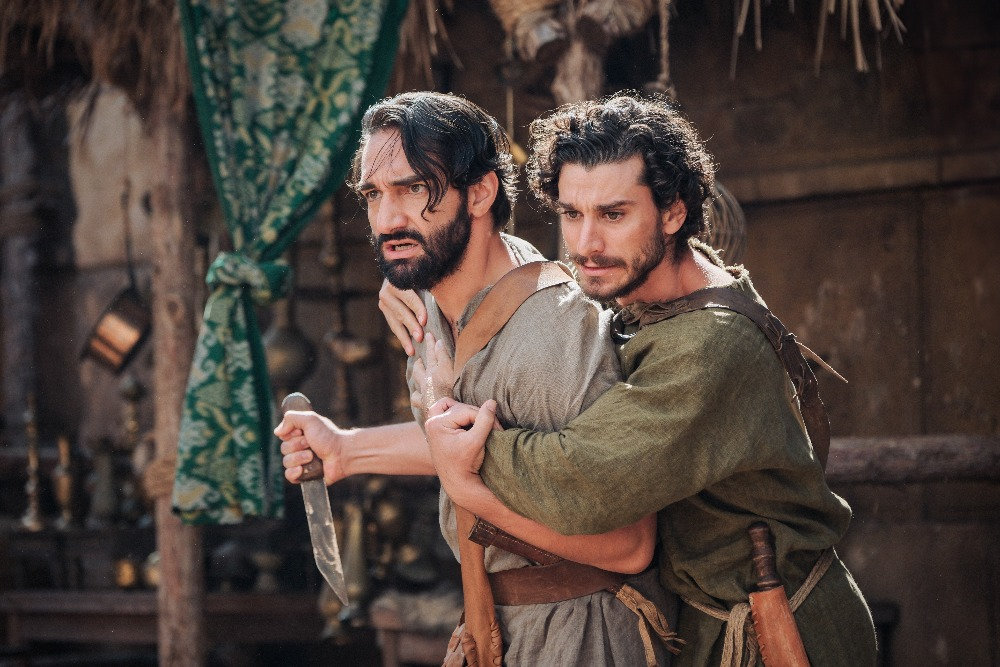
We see other disciples (depicted in the picture above) who reverted to their pre-Jesus way of thinking. Their gut reaction, “One of ours is attacked? We need to attack back!” Violence is so close to the surface for so many, whatever the time, whatever the culture.

Posted in Bible, Death, Discipleship, God, Love, The Chosen, Violence | Tagged , , , , , , , | Leave a comment

The Chosen, Season 4 episode 2

Some thoughts and questions from The Chosen Season 4 Episode :

– Jesus and Andrew are talking about the recent death of John the Baptist. They get to a point where they’re both laughing, and Andrew wonders if it’s ok to laugh, if laughing is compatible with grieving.

– Jesus takes the disciples to a pagan worship area at Caesarea Philippi. They’re disgusted by what they see the pagans doing. Jesus asks, “Are you ready to follow me even if it leads to a place like this?”

– We see Peter’s confession of Jesus’ as Messiah (and his new name). What I wonder about is the moviemaker’s decision to separate that confession from Jesus’ statement that he will go to Jerusalem, be rejected, killed, and raised on the third day. Each of the synoptic gospels puts these events adjacent to each other. I’m waiting to see where The Chosen will put Jesus’ comments.

– Matthew and Peter both take their feelings of guilt & unforgiveness to Jesus – exactly the right thing to do. Jesus tells Matthew, “You don’t apologize to be forgiven. You apologize to repent.”

– With his new name Peter and the others are wondering what it’s supposed to mean. So far he seems like the same person. Asked about it Jesus says, “I make people what they aren’t.”

– Peter’s first important act of leadership was to publicly forgive Matthew.

Note: If you have not seen The Chosen, it is an imaginative retelling of the story of Jesus. Some of the stories and dialog come directly from scripture; most, however, does not.

Posted in Bible, Discipleship, Forgiveness, Jesus, Leadership, Sin, The Chosen | Tagged , , , , , , , | Leave a comment

The Chosen, Season 4 episode 1

A couple thoughts on the first episode of season 4 of The Chosen.

– Judas and Zee are doing laundry. Judas wants to do more to support and advance Jesus’ mission. He brings up that they each have a “former way of life in the world, Zee as a zealot working for violent revolution against Rome and Judas as a businessman. Judas is convinced there ought to be some way to adapt their “former way of life in the world” so it serves Jesus and his Kingdom. Judas is not wrong, but this is a difficult question for all of us to work through. Repentance is a “turning from.” It’s not just a “turning from” my personal sins; it’s also a “turning from” my former way of life in the world” and a “turning to” Jesus’ way. Looking at Christian history it looks like our repentance (our “turning from”) is usually more partial than we’d like to think, and our “turning to” less than we imagine.

– The episode focuses on John the Baptist. Unlike Zee & Judas his “way of life in the world” was on a single track from birth to death. It’s easy to look at his life and the way it ended as a sad failure. But he and Jesus’ disciples count him as having fulfilled his mission. Can we fulfill our mission without the signs of worldly success we seek?

Posted in Bible, Death, Discipleship, Jesus, The Chosen | Tagged , , , , , , | Leave a comment