
I first noticed this meme circulating several years ago:
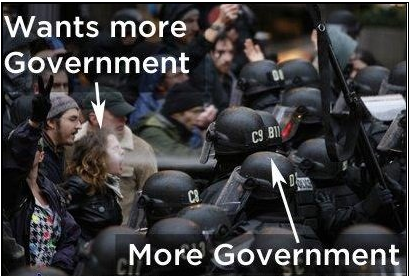
The first assumption is that the people on the left are, well, leftists, and that being “of the left” means desiring “more government.” Given this assumption, the meme, produced by an opponent of that desire associated with the left, attempts to be a reductio ad absurdum of the leftist position. That is, “Leftists say they want more government. Here is a picture of what ‘more government’ looks like. We’ll see how long they hold to such an absurd position.”
That’s the first assumption.
There’s a second assumption worth consideration. That’s the assumption common to at least some opponents of the left that the legitimate purpose of government is maintaining order. Since there are forces that seek to destabilize order, for example, criminal, terrorists, enemies, and (illegal?) immigrants, we need government – and sometimes more government – to oppose those forces of disorder and to impose order. We identify those legitimate functions of government as being carried out by our military and various police agencies.
It may be the case that Max Weber’s claim that government should have the sole legitimate claim to use of violence is very popular. It is not the case that this account of the purpose of government is universal.
I’m not one of those protesting for “more government,” but my assumption is that those who are are not defining government and its proper functions the same way as their opponents. They are likely putting value on the role of government as an agent producing positive liberty (the capacity to do things, individually and corporately) and not just negative liberty (the lack of restraint).
Providing schools, clean water, reliable electricity, and a road system are a few aspects of a government system that produces positive liberty. There is nothing in this that entails an increased number of armed agents deployed to (legitimately) employ violence.
So yes, the meme may get a laugh from those who take extending negative liberty to be the only legitimate function of government, but it misses the prior and most important question, “What is government for?”

 Bandits No More