Friendly & Loving?

We’re in the midst of some big changes. As of June 1 we’ll be part of the North District of the Texas Conference of the United Methodist Church. The old Texarkana District will be history. Conference wide we’re seeing a huge shift in accountability structures. The Annual Conference will exist to equip local congregations (like ours) to fulfill our mission to reach people for Jesus. That’s a huge change from the ethos of the local church existing to support the general church.

At the closing worship service for the Texarkana District we heard one way this will work itself out. In her first year in the Texas Conference Bishop Huie visited all the churches, inquiring into their strengths and challenges. Can you guess what the most commonly reported strength was? “We’re a friendly loving church.” It sounds better than, “We’re an unfriendly hateful church,” doesn’t it? But the dirty little secret of our “friendly loving” churches is that they’re not fulfilling their God-given mission. Some are so self-absorbed in their friendly love that they want nothing to do with outsiders (I’ve pastored one of those churches before). Some settle for being loving by just being nice to people. When it comes to evangelism we either reduce it to “being nice” or we add the thought, “When people see that I’m a nice person they’ll come to believe good things about Jesus.”

I don’t know if outsiders think of our churches as “friendly and loving” or not, but the statistics have been consistent over many years: we’re not winning people to Christ. Many churches aren’t even maintaining their membership levels. Attendance is dropping. “Friendly and loving” may be nice, but it’s not fulfilling our primary mission (Remember – Jesus said, “Go make disciples of all nations. Baptize them in the name of the Father, Son and Holy Spirit, teaching them to obey everything I have commanded you.” – That’s our mission).

Bishop Huie has noticed how many churches are happy to be friendly and loving while the people around them miss Jesus. Our preacher Sunday night, retiring Texarkana District Superintendent Howdy Dawson, reported that she told the cabinet, “If I hear one more church say, ‘We’re friendly and loving’ I think I’m going to puke.” Mighty strong language from a bishop. And just what we need to hear.

Howdy recognized the seriousness of the issue. He spoke of being a friendly loving pastor to friendly loving churches throughout his whole ministry. Everyone who knows Howdy knows he has a big heart. We like friendly and loving. But Howdy said that after listening to the bishop over the past couple of years he’s wondering if he hasn’t missed something – that by settling for being friendly and loving he’s missed out on leading his churches to reach people for Jesus.

Instead of being held accountable for being friendly and loving, we’re now going to have to give account for winning people to Christ. That’s going to cause some discomfort and conflict. We’re going to be roused from our sentimental apathy, complacency and comfort. Nice just won’t cut it anymore.

The bible says, “We love, because he [Jesus] first loved us.” That same book said that that same Jesus is the standard for our love. If we really love people we will tell them about Jesus. Though it’ll cost us, we won’t settle for having them think, “Those Methodists sure are nice.” Instead it’ll be, “That Jesus those Methodists exhibit sure looks interesting. I think I’d like to follow him too.”

Posted in Uncategorized | 6 Comments

Bi-Polar UM Ecclesiology

Perhaps you’ve heard the joke, “How many United Methodists does it take to change a light bulb?” Sometimes the answer is, “Change? What do you mean, Change?” The other answer is, “About a hundred. You need to set up a study commission composed of equal representation from each Conference, Jurisdiction, Racial/ethnic group, every gender, etc. Give them a quadrennium or two and maybe something will happen.”

One of our current study commissions is looking into ordained ministry. If you’d like, you can read a news report of their latest gathering. What most struck my interest are the final comments.

The Rev. Grant Hagiya said the commission needs to explain the theological foundation behind current practices. He is superintendent of the Los Angeles District of the California-Pacific Annual Conference and a member of the ministry study commission.
“We think the church is confused because it’s not presented to them in a way that’s a practical understanding. If we can do that, we can provide a great service to the church,” he said.
“We have a dual ecclesiology, Catholic in that we have bishops and elders, but Protestant in that we have deacons and local pastors,” he said. “There’s a healthy tension about this, but it also points to the practical ways we need to deal with polity.”

Rev. Hagiya could go farther. Our Catholic ecclesiology also shows up in much of our sacramental thinking. The church is seen as the dispenser of grace. I think that’s a major reason for the outcry against the Ed Johnson decision. When Rev. Johnson denied membership to a practicing homosexual, some took it as akin to shutting the doors of grace to the man. Since grace comes through the church, closing the door of membership to him was equivalent to closing the doors of grace. Rev. Johnson’s supporters (I’ve read more from them than from Rev. Johnson himself) take a more Protestant point of view. While the church may be a place of grace, it has no monopoly on grace. Thus the statement, “You are not at the appropriate place for membership now” is not at all the same (from their point of view) as “No grace for you, bub, until you straighten yourself out.”
In this sense at least, we have come so far from Wesley’s position that our membership policies would be unrecognizable to him. Unrecognizable as Methodist, any way. He’d likely see in them a mirror of the Church of England of his day. In Wesley’s day it was remarkably easy to become a Methodist – just evidence a “desire to flee the wrath to come.” Getting in was easy. Staying in – that was the tough part. The old time Methodists used the General Rules as a sort of “epistemology of seriousness” to see if the evidence was real. If you weren’t living according to the Rules, then they’d judge you weren’t really interested in fleeing the wrath to come. Wesley practiced strict discipline with his people.
We gave up on strict discipline long ago. We’ve come to think discipline, rather than an expression of grace, is the antithesis thereof. Oh, we still play at discipline – one the one side we come down on the homosexuals, on the other, we condemn our Presidential and Vice Presidential United Methodists for their participation in war. Because we’ve given up being a disciplined people (who hate nothing but sin and love nothing but God), so many of our current attempts at discipline seem to unchristian pettiness to those in the opposite camps.
Our Catholic/Protestant bi-polarity doesn’t help us in this regard. Notice how Rev. Hagiya divides the territory. On the Catholic side: Bishops & Elders. On the Protestant side: Deacons & Local pastors. Where is the power in the church? Who makes the policy? Who makes the decisions? Sure looks like a power imbalance to me. Is there any wonder our “Catholic” side argues for a “Catholic” view of church membership?
But don’t think it’s easy for the bishops. While they may have the most power, they also experience the greatest conflict. In their (“Catholic”) position they have a duty to stand up for the unity, holiness and purity of the church. They are to lead the application of discipline in the church. But many don’t want to. Some don’t want to remove their homosexual friends from ministry. Who would want to remove a friend of any kind from ministry? Some want to have theological freedom akin to their peers who work in the university – to be able to rationalize key doctrines like the Trinity, the Incarnation, and the Resurrection without consequence. But they can’t – their job is to uphold the doctrine and discipline.
While I think many things can and should be held in “healthy tension,” I’m afraid, contrary to Rev. Hagiya, the Catholic/Protestant divide within our ecclesiology isn’t one of them.

Posted in Uncategorized | 4 Comments

If jazz is blue, what color is U2?

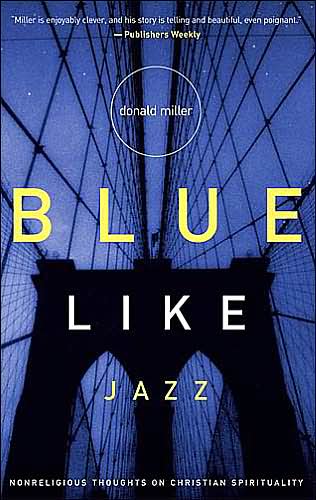
Just finished Donald Miller’s Blue Like Jazz. It was a good read. Sometimes it was a great read, sometimes a less than satisfying read, so overall I’ll settle with good.

For two reasons I really do recommend it to you, though.
1) it is written from the perspective of a person who, though he grew up in church, “gets” why so many people in our society do not want anything to do with “The Church.”

2) it is a provocative account of Christian spirituality that is written entirely without Christianese. More than two decades after Steve Taylor’s “I want to be a clone,” this book finally follows through on translation. Not that others haven’t done it before, but Miller does a fine job at talking things Christian without using language you would only know if you had never missed a VBS.

Posted in Uncategorized | Leave a comment

Another Kind of Immigration

When Christians immigrate to America (or any other country), they not only have to learn a new language, but also a range of concepts that either have no role in the Kingdom of God or else are understood very differently. One such concept is “enemy.”

Those whose lives are shaped by following Jesus remember the Master talking about enemies. “If they hate me, they will hate you also,” he said. Jesus demonstrated that this hate was unidirectional, however. How else could it be when we also hear him say, “Love your enemies. Pray for those who persecute you.” When we combine Jesus’ statements with what we see in his life, we get the idea that this enmity is a one-way affair. They hate us, we love them. They try to hurt us, we try to bless them. Their decision to stand as our enemies in no way forces us to take the same stance toward them.

But then we immigrate to a country that has enemies. Once we arrive we learn that our position has weakened. When we lived with our primary allegiance to Jesus, someone’s declaration of enmity did not compel us to make a similar declaration toward them. With our new dual citizenship (or have we been naturalized – given up our Kingdom citizenship?), we learn that the declaration of enmity does control us. Now when someone speaks enmity or acts as an enemy to us we are required to respond in kind.

Doubtless this relinquishing of control to those who would be our enemies makes sense in the logic of our new citizenship. Although we are allowed to trust in a god, this trust is not allowed to go very far. Instead of trusting in a god who commands us (often in ways contrary to our own desires), we get guns, bombs, tanks, planes, etc. Apparently, it is thought, these are more powerful than any god, and thus more worthy of our trust. When we read the bible we see Israel thinking similar thoughts. Unfortunately, we also see that it didn’t work very well.

Millions of people have come to America – in ways not in accord with America’s laws – looking for a better life. Many stubbornly refuse to assimilate and learn American language. Even as they work hard, participate in and contribute to their new communities, they retain their primary allegiance to their homeland. Who knows – maybe Christians can learn something from them.

Posted in Uncategorized | 1 Comment

Thoughts on Oil

I’m going to join the crowd and comment on the rising price of oil and gasoline. Here are some random thoughts in no particular order:

  • I’d rather pay low prices than high.
  • I hear lots of complaints about the high prices. At the same time, I still see lots of low MPG vehicles on the road. The high prices have not significantly cut into demand yet.
  • From what I’ve seen, most of our elected officials want to make prices lower. Some seem to believe this can be done by legislative fiat. The PRC (other folks unelected officials) have tried this. While it makes buyers happy, it has the effect of keep demand high and creating supply problems. What has happened is that while the price for consumers has been held artificially low, someone still has to pay the asking price.
  • There are two ways to bring about lower prices: raise the supply or lower the demand. In our country the Republicans tend to favor the former, the Democrats the latter. Middle of the Roaders tend to say we need to do both.
  • Reducing dependence on the other countries for our oil supplies looks like a good thing from the point of view of national security. Several major Middle East producers – and nations beyond the Middle East like Nigeria and Venezuela – are politically unstable. As long as Mexico can’t (or won’t) get it’s economic act together and provide for its own population, it will face political instability also. On the other hand, it is good that poor countries have something of value to sell. As Christians, we should rejoice that they have something to jumpstart their economic growth. As Christians we should also lament that their wealth is all too often being sucked up by corrupt leaders and oligarchs.
  • Oil will only last so long. The current understanding of petrochemistry and the formation of oil tells us that oil is not a renewable resource. Once we burn it, it’s gone. (I’m not talking about biomass diesel, which is renewable). At some point in the future the currently available supply with be small enough relative to demand that we won’t be able to pay for it.
  • Burning hydrocarbons has bad side effects. If we reduce the burning, we’ll reduce our addition to the side effects.
  • Some point to mass transit as the solution to rising travel costs. I like mass transit when it goes where I want when I want at an affordable price. We Americans are strongly habituated against it, however. We’re also too spread out to make it feasible as a universal solution.
  • Exxon et al. sure are making some large profits. What are the mechanisms behind their profit margins? If they have control over profit margins (and I assume they have at least some control), then would I be wrong to say that either people are buying more from them than ever, or, that their profit margin is too high? What do they do with their profits (other than give truckloads of cash to Lee Raymond)? Are their shareholders profiting from this? If so, how does one become a shareholder?
  • When talking about money, John Wesley advised to “Save all you can.” He was speaking not merely of having a large and ever growing bank account, but of not spending. As those who learn from Wesley, we can apply this maxim by minimizing our driving, combining trips, and filling our cars with more than one person. While it isn’t always possible to do these things, I believe it’s possible more often than we do it now.
Posted in Uncategorized | 2 Comments

Where Are You From?

“Where are you from?” That’s a standard question we ask each other when we meet new people. My two most common answers are, “Around,” and “A small town in southern Illinois, though I’ve never lived there.” Both are the consequences of growing up in a military family – and a desire to extend the conversation.

Geographically I’ve lived in California, Washington, D.C., Massachusetts, Japan, Korea, Maryland, Kentucky and Texas. In my formative years, however, it wasn’t so much the geography that mattered but the regular moving and the two types of culture I experienced. Being a military family, we spent some years living on base (in Japan & Korea). Though these were outposts of American culture, we daily experienced reminders that we weren’t in America: no English language TV, different money, and strange smells to name just a few. From my perspective as a child it was all a great adventure.

From the time we moved back to the US in 1972 until I finished high school, I lived in suburbia. After high school, I spent my next seven years in a third type of culture: academia. One of the best classes I took in those years was my mission anthropology course. Dr. Whiteman taught us that every culture shapes the way we live life, interact with God, and do church. My Annual Conference, being firmly committed to cross cultural ministry, considered my experience on military bases, American suburbia and academia and sent me to – small town East Texas! The closest I’d ever come to living in the country was when we lived in Hayama. In case you’re not up on your geography, that’s in Japan. It’s across the peninsula from Yokosuka. The emperor has a palace there (on the beach). It might have been a small town, but it wasn’t any closer to the culture of East Texas than any place else I’d lived.

While my experience hadn’t prepared me specifically for small town East Texas, the great diversity and constant moving of my childhood, combined with training in mission anthropology did keep me from culture shock. (It also helped a lot that my wife grew up in East Texas. It’s great to have an in-house informant.) I’ve lived enough places now that I’m pretty adaptable. I can see the benefits of most places.

Of late, there has been a renaissance movement both toward the (large) city and the small town – to the detriment of the suburb. As one raised in suburbia, I’m not always happy to have my (former) way of life impugned. Usually it’s condemned as an inauthentic way of life. If one wants authentic culture, the big city is the place to be. If one wants to have deep relationships and be closer to nature, the small town is the place to be. The suburbs fake culture with their housing developments, and fake nature with their large yards. While my experience has made me a cultural relativist in this particular fight, I’ve just run across a book by Dave Goetz that approaches the “problem of the suburbs” from a Christian point of view. His website posts 8 sets of “toxins” and the “practices” that overcome them. From my point of view, they will valuable to many of us, whether we’re in the suburbs or have the suburbs living in us.

Toxin 1 – “I am in control of my life”
Practice – The Prayer of Silence
Toxin 2 – “I am what I do and what I own”
Practice – The Journey through the Self
Toxin 3 – “I want my neighbor’s life”
Practice – Friendship with the poor
Toxin 4 – “My life should be easier than it is”
Practice – Accepting my cross with grace and patience
Toxin 5 – “I need to make a difference with my life”
Practice – Pursuing action, not results
Toxin 6 – “My church is the problem”
Practice – Staying put in your church
Toxin 7 – “What will this relationship do for me?”
Practice – Building deep friendships
Toxin 8 – “I need to get more done in less time”
Practice – Falling in love with a day

Whether these “toxins” are peculiar to suburbia or are more generally endemic to the current American ethos, my guess is that many of us have been negatively affected by at least some of them. If you’d like to explore how Goetz develops each of these, you can check out his website, or better, read his book, Death By Suburb.

Posted in Uncategorized | 1 Comment

Job Recruiting From Hell?

When we hear about Job Fairs we think about bringing employers and job seekers together for mutual benefit. The former need workers, the latter need to make a living.

A group in Tehran is now sponsoring a different kind of job fair. They need suicide bombers to attack Israel. The Guardian reports:

Mohammad Samadi, a spokesman for the group, told the Guardian that striking at Israel was the priority of his recruitment drive. “The first target is Israel. For us, that is the battlefield,” he said. “All the Jews are targets, whether military or civilian. It’s our land and they are in the wrong place. It’s their duty to pay attention to safety of their own families and move them away from the battlefield,” he said.

“It’s our land.” That’s the Muslim idea that Muslims should always rule any land ever ruled by Muslims. Though a common idea in history (“What’s mine will always be mine”), is has always had the potential to cause war. If Christians and Muslims both thought this way today, we’d not only have violent conflict in the Middle East, but also in North Africa (which used to be “Christian” before the Muslim armies conquered it), the Iberian Peninsula, and other parts of Europe.
It doesn’t take much knowledge of history to know that peoples move, and boundaries and ideologies change. Some have noticed that we have a major people movement underway here in the US. As people movements go (think of the Huns, Mongols, Vandals and the European conquest of North America), this one appears fairly benign.
Back to Iran.
Mr. Samadi claims to have over 50,000 people (30% women) signed up to be suicide bombers. If recent Iranian history is any indication, they probably have children among that number also. It wasn’t long ago that current president Ahmadinejad was involved with thousands of Iranian children being used as mine sweepers during the Iran-Iraq war.
Samadi’s group is also recruiting in the Muslim Diaspora in Europe:

“Britain and other European countries have a lot of disaffected Muslims who are ready. We understand the suspicion with which Britain, America and other western countries regard their Muslim populations. We don’t condemn them for this because we believe every Muslim has the potential to turn into a bomb against the west.”

Because of my experience with Muslims, I don’t believe what he believes – that every Muslim is ready to turn into a bomb to kill people. Unfortunately, not everyone has an opportunity to meet non-Samadi-like Muslims. All they hear are the claims of Samadi and his co-belligerents in Hamas, Hezbollah, Al Qaeda, etc. Also, unfortunately, there are a number of folks who think Samadi et al. are merely posing, and have no intent of acting on their stated beliefs – even with plenty of evidence to the contrary.

Posted in Uncategorized | Leave a comment

Forming Christian College Students

Guy Williams writes today about United Methodist campus ministry. He says,

Many churches send students to the college and university campus assuming that they will be stepping away from the church and the Christian life for a brief time. The generation gap in many congregations alerts us to the fact that our assumptions (expectations?) are coming true. But they may not be stepping away for a brief time after all. What if they don’t return when we expect—say, after marriage, or at the latest, a child or two? A part of our call to faithful ministry on the campus frontier is to fulfill our congregational baptismal vow to support and uphold one another in our Christian walks.

Guy is the current chair of the Division of Campus Ministry here in the Texas Conference. It’s very encouraging to hear someone in that position speak so clearly.

In my undergrad days (at a UM school) I saw a number of people come to school as professing Christians, but before too long many appeared to be little more than practicing hedonists. If this is the pattern at a Christian school (and I haven’t seen evidence to show that things have changed much in 25 years), I wouldn’t be surprised if it were also the pattern at non-church-related schools. How does this happen?

It’s easy to blame academia. While our UM schools tend to have religion departments and chaplains, these frequently embody the scientific study of religion (either the dead thing we dissect or those archaic practices other people engage in). The central doctrines of Christianity – the Incarnation, the Trinity, the Resurrection – are treated from a Humean or Bultmannian point of view (impossible or mythological). It’s easy to say that it’s these and other acids of modernity that eat away the faith of college students.

While the current character of academia likely has some effect on the faith of students, I think there is a larger factor – a factor that we can’t blame on those other folks. I perceive that in our congregations we have either (a) adopted the Humean and Bultmannian positions – or their correlates – that faith has no substance, no connection to historic Christian doctrine, but is rather a personal (individual) expression of authenticity or trust (in something); or, (b) we’ve seen the naturalistic position and assumed that scholarship in our era must take that form; since we don’t want a naturalistic approach to the faith we evacuate it of intellectual substance. To put it bluntly, we’ve failed to love God with all our minds.

What might an alternative look like? Here are a few ideas.

  1. We need to shepherd our kids through challenges to their faith so that their first experience of such challenges doesn’t happen when they’re alone at college. This is very different from sheltering them from the “acids of modernity” (or postmodernity). Not only will this sharpen them for their encounter, it will also remove reasons for them to think the “old church back home” was simply ignorant, living in the medieval world.
  2. We need to teach our people that there are reasons Christians believe and do what they do. It’s not just because Mom, the preacher or the Sunday School teacher say to do it. Our kids have the advantage today of being exposed to difference at an early age. Our Christian kids go to school and play with Jewish, Muslim, Buddhist and non-theist kids. They are engulfed by a consumerist, hedonist culture. They are taught early on that violence and vulgarity are perfectly normal and acceptable. They need to be taught by the church what Christians do and believe and why Christians do and believe what they do. While they don’t need a foundationalistic account of Christianity, they need some account of the rationality of the faith.
  3. We need to maintain relationships with our students. For this to help, we’ll have to do more than just send them a church newsletter or a scholarship. We’ll need to visit them on campus. We’ll need to find ways to enter into their academic world. We need to make sure they know that they never stand alone. If we wait to start this kind of relationship when they go off to college, it may not work well. We need to start now, while they’re in high school (and earlier grades!), to interact with what they’re learning, to help them contextualize it within a Christian worldview.

Even once we figure out what to do for our college students, it won’t be easy. As I tell my young people all the time, “When you go off to college you’ll be away from Mom & Dad and the church folks. You’ll have the freedom to be and do whatever you want. Now is the time to find your identity and security in Christ.” That freedom is a dangerous thing. At the same time it is necessary and good. As Guy observes, we’re going to have to pray.

Posted in Uncategorized | 7 Comments

114437578003441691

The New York Times had a story today about the “Gospel of Judas.” As you can see from the story below, it is being sensationalized. I’ve interspersed the text with some of my own comments.

Note: This is not my field of expertise. I have no access to the original manuscript – and it wouldn’t do any good if I did since I’ve never studied Coptic. My comments are based on general knowledge of biblical literature, history, and rhetoric.

Note also: Though called the Gospel of Judas, it was not written by Judas.

New York Times, April 6, 2006

‘Gospel of Judas’ Surfaces After 1,700 Years

By JOHN NOBLE WILFORD and LAURIE GOODSTEIN

An early Christian manuscript, including the only known text of what is known as the Gospel of Judas, has surfaced after 1,700 years. The text gives new insights into the relationship of Jesus and the disciple who betrayed him, scholars reported today.

Already the assumption is that this is a historical document.

In this version, Jesus asked Judas, as a close friend, to sell him out to the authorities, telling Judas he will “exceed” the other disciples by doing so.

Though some theologians have hypothesized this, scholars who have studied the new-found text said, this is the first time an ancient document defends the idea.

What we’ll likely see in the document is not “an ancient document defend[ing] the idea” but an ancient theologizing stating a hypothesis.

The discovery in the desert of Egypt of the leather-bound papyrus manuscript, and now its translation, was announced by the National Geographic Society at a news conference in Washington. The 26-page Judas text is said to be a copy in Coptic, made around A. D. 300, of the original Gospel of Judas, written in Greek the century before.

If it truly originated around 200 A.D. then it’s pretty old. But keep in mind that the canonical Gospels (Matthew, Mark, Luke & John) are over a century earlier in origin. Mark was written as early as the mid 60s; John, likely the last written, was written by about 95. Coptic was the language of Egypt at the time. Still today the native Christians of Egypt are known as the Copts.

Terry Garcia, an executive vice president of the geographic society, said the manuscript, or codex, is considered by scholars and scientists to be the most significant ancient, nonbiblical text to be found in the past 60 years.

He means since the discovery of the Dead Sea Scrolls in 1948.

“The codex has been authenticated as a genuine work of ancient Christian apocryphal literature,” Mr. Garcia said, citing extensive tests of radiocarbon dating, ink analysis and multispectral imaging and studies of the script and linguistic style. The ink, for example, was consistent with ink of that era, and there was no evidence of multiple rewriting.

Translation: the manuscript is really as old as they say. It is called “apocyphal” because that’s the name for literature (from that period) whose form is similar to scripture but was not accepted by the church as canonical. Note: The vast majority of writings of the period were NOT accepted as canonical (i.e., included in the bible).

“This is absolutely typical of ancient Coptic manuscripts,” said Stephen Emmel, professor of Coptic studies at the University of Munster in Germany. “I am completely convinced.”

The authentication of the date is not only from the physical aspects of the manuscripts, but from the text and style.

The most revealing passages in the Judas manuscript begins, “The secret account of the revelation that Jesus spoke in conversation with Judas Iscariot during a week, three days before he celebrated Passover.”

Apocryphal literature – particularly that originating with the Gnostics – typically offered “secret accounts” of events commonly known.

The account goes on to relate that Jesus refers to the other disciples, telling Judas “you will exceed all of them. For you will sacrifice the man that clothes me.” By that, scholars familiar with Gnostic thinking said, Jesus meant that by helping him get rid of his physical flesh, Judas will act to liberate the true spiritual self or divine being within Jesus.

The Gnostics, like some variants of Greek philosophy, thought of the body as evil, inasmuch as it is part of the physical world. Note that this is very much in contrast to the Jewish view that sees the world as God’s good creation. The Gnostics didn’t care for the Jews & Jewish influence so it was common for them to throw out the OT. In the NT we don’t see Jesus “liberated” from his body. We see him resurrected in a new kind of body, a new kind of physicality, not a denial or rejection of physicality.

With the film version of The Da Vinci Code coming out soon, it may also be worth noting that while that best seller presents the true message of Jesus as more in accord with Gnosticism than the canonical texts, it also claims that the real Jesus was more open to the “feminine.” If you actually read the gnostic documents you’ll find that’s mostly hogwash. In one of them in fact, Jesus speaks of saving Mary by helping her become a man.

Unlike the accounts in the New Testament Gospels of Matthew, Mark, Luke and John, the anonymous author of the Gospel of Judas believed that Judas Iscariot alone among the 12 disciples understood the meaning of Jesus’ teachings and acceded to his will. In the diversity of early Christian thought, a group known as Gnostics believed in a secret knowledge of how people could escape the prisons of their material bodies and return to the spiritual realm from which they came.

The Gnostics, like some currents in Greek thought and Hindiusim, thought in terms of reincarnation and the transmigration of souls. They thought our souls were divine, but fallen into this physical world they acquired bodies. “Gnostic” refers to knowledge. Note that Judas is credited here with scret knowledge.

Elaine Pagels, a professor of religion at Princeton who specializes in studies of the Gnostics, said in a statement, “These discoveries are exploding the myth of a monolithic religion, and demonstrating how diverse — and fascinating — the early Christian movement really was.”

There was diversity in early Christianity – just like there is diversity in modern Christianity. I’m not of the opinion that everything that goes by the name Christian IS Christian.

The Gospel of Judas is only one of many texts discovered in the last 65 years, including the gospels of Thomas, Mary Magdalene and Philip, believed to be written by Gnostics.

These other gospels were also found in Egypt, at a place called Nag Hamadi.

The Gnostics’ beliefs were often viewed by bishops and early church leaders as unorthodox, and they were frequently denounced as heretics. The discoveries of Gnostic texts have shaken up Biblical scholarship by revealing the diversity of beliefs and practices among early followers of Jesus.

This “shaken up” rhetoric is reminiscent of the Da Vinci Code. Diversity within Christianity (and movements along the edges) has long been recognized. Surely if the ancient leaders denounced the gnostics they had to have known about them. What is different now is that the value of orthodoxy is held by fewer people. If it’s wrong to speak of truth in the realm of religion, then surely we can revel in this ancient diversity. We just mustn’t pretend the idea is a new one from ancient Christianity.

As the findings have trickled down to churches and universities, they have produced a new generation of Christians who now regard the Bible not as the literal word of God, but as a product of historical and political forces that determined which texts should be included in the canon, and which edited out.

Not exactly. The final claim of this paragraph is really a variant of Nietzscheanism: “There is no such thing as truth, just power. If you see a truth claim, what you’re really seeing is an assertion of power.”

What might be meant by saying “the bible is the literal word of God?” When we read the bible we do come across portions where it appears that God is speaking directly. Other portions (the majority of the text) is not in the form of direct quotation of God. When NT characters refer to the OT (inside the text of the NT) it appears that they believed God was speaking through the human writers who produced scripture. Such a belief has been common in the church from the beginning. While some have adopted the Islamic view of the Koran to apply to Scripture – the notion that God literally dictated every word of the bible – most christian scholars deny such a view.

Another thing one might be thinking when one hears “literal word of God” is the notion that everything in the bible is to be taken literally. I don’t think this position even makes sense (though many seem to hold it). In the NT we see many occasions where the OT is quoted and treated in a non-literal sense (if you need an example consider how Peter handled the quotation of Joel 2 in Acts 2).

For that reason, the discoveries have proved deeply troubling for many believers. The Gospel of Judas portrays Judas Iscariot not as a betrayer of Jesus, but as his most favored disciple and willing collaborator.

I can’t think why I’d find the discoveries troubling. It’s interesting to know what strange ideas some people had back then – and to see how they parallel some of the strange ideas people have today. But I’m not troubled in the least.

Scholars say that they have long been on the lookout for the Gospel of Judas because of a reference to what was probably an early version of it in a text called Against Heresies, written by Irenaeus, the bishop of Lyons, about the year 180.

Irenaeus was a hunter of heretics, and no friend of the Gnostics. He wrote, “They produce a fictitious history of this kind, which they style the Gospel of Judas.”

When we hear “hunter of heretics” we’re made to think of someone with a big gun – or at least big piles of wood, a can of gasoline and a box of matches. As a bishop (overseer) of the church, Irenaeus had the job of watching out for his people. When he saw ideas coming down the road that might lead people astray, it was his job to point them out and warn the people. That’s still the job of the pastor today (though performed too rarely in this age).

Karen L. King, a professor of the history of early Christianity at Harvard Divinity School, and an expert in Gnosticism who has not yet read the manuscript released today, said that the Gospel of Judas may well reflect the kinds of debates that arose in the second and third century among Christians.

“You can see how early Christians could say, if Jesus’s death was all part of God’s plan, then Judas’s betrayal was part of God’s plan,” said Ms. King, the author of several books on the Gospel of Mary. “So what does that make Judas? Is he the betrayer, or the facilitator of salvation, the guy who makes the crucifixion possible?”

Yes, people wonder about this issue. The canonical texts raise more questions than answers when it comes to Judas. Gnosticism, however, offers more than a new view of Judas. It offers a completely different view of salvation than we find in the canonical texts. So the salvation that he “facilitates” is a different salvation than that attested to in scripture.

At least one scholar said the new manuscript does not contain anything dramatic that would change or undermine traditional understanding of the Bible. James M. Robinson, a retired professor of Coptic studies at Claremont Graduate University, was the general editor of the English edition of the Nag Hammadi library, a collection of Gnostic documents discovered in Egypt in 1945.

Robinson is right.

“Correctly understood, there’s nothing undermining about the Gospel of Judas,” Mr. Robinson said in a telephone interview. He said that the New Testament gospels of John and Mark both contain passages that suggest that Jesus not only picked Judas to betray him, but actually encouraged Judas to hand him over to those he knew would crucify him.

I’m not sure how far I’d take this last statement. I’d certainly try to contextualize it differently.

Mr. Robinson’s book, “The Secrets of Judas: The Story of the Misunderstood Disciple and his Lost Gospel” (Harper San Francisco, April 2006), predicts the contents of the Gospel of Judas based on his knowledge of Gnostic and Coptic texts, even though he was not part of the team of researchers working on the document.

The Egyptian copy of the gospel was written on 13 sheets of papyrus, both front and back, and found in a multitude of brittle fragments.

Rudolphe Kasser, a Swiss scholar of Coptic studies, directed the team that reconstructed and translated the script. The effort, organized by the National Geographic, was supported by Maecenas Foundation for Ancient Art, in Basel, Switzerland, and the Waitt Institute for Historical Discovery, an American nonprofit organization for the application of technology in historical and scientific projects.

The entire 66-page codex also contains a text titled James (also known as First Apocalypse of James), a letter by Peter and a text of what scholars are provisionally calling Book of Allogenes.

Discovered in the 1970’s in a cavern near El Minya, Egypt, the document circulated for years among antiquities dealers in Egypt, then Europe and finally in the United States. It moldered in a safe-deposit box at a bank in Hicksville, N. Y., for 16 years before being bought in 2000 by a Zurich dealer, Frieda Nussberger-Tchacos. The manuscript was given the name Codex Tchacos.

When attempts to resell the codex failed, Ms. Nussberger-Tchacos turned it over to the Maecenas Foundation for conservation and translation.

Mr. Robinson said that an Egyptian antiquities dealer offered to sell him the document in 1983 for $3 million, but that he could not raise the money. He criticized the scholars now associated with the project, some of whom are his former students, because he said they violated an agreement made years ago by Coptic scholars that new discoveries should be made accessible to all qualified scholars.

$3 millions dollars. That’s pretty sensational in itself. Sometimes it’s worth while to ask who stands to profit from the publishing of ancient manuscripts. While not a decisive factor, it can be worth considering.

The manuscript will ultimately be returned to Egypt, where it was discovered, and housed in the Coptic Museum in Cairo.

Ted Waitt, the founder and former chief executive of Gateway, said that his foundation, the Waitt Institute for Historical Discovery, gave the National Geographic Society a grant of more than $1 million to restore and preserve the manuscript and make it available to the public.

“I didn’t know a whole lot until I got into this about the early days of Christianity. It was just extremely fascinating to me,” Mr. Waitt said in a telephone interview. He said he had no motivation other than being fascinated by the finding. He said that after the document was carbon dated and the ink tested, procedures his foundation paid for, he had no question about its authenticity. “You can potentially question the translation and the interpretation, he said, but you can’t fake something like this. It would be impossible.”

You’re going to have to read a lot more than the Gospel of Judas to understand the era and its movements.

Posted in Uncategorized | 2 Comments

Sterile Traditions and Higher Education

Terry Eastland recently wrote about the transformation of Davidson College. In the past couple of years the trustees have led the school from association with the Presbyterian Church (USA) to merely being an expression of the Reformed Tradition. While they are dropping the requirement that all the trustees be Christians (it’s been a few decades since all the faculty were required to be Christians), they are adding a chair in “Reformed Theology.” While some might see this as a step away from Christianity, Eastland says the trustees see the move as flowing distinctly from their conception of the Reformed Tradition.

While I am neither a Presbyterian not a participant in the Reformed Tradition (though I consider myself a friend of that tradition), I see parallels between Davidson’s situation and United Methodist higher education.

Since my own attendance at an institution of higher education that was United Methodist but not Christian, I have been wondering how we lost our colleges and universities. While my alma mater still claims its United Methodist affiliation, many others have left even the scent of affiliation in behind. USC and Syracuse were once Methodist schools. Perhaps they had left the church behind because of the secularizing forces of modern academia. If Eastland’s account of the happenings at Davidson is correct, another possibility appears.

At Davidson the trustees, not academics, led the change. Their very conception of what the church’s nature and purpose is identified as the cause.

Indeed, the trustees made clear their belief that the Reformed tradition actually provides the basis for their decisions. Writing in the Charlotte Observer, the college chaplain, the Reverend Robert Spach, declared that the Reformed tradition “in which we stand” is not one that “fears, excludes or belittles those who are different” but is “ecumenical in spirit,” the point being that ecumenism—a truth now more fully understood, apparently—compelled opening board membership to non-Christians. Spach envisioned the “pursuit of truth” by an ecumenical board: “We [Christians] tell others what we believe and also humbly…listen to [the] beliefs” of “people of other faiths”—and “perhaps” learn “from each other.” For Spach, an ecumenical board will be better able to pursue truth than an entirely Christian board.

When I hear “Reformed Tradition” it’s not ecumenism that comes to mind. I think instead of Calvin, Knox, the sovereignty of God, TULIP, common grace, etc. According to Spach, the “Reformed Tradition” seems indistinguishable from the ethos of modern academia: tolerance, constant seeking for truth, humility, and diversity. Surely these four virtues are unquestionably good (assuming, of course, that we know for sure what they are), but surely there is more to the Reformed – or Christian – Tradition than these modern platitudes? My search for institutions of higher education that are both United Methodist and Christian has led me to examine many University mission statements. Though many remain “affiliated” with the United Methodist Church – part of the Wesleyan Tradition – they tout an ethos indistinguishable from Davidson or completely secular schools.

And yet they see themselves as being faithful to the Wesleyan Tradition!

What Eastland’s article suggests is that it’s not the colleges that are to blame: they’re merely tools of academia and the church. Rather, it is the theological and ecclesiological traditions themselves that have become sterile. Not only do our institutions not produce new participants (“babies”), we actually think that reproduction is a bad thing. We don’t have the truth – well, maybe a little bit, but every other tradition out there has at least as much (maybe more). Why should our new children be Methodists? They can have everything out institutions offer – intelligence, courage, character and success – and sleep in on Sunday mornings.

Until we learn to see Christianity and the Methodist tradition as true – as worth reproducing (which is not the same as saying all other traditions are valueless), we will continue to lose not only our institutions, but also our next generation.

Posted in Uncategorized | 3 Comments