
As a Christian – and a Pastor, no less! – I’m expected to be for the public imposition of signs of (my own) religion. Recently Texas has taken the step of requiring the posting of the Ten Commandments in school classrooms. The bill specifies the precise text by which the Ten Commandments are to be rendered:
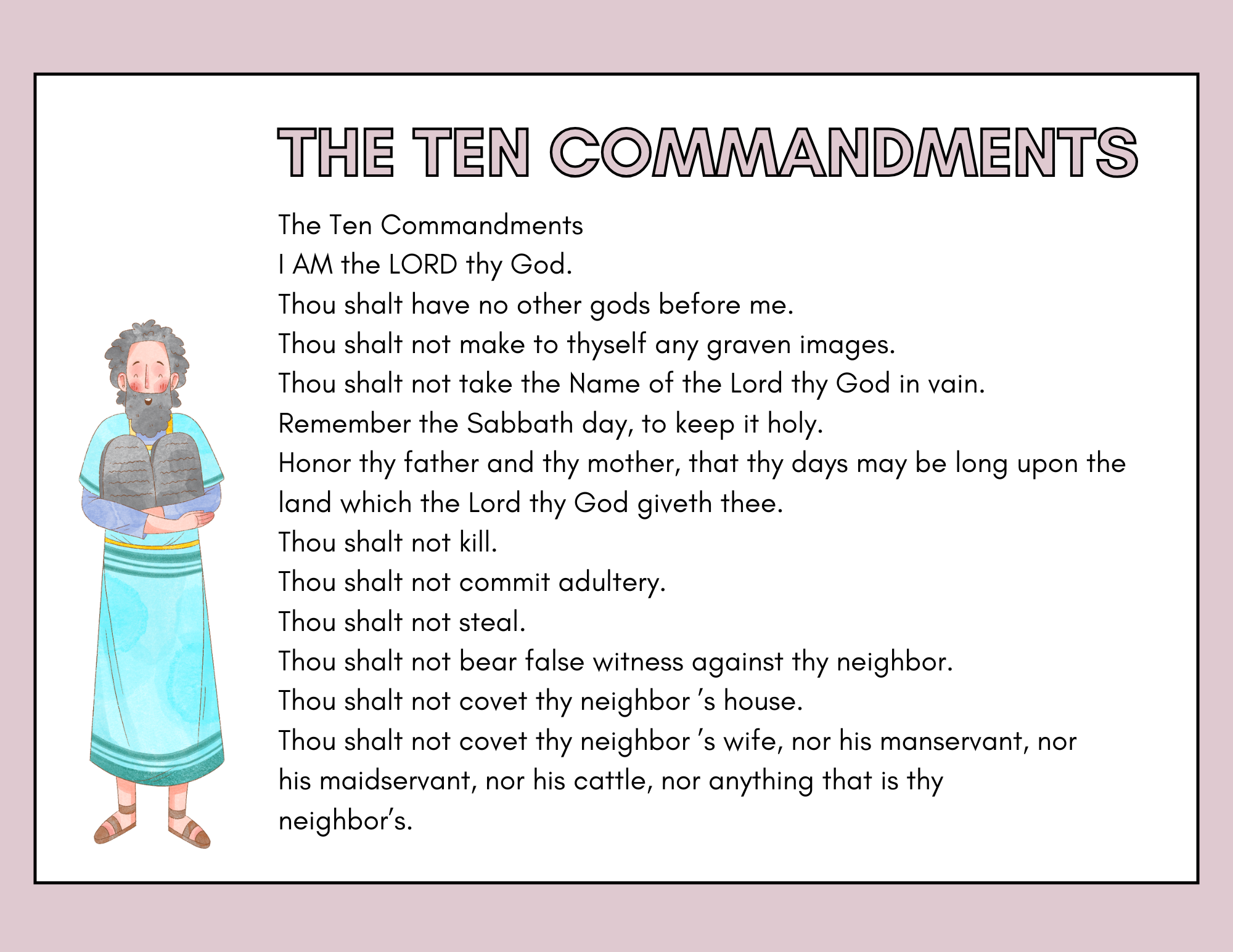
A few observations:
- English is the required language, even though the Commandments did not originate in English.
- They must be posted in the early modern English of the King James Version of the English Bible. Does this indicate that the King James Version is the most authoritative translation available? Does it suggest that one must apprehend the commands via archaic language? Does this make it more or less likely that any students reading the Commandments will take them seriously?
- The legislature has taken it upon itself to edit the text to (a) decontextualize it, thereby (possibly) (b) making it fit better a model of generic morality, theoretically applicable to all people everywhere.
Beyond the fact that non-Christians are taking this action as the state imposing a religion on students, it is this last aspect that bothers me the most. The bill’s text abbreviates “I am the LORD thy God which have brought thee out of the land of Egypt, out of the house of bondage” to “I am the LORD thy God.” Whose God? To whom is this God speaking? Everyone on earth, every human? With the state’s excision of “which have brought thee out of the land of Egypt, out of the house of bondage,” one gets that idea. Read in context and unedited, however, the Commandments are clearly addressed to those the LORD has rescued from bondage in Egypt,” i.e., the Israelites. By this clear act of self-identification – which, again – the state has edited out – the Commandments are framed as a response to a prior act of gracious deliverance. We’re left with bare commands, no grace, no prior action of God. If we have a simple Divine Command theory of ethics this decontextualized set of edited commands may be enough to make proponents of generic religion happy, but it falls short of biblical Christianity.
As a Christian, I’d rather entrust witness for Christ to his disciples that are in the schools: students, teachers, staff, volunteers, who can demonstrate God’s reality, character, and intentions through the way they live and what they say. I don’t trust the state – and its authority – to faithfully represent Christ and his ways.

 Bandits No More